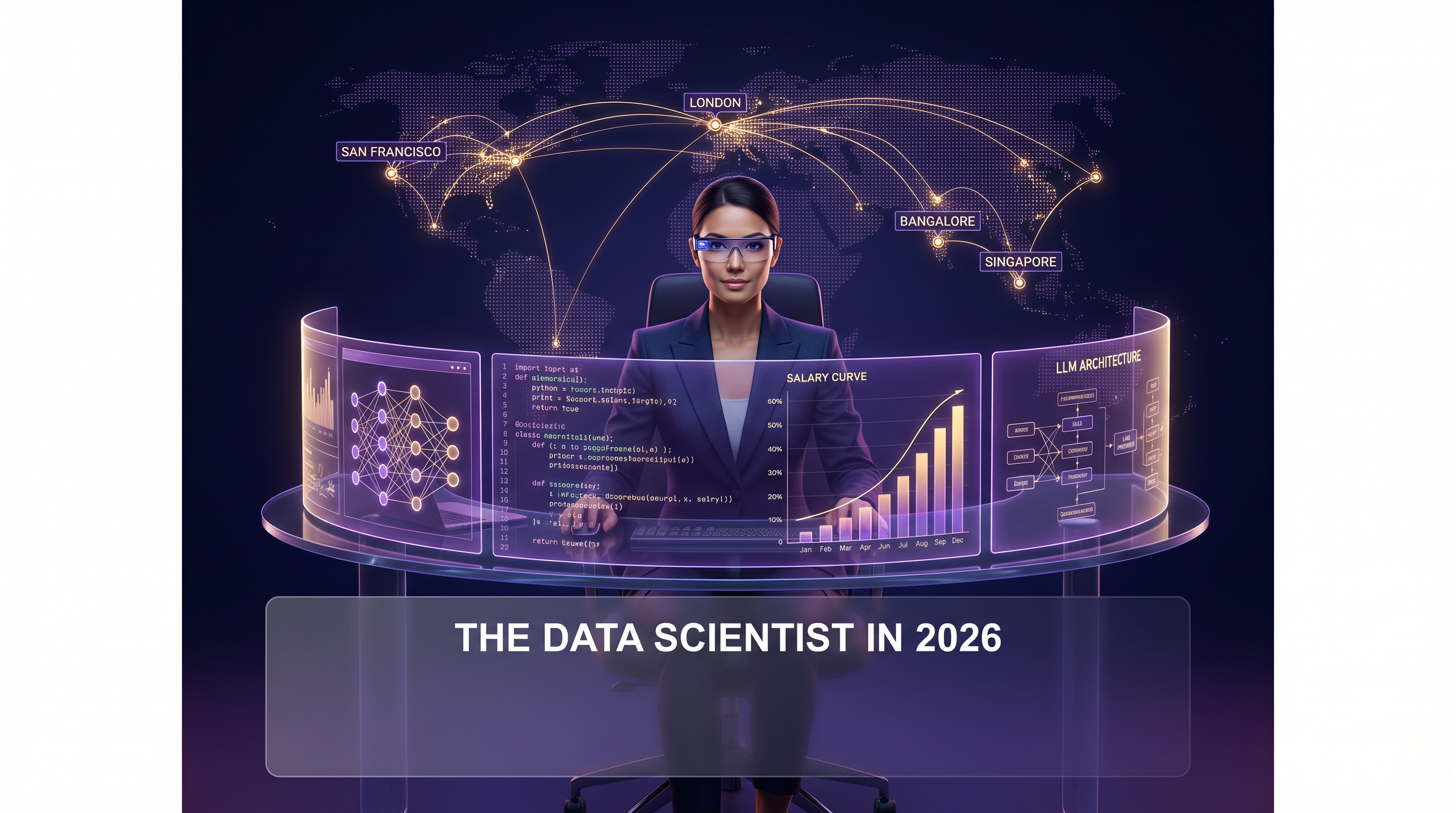
In 2026, Data Science remains one of the most sought-after careers on the planet — and it has never been more complex, more rewarding, or more misunderstood. The rise of Generative AI, Agentic AI workflows, and large language models (LLMs) has fundamentally reshaped what a Data Scientist actually does. Far from making the role obsolete, AI has amplified its importance: companies now need professionals who can not only build models but also orchestrate AI agents, fine-tune LLMs, and translate machine intelligence into business outcomes.
The numbers tell a compelling story. The U.S. Bureau of Labor Statistics projects a 34% growth in data scientist employment from 2024 to 2034 — one of the fastest growth rates of any profession. The World Economic Forum's Future of Jobs Report 2025 lists Big Data Specialists as the world's single fastest-growing job category. In India, Naukri.com reports a 32% year-on-year increase in data science job postings in 2026. McKinsey estimates a global talent gap of 250,000 qualified data professionals. This is not a saturated market — it is a market with a massive, growing supply-demand imbalance in favour of skilled candidates.
This article is your definitive guide to the Data Scientist role in 2026 — covering responsibilities by level, exact qualifications required at global and Indian companies, salary data, and the skills gap that is keeping thousands of candidates from landing their dream role.
1. The Global Job Market: How Big Is It Really?
The global data science job market has grown from approximately 93,000 open positions in 2020 to an estimated 278,000 active job postings in 2026 — a nearly 3x increase in six years. This growth has been driven by digital transformation across every sector, the explosion of data generated by mobile and IoT devices, and most recently, the enterprise adoption of Generative AI tools that require human oversight and orchestration.
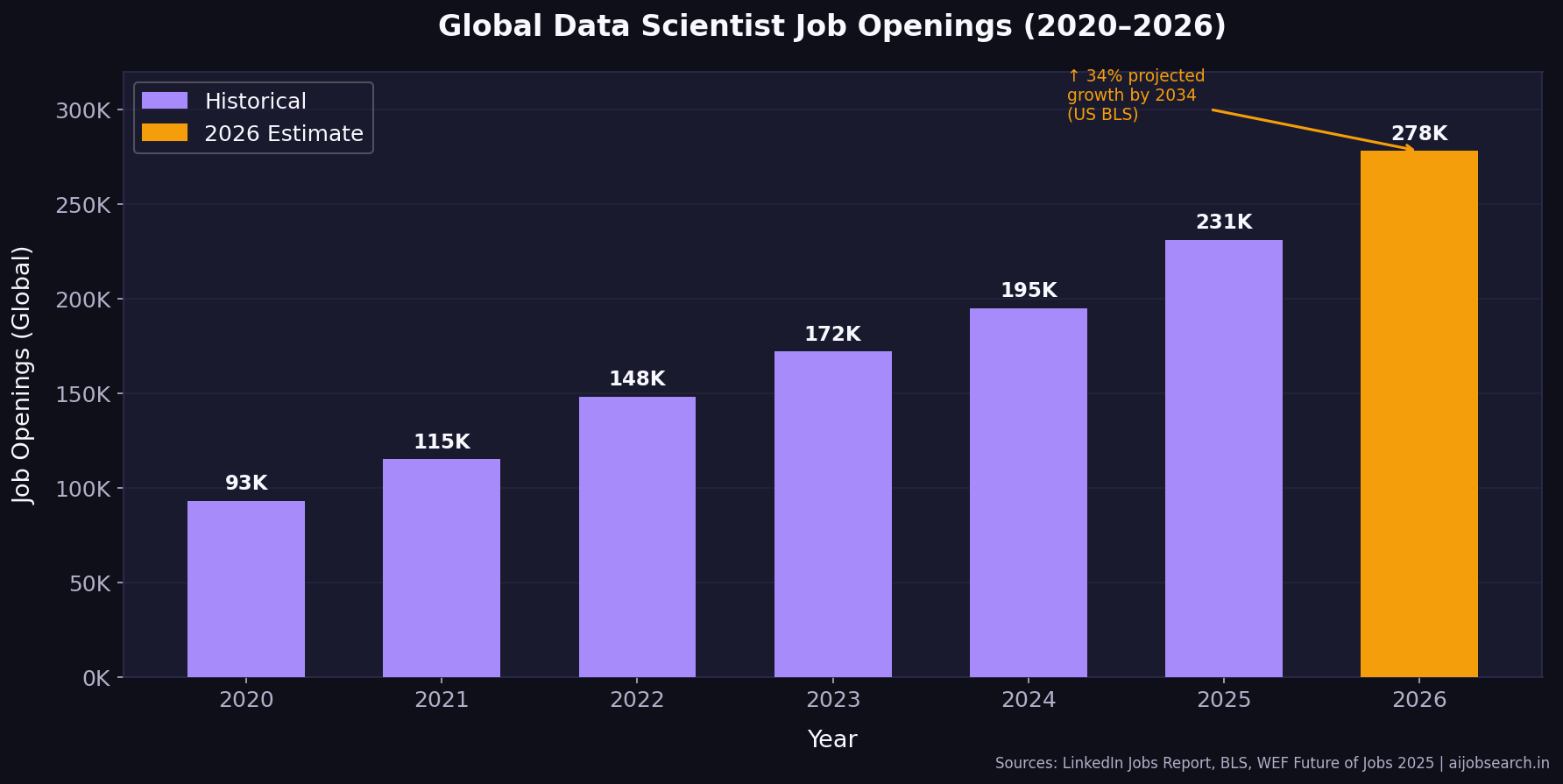
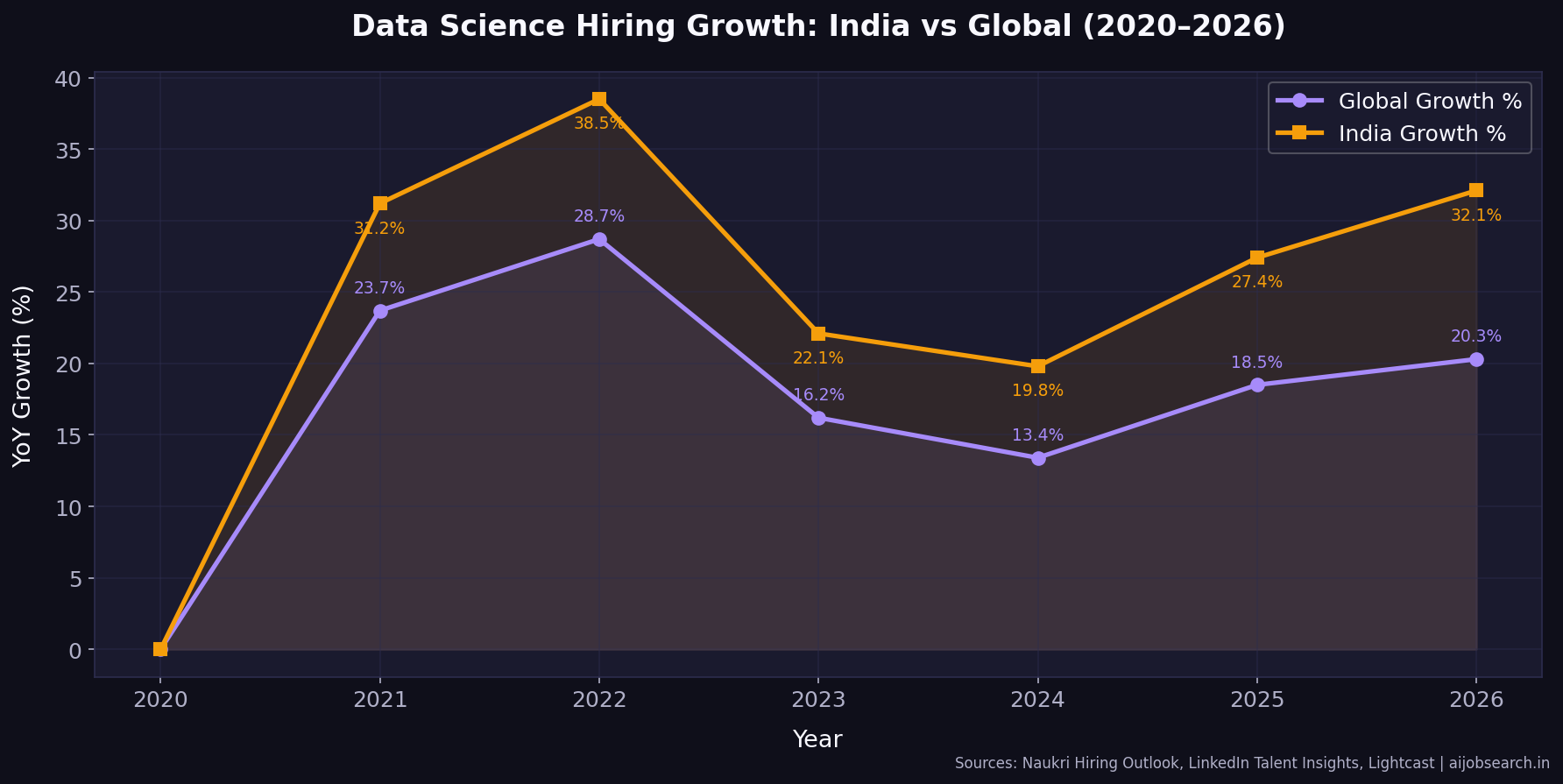
India's growth rate has consistently outpaced the global average. While global hiring grew at 20.3% in 2026, India's data science job market expanded at 32.1% — driven by the maturation of India's startup ecosystem, the expansion of global capability centres (GCCs) of Fortune 500 companies in Bangalore and Hyderabad, and a surge in fintech, healthtech, and D2C e-commerce companies building data teams from scratch.
2. Roles & Responsibilities in 2026: Junior to Senior
The Data Scientist role has fragmented significantly in 2026. Where a single "Data Scientist" title once covered everything from data cleaning to model deployment, companies now distinguish between Analytics-focused Data Scientists, ML-focused Data Scientists, and AI/LLM-focused Data Scientists. However, the core career ladder remains consistent across three levels:
| Level |
Experience |
Core Responsibilities |
2026 AI-Specific Additions |
| Junior |
0–2 years |
Data cleaning, EDA, building baseline ML models, writing SQL queries, creating dashboards (Tableau/Power BI) |
Using AI copilots (GitHub Copilot, Cursor) for code; prompt engineering for data extraction from LLMs; running AutoML experiments |
| Mid-Level |
3–6 years |
End-to-end ML pipelines, model deployment (MLflow, Docker), A/B testing, stakeholder communication, mentoring juniors |
Building RAG pipelines, fine-tuning open-source LLMs (Llama 3, Mistral), integrating LangChain/LlamaIndex into products, LLMOps |
| Senior |
7–10+ years |
Setting data strategy, leading cross-functional teams, owning P&L impact of ML systems, hiring and growing teams |
Designing Agentic AI workflows, evaluating LLM safety and hallucination, building AI governance frameworks, multi-model orchestration |
A key 2026 shift: AI copilots have not replaced Data Scientists — they have raised the floor. Junior tasks that once took days (writing boilerplate code, basic EDA) now take hours. This means companies expect more from junior hires: they want candidates who can use AI tools effectively, not just candidates who know Python syntax.
3. Qualifications Required — Global Top Companies
Hiring standards at global tech companies have evolved significantly. The era of "PhD required for all data roles" is over — companies like OpenAI and Anthropic explicitly state that PhDs are not required, though approximately 50% of their technical staff hold one. What matters more in 2026 is demonstrable impact: shipped models, open-source contributions, and measurable business outcomes.
| Company |
Degree Required |
Preferred Certifications |
Experience |
Preferred Background |
| Google / DeepMind |
BS/MS/PhD in CS, Stats, Maths |
GCP Professional ML Engineer |
3–7 years |
Research publications, large-scale ML systems |
| Meta (Facebook) |
BS/MS in CS, Applied Maths |
PyTorch certifications preferred |
2–6 years |
Ads/ranking systems, social graph ML |
| Amazon / AWS |
BS/MS in quantitative field |
AWS ML Specialty |
2–5 years |
Supply chain, recommendation systems, NLP |
| Microsoft |
BS/MS in CS, Statistics |
Azure AI Engineer Associate |
3–8 years |
Azure ML, Copilot integration, enterprise AI |
| Apple |
MS/PhD strongly preferred |
None specified |
5–10 years |
On-device ML, privacy-preserving AI, CoreML |
| Netflix |
MS/PhD in CS, Stats |
None specified |
4–8 years |
Recommendation systems, causal inference, A/B testing at scale |
| OpenAI |
BS+ (PhD not required) |
None specified |
3–7 years |
LLM evaluation, RLHF, product data science, safety research |
| Anthropic |
BS+ (50% staff hold PhDs) |
CodeSignal 520+/600 required |
3–8 years |
Constitutional AI, interpretability, alignment research |
4. Qualifications Required — Top Indian Companies
India's hiring landscape for Data Scientists is bifurcated: IT services giants (TCS, Infosys, Wipro) prioritise structured hiring with clear degree requirements, while product-first companies like Flipkart, Swiggy, and Razorpay place far greater weight on portfolio projects, system design skills, and hands-on ML experience. The Zepto 2026 fresher hiring is a prime example — they explicitly ask for GitHub portfolios and real ML projects, not just degrees.
| Company |
Degree Required |
Certifications |
Experience |
Preferred Background |
| TCS |
B.Tech/BE/MCA/M.Sc |
TCS iON, AWS/Azure basics |
0–4 years |
Python, SQL, ML basics, client-facing analytics |
| Infosys |
B.Tech/BE/M.Sc in CS/Stats |
Infosys Springboard, Google ML |
1–5 years |
Data engineering, NLP, cloud ML pipelines |
| Wipro |
B.Tech/BE/MCA |
AWS/GCP ML certifications |
1–4 years |
Computer vision, NLP, enterprise AI consulting |
| Flipkart |
B.Tech/MS from IIT/NIT preferred |
Not mandatory |
2–6 years |
Recommendation systems, pricing ML, supply chain AI |
| Swiggy |
B.Tech/MS in CS/Stats/Maths |
Not mandatory |
2–5 years |
ETA prediction, demand forecasting, fraud detection |
| Zomato / Blinkit |
B.Tech/MS preferred |
Not mandatory |
2–5 years |
Hyperlocal ML, restaurant ranking, LLM for search |
| Razorpay |
B.Tech/MS in CS/Maths/Stats |
Not mandatory |
2–6 years |
Fraud detection, risk scoring, payment anomaly detection |
| PhonePe |
B.Tech/MS in CS/Stats |
Not mandatory |
2–5 years |
Transaction ML, credit scoring, personalisation |
| Zepto |
B.Tech/BE (any tier college) |
Not mandatory — portfolio matters |
0–2 years |
Inventory forecasting, dark store optimisation, demand ML |
5. Skills Required in 2026: What Companies Actually Want
An analysis of over 700 data science job postings in 2026 (Lightcast, LinkedIn Talent Insights) reveals a clear skills hierarchy. Python and SQL remain the bedrock — present in 94% and 78% of postings respectively. But the fastest-growing skill requirements are in Generative AI and LLMOps: Prompt Engineering appeared in 41% of postings in 2026 vs. just 8% in 2023. RAG pipeline experience is now required in 29% of senior roles. Vector databases (Pinecone, Weaviate, Chroma) went from niche to mainstream.
| Skill Category |
Foundation (All Levels) |
Advanced (Mid–Senior) |
🔥 2026 Premium Skills |
| Programming |
Python, SQL |
Scala, R, Julia |
Python async, LLM API integration |
| ML/AI Frameworks |
Scikit-learn, Pandas, NumPy |
TensorFlow, PyTorch, XGBoost |
Hugging Face Transformers, PEFT, LoRA fine-tuning |
| Gen AI & LLM Tools |
ChatGPT/Claude for productivity |
LangChain, LlamaIndex, OpenAI API |
RAG pipelines, Vector DBs (Pinecone, Weaviate), Agentic AI (CrewAI, AutoGen) |
| Cloud Platforms |
AWS S3, GCP BigQuery basics |
AWS SageMaker, GCP Vertex AI, Azure ML |
LLMOps on cloud, model serving (Triton, vLLM), cost optimisation |
| MLOps / DevOps |
Git, basic Docker |
MLflow, Airflow, Kubernetes, CI/CD |
LLMOps (evaluation, monitoring, guardrails), Weights & Biases |
| Soft Skills |
Communication, curiosity |
Stakeholder management, data storytelling |
AI ethics judgment, explaining LLM limitations to non-technical leadership |
6. India City-wise Demand
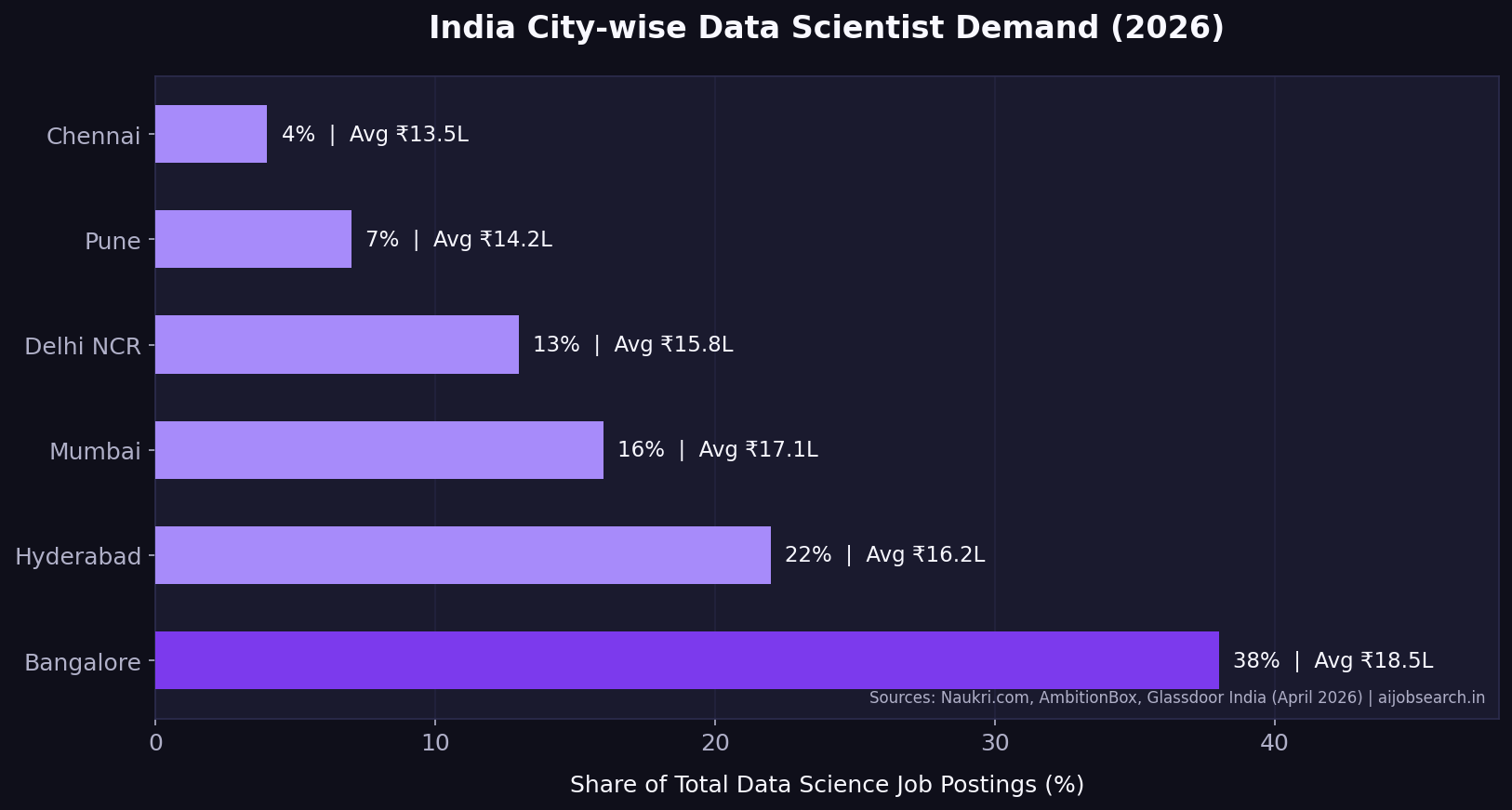
Bangalore dominates India's data science hiring with 38% of all active postings, driven by the concentration of product companies, GCCs, and AI-native startups. Hyderabad has emerged as a strong second hub (22%), particularly for Microsoft, Amazon, and Deloitte's analytics centres. Mumbai leads in fintech data science roles (Razorpay, PhonePe, HDFC, Axis Bank). Delhi NCR is growing rapidly in government AI and consulting-led data roles.
7. Salary Infographics: What Data Scientists Earn in 2026
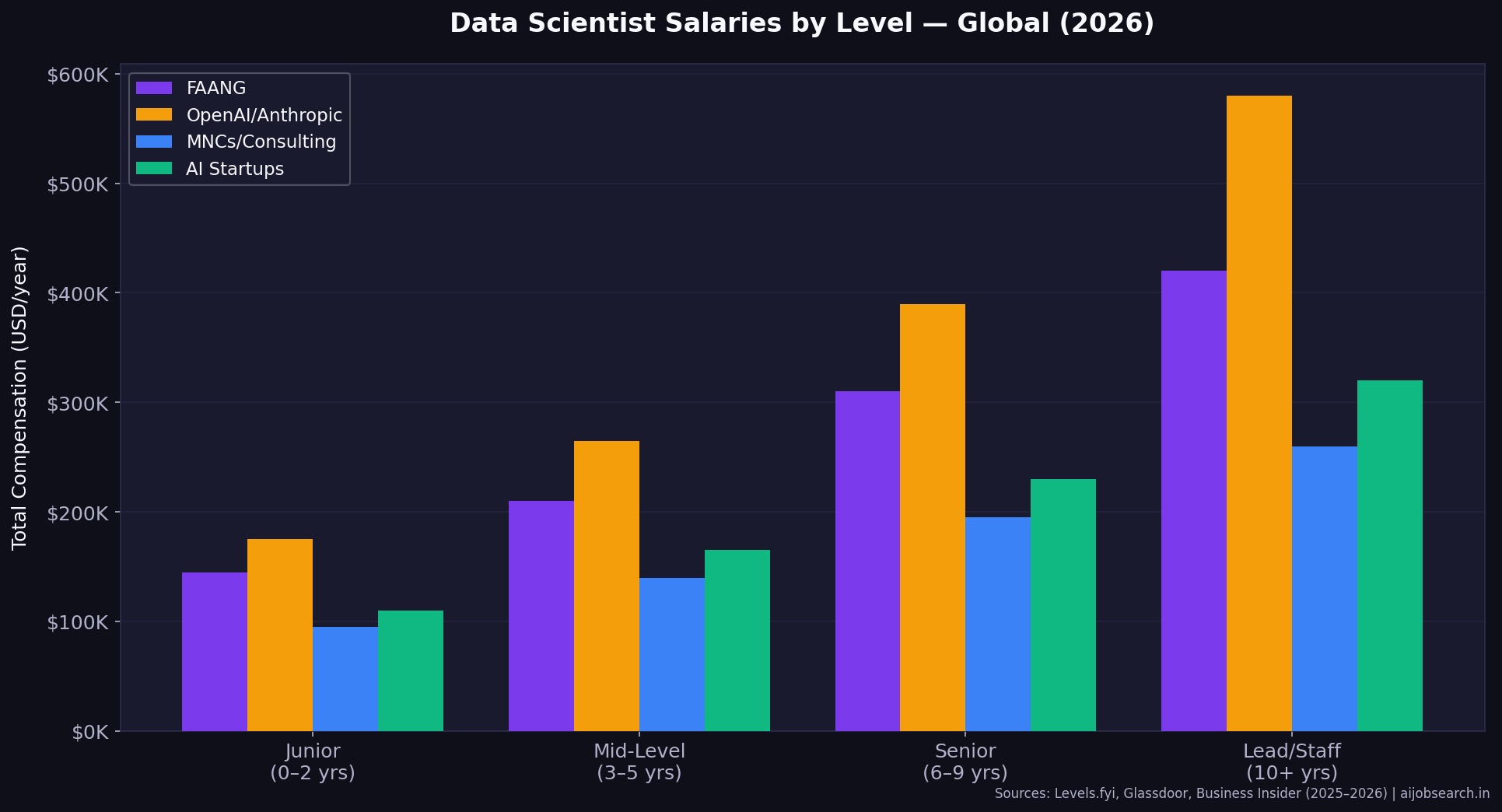
Compensation data from Levels.fyi, Glassdoor, and Business Insider paints a striking picture: the median Data Scientist salary at FAANG is $176,000, while at OpenAI it reaches a staggering $810,000 total compensation at senior levels. The AI-native company premium is real and growing.
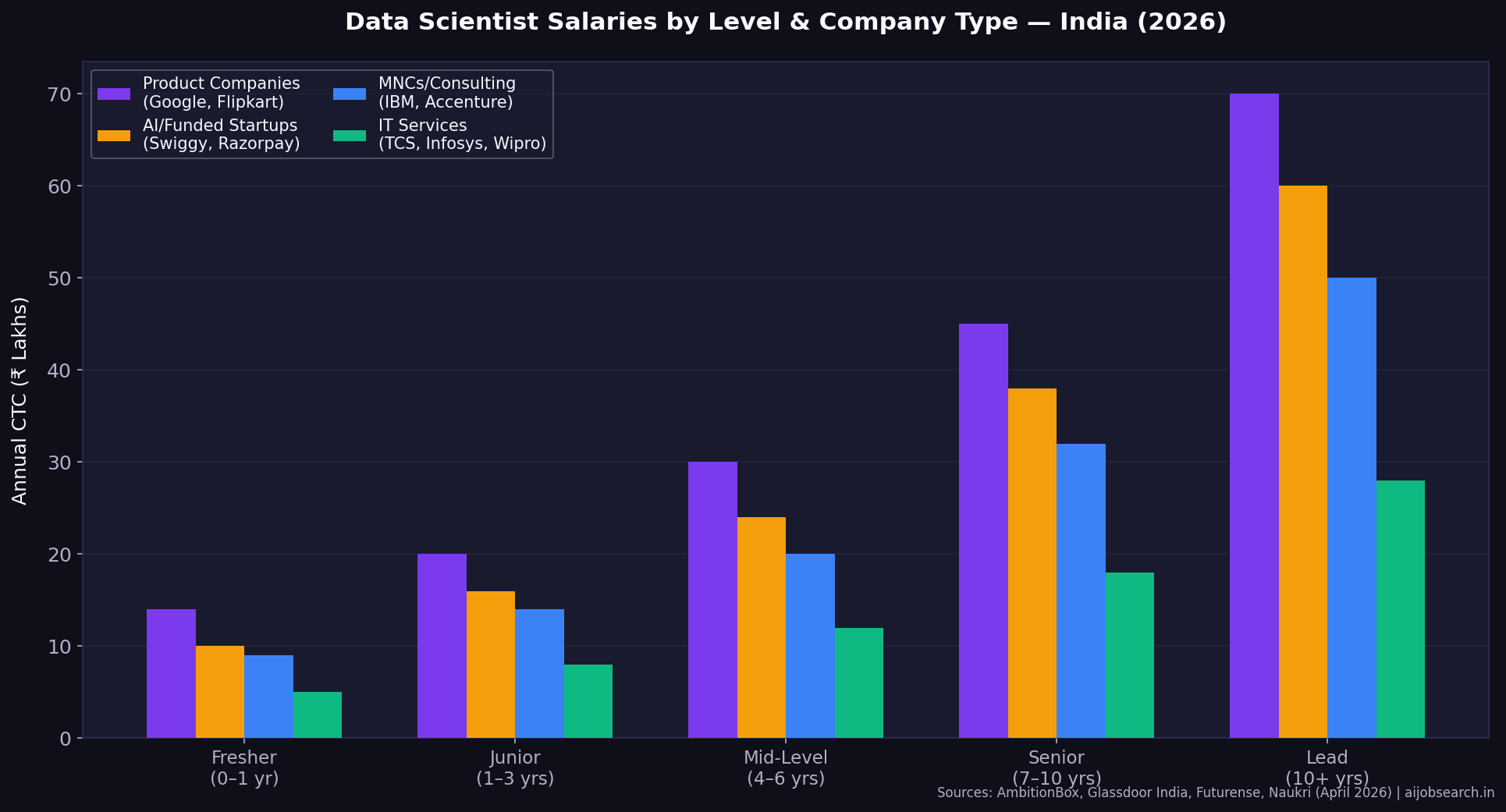
In India, the salary spread is dramatic. According to Futurense's April 2026 report, a fresher from an IIT or NIT at a product company can earn ₹12–20 LPA, while the same role at an IT services firm pays ₹4.5–8 LPA. The single biggest salary lever in India is company type — product companies pay 2–3x more than IT services for identical experience levels.
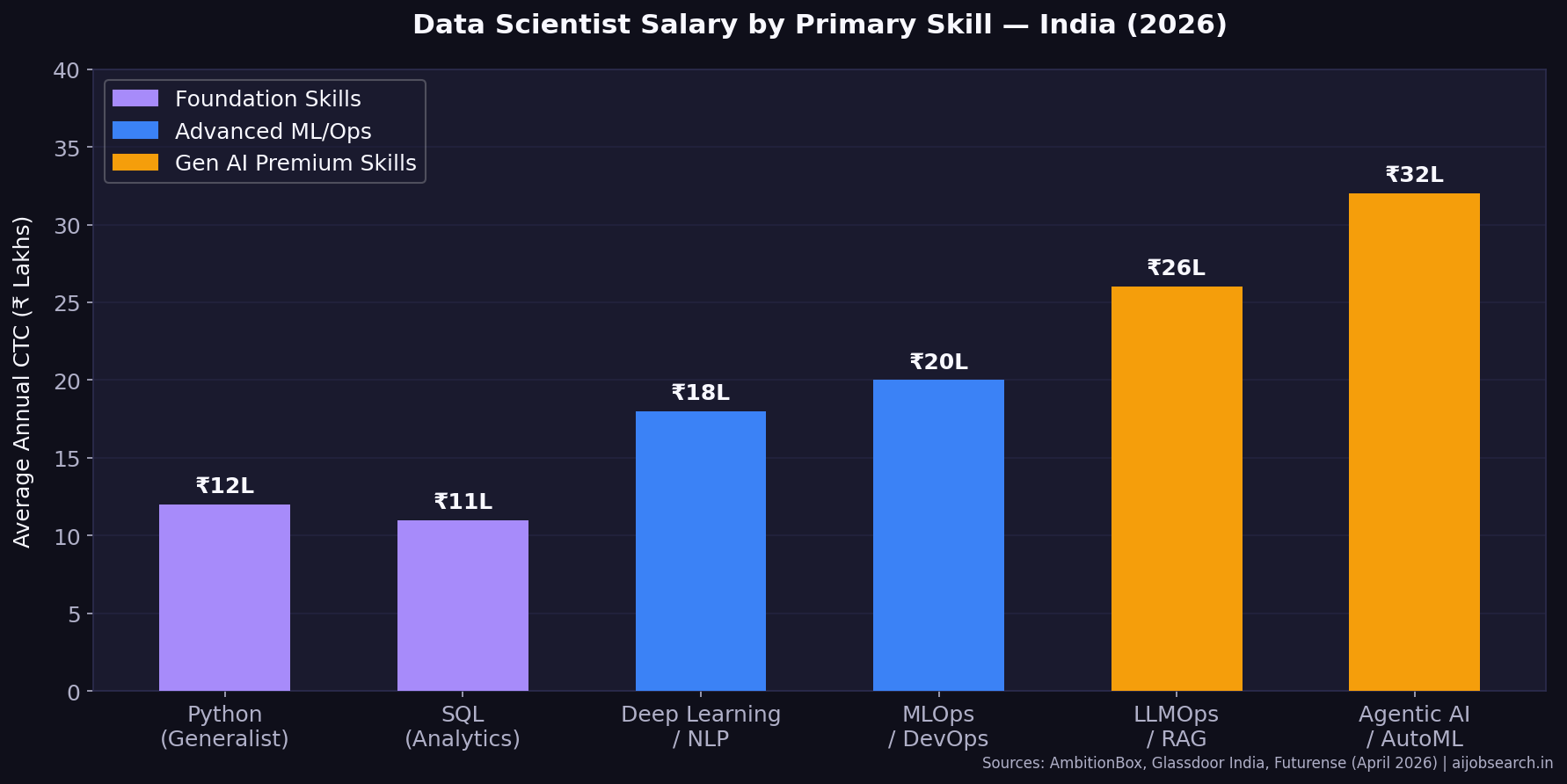
The GenAI premium is the most important salary trend of 2026. Data Scientists with LLMOps, RAG pipeline, and Agentic AI skills earn 25–40% more than generalists at the same experience level. An LLM Engineer in India earns ₹20–35 LPA vs. ₹12–18 LPA for a generalist with identical years of experience.
8. Demand vs Supply: The 250,000 Talent Gap
McKinsey's 2025 AI Report estimates a global shortage of 250,000 qualified data professionals. This gap is not evenly distributed — it is most acute in Healthcare AI (where HIPAA compliance expertise compounds the shortage), Financial Services (where explainability requirements filter out many candidates), and Manufacturing (where domain knowledge of industrial processes is rare among data scientists).
A critical nuance: AI tools have not reduced demand for Data Scientists. Harvard University's 2025 study on AI adoption found that companies using AI tools actually hired more data scientists — because AI-augmented teams could take on more projects, creating demand for more oversight and orchestration roles. The concern that "AI will replace Data Scientists" has been empirically disproven in the 2024–2026 hiring data.
What AI has changed is the type of Data Scientist in demand. Pure analytics roles (reporting, dashboarding) are declining as BI tools become self-service. But ML engineering, LLMOps, and AI product data science roles are growing at 40–60% annually. The job title landscape is also shifting: "AI Engineer," "ML Engineer," and "AI Product Analyst" are capturing roles that were previously called "Data Scientist."
9. The Skills Gap: Why Candidates Fail in 2026
Despite the talent shortage, thousands of data science candidates are rejected every month. LinkedIn Talent Insights and Lightcast data reveal a consistent pattern of rejection reasons that hiring managers cite in 2026:
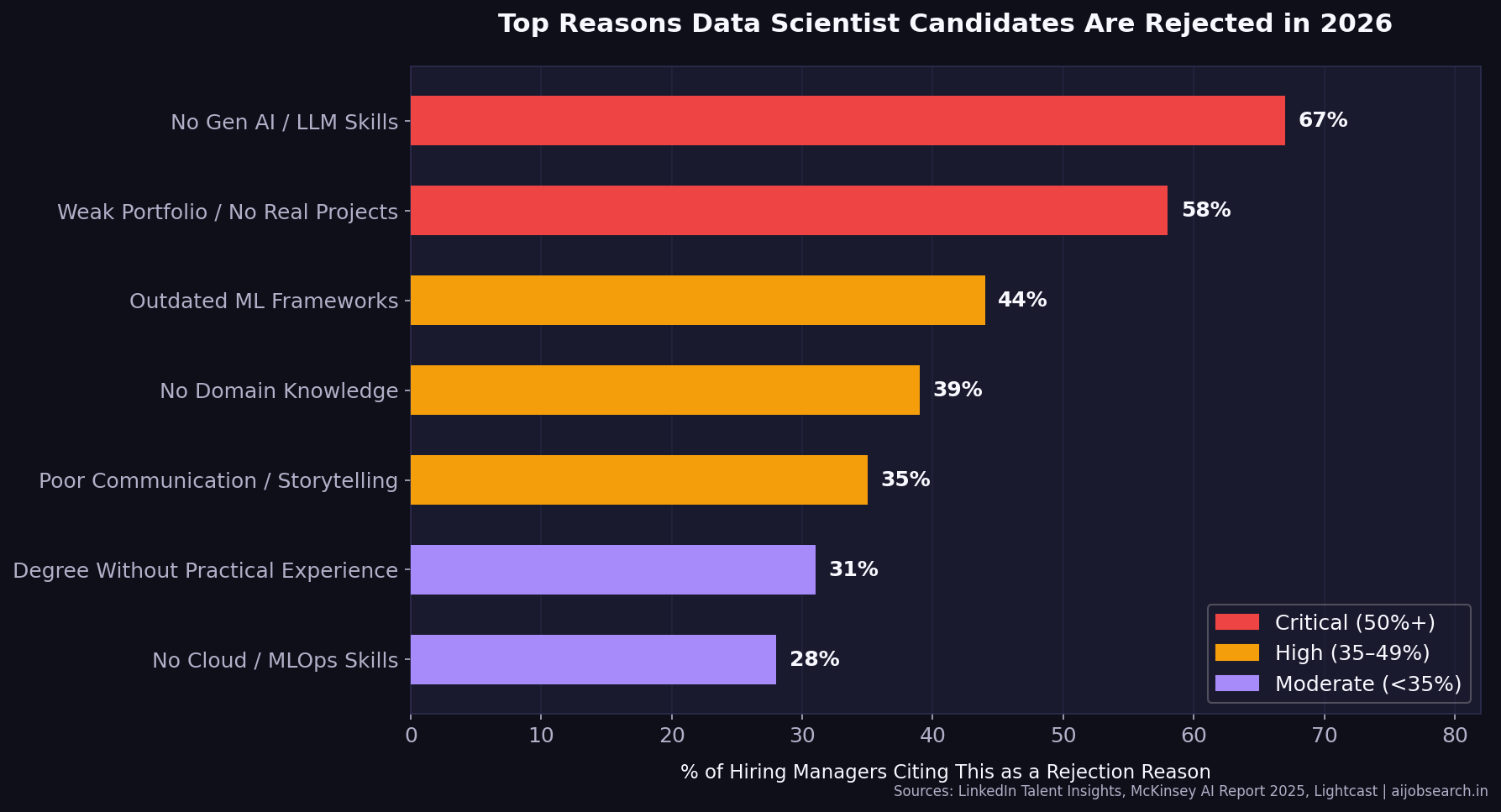
The most striking finding: 67% of hiring managers cite the absence of Gen AI and LLM skills as a primary rejection reason in 2026 — up from near-zero in 2023. This is the fastest-growing skills gap in the profession. Candidates who completed their data science education before 2024 and have not updated their skills are at a severe disadvantage.
The second most common rejection reason (58%) is a weak portfolio. In 2026, a portfolio of Kaggle competition notebooks is no longer sufficient. Hiring managers want to see real-world, deployed projects — a recommendation system that is live, a RAG chatbot that answers domain-specific questions, an MLOps pipeline that runs in production. The degree vs. practical experience debate has been settled: practical experience wins, but only if it is documented and demonstrable.
Pro tip for Indian candidates: If you are applying to global companies or remote roles, your resume needs to be ATS-optimised for each specific job description. Tools like aijobsearch.in can analyse your resume against a job description and show you exactly which keywords are missing — a critical step that most candidates skip, causing their applications to be filtered out before a human ever reads them.
10. Your 10-Step Action Plan for 2026
Whether you are starting fresh or transitioning from another field, here is the exact roadmap for landing a Data Scientist role in the AI-first landscape of 2026:
- Master the foundations first — Python (Pandas, NumPy, Scikit-learn), SQL (window functions, CTEs), and Statistics (probability, hypothesis testing, Bayesian thinking). These are non-negotiable at every level.
- Pick one domain and go deep — FinTech, HealthTech, or E-commerce. Domain knowledge commands a 20–30% salary premium and dramatically improves interview performance.
- Learn at least one cloud platform — AWS SageMaker or GCP Vertex AI. Get the ML Specialty certification. Cloud skills add a 15–25% salary bump according to AmbitionBox data.
- Build a Gen AI project immediately — Build a RAG chatbot, fine-tune a small LLM (Llama 3.2 3B), or build an Agentic AI workflow using LangChain or CrewAI. This is the single highest-ROI skill investment in 2026.
- Create a portfolio with deployed projects — Not Jupyter notebooks. Deployed applications with a live URL, GitHub repo, and a README that explains the business problem solved.
- Optimise your resume for ATS systems — 75% of resumes are filtered by ATS before reaching a recruiter. Use aijobsearch.in's ATS Analyser to check your resume score against each job description and rewrite bullets to match keywords.
- Target product companies over IT services — The same experience earns 2–3x more at Flipkart, Swiggy, or Razorpay compared to TCS or Infosys. If you are in IT services, plan your transition to a product company within 2–3 years.
- Publish your work publicly — Write on Medium or LinkedIn about a project you built. This creates inbound recruiter interest and demonstrates communication skills simultaneously.
- Network with intent — Connect with data scientists at your target companies on LinkedIn. Ask for 15-minute informational calls. 40% of data science hires in India come through referrals (Naukri Hiring Outlook 2026).
- Negotiate on impact, not tenure — When you get an offer, quantify what your model saved or earned (e.g., "reduced fraud losses by ₹2 crore"). Candidates who negotiate with business impact data receive 15–25% higher offers than those who negotiate on years of experience alone.
Conclusion
The Data Scientist in 2026 is not the same role it was in 2020. The profession has been reshaped by Generative AI, Agentic workflows, and the democratisation of ML tools. The good news: demand has never been higher, the talent gap has never been wider, and the salary ceiling has never been more elevated. The challenge: the skills required have shifted dramatically, and candidates who have not kept pace with Gen AI, LLMOps, and RAG pipelines are being left behind.
For Indian candidates specifically, the opportunity is extraordinary. India's data science hiring is growing at 32% annually, Bangalore and Hyderabad are becoming global AI hubs, and the salary gap between India and global markets is narrowing — especially for remote roles at US and UK companies. The 10-step action plan above is your roadmap. The tools, data, and opportunities are all available. The only variable is execution.
Ready to Land Your Data Scientist Role?
Upload your resume to aijobsearch.in and get an instant ATS score, keyword gap analysis, and AI-rewritten bullet points tailored to your target job description. Free to use.
Analyse My Resume Free →
References & Sources
- U.S. Bureau of Labor Statistics — Data Scientists Occupational Outlook 2024–2034
- World Economic Forum — Future of Jobs Report 2025
- Levels.fyi — Data Scientist Salary Data (2026)
- Glassdoor India — Data Scientist Salary 2026
- Futurense — Data Scientist Salary in India 2026 (Fresher to Senior)
- Business Insider — OpenAI and Anthropic Salary Data 2025
- DataExec — Breaking Into AI in 2026: What Anthropic, OpenAI, and Meta Actually Hire For
- Students Circles — Zepto Data Scientist Fresher Recruitment 2026
- Medium / Data Science Collective — AI and Data Scientist Job Market in 2026 (700 postings analysis)
- LinkedIn — Jobs on the Rise 2026: 25 Fastest-Growing Roles