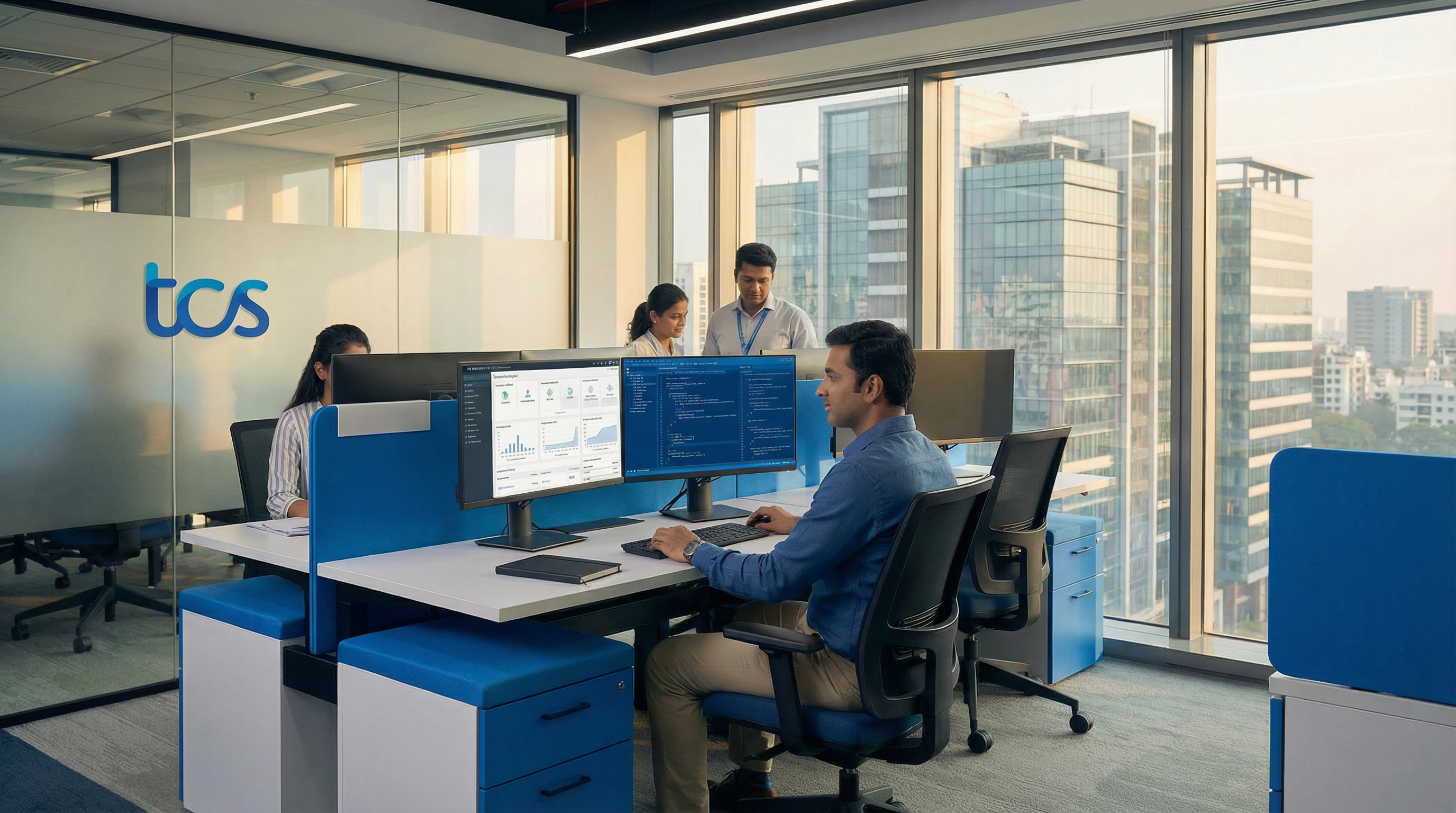
Tata Consultancy Services is not just India's largest IT company — it is the single largest private-sector employer of engineers in the country. With over 600,000 employees worldwide, a market capitalisation that regularly exceeds ₹14 lakh crore, and operations in 55 countries, TCS shapes the career trajectory of more Indian technology professionals than any other organisation. For freshers, mid-career professionals, and experienced engineers alike, understanding how TCS hires, what it pays, and how to get in has never been more important than in 2026.
This guide covers everything you need to know: the top roles TCS is hiring for, realistic salary figures, the hiring process in detail, and a concrete 6-month preparation roadmap that has helped thousands of candidates clear TCS NQT and TCS Digital.
TCS at a Glance: 2026
| Metric | Figure |
|---|
| Total Employees | 600,000+ |
| Fresher Hiring (FY2025–26) | 40,000–50,000 (projected) |
| Revenue (FY2025) | $29.1 billion |
| Presence | 55 countries, 150+ delivery centres |
| India Offices | Mumbai, Chennai, Bengaluru, Hyderabad, Pune, Delhi NCR, Kolkata, Kochi |
| Key Verticals | BFSI, Retail, Manufacturing, Healthcare, Telecom, Energy |
TCS is the go-to employer for engineering graduates from tier-2 and tier-3 colleges across India. Unlike Infosys or Wipro, TCS has historically hired in very large volumes — even during slowdowns — making it the most accessible major IT company for freshers. In 2026, that dynamic continues, though the company has become more selective about the specific skills it wants.
Top 10 Roles TCS Is Hiring For in 2026
1. Assistant System Engineer (ASE) — Fresher Role
The entry point for most engineering graduates. ASEs join TCS's Initial Learning Program (ILP), a 3-month residential training programme at TCS campuses in Thiruvananthapuram, Chennai, Pune, or Hyderabad. After ILP, you are deployed to a project based on your performance and business demand.
Salary: ₹3.36 LPA (base) | Eligibility: BE/BTech/MCA/MSc with 60% throughout (no active backlogs)
2. System Engineer (SE)
The next level after ASE, typically reached after 1–2 years. System Engineers work on client projects with more autonomy. Many freshers who join via TCS Digital or TCS NINJA are placed directly at SE level.
Salary: ₹4.5–6 LPA | Experience: 1–3 years
3. IT Analyst
Mid-level role for professionals with 3–5 years of experience. IT Analysts lead modules, mentor junior engineers, and interact directly with clients. This is where most TCS employees spend the bulk of their early career.
Salary: ₹7–12 LPA | Experience: 3–6 years
4. Assistant Consultant
The transition from technical to consulting. Assistant Consultants are expected to understand business requirements, translate them into technical solutions, and manage client relationships. Strong communication skills are essential.
Salary: ₹12–18 LPA | Experience: 5–8 years
5. Data Engineer
One of the fastest-growing roles at TCS in 2026. Data Engineers build and maintain data pipelines, work with cloud platforms (AWS, Azure, GCP), and support analytics and AI initiatives for clients. TCS has significantly increased hiring in this area as clients demand more data-driven solutions.
Salary: ₹6–18 LPA | Skills: Python, SQL, Spark, Kafka, Databricks, Azure Data Factory
6. Cloud Engineer / Cloud Architect
TCS's cloud business has grown dramatically, driven by enterprise migration projects. Cloud Engineers work on AWS, Azure, and GCP implementations. Cloud Architects design multi-cloud strategies for large enterprise clients.
Salary: ₹8–25 LPA | Certifications valued: AWS Solutions Architect, Azure Administrator, GCP Professional Cloud Architect
7. Full Stack Developer
TCS's digital transformation projects require engineers who can work across the stack. In 2026, the most valued stack is React/Angular (frontend) + Java Spring Boot or Node.js (backend) + cloud deployment.
Salary: ₹5–16 LPA | Skills: React, Angular, Java, Node.js, REST APIs, Docker, Kubernetes
8. AI/ML Engineer
TCS's AI practice has expanded significantly. The company's proprietary AI platform, TCS AI WisdomNext, is deployed across client projects. ML Engineers build models, work on NLP applications, and develop AI-powered automation solutions.
Salary: ₹10–30 LPA | Skills: Python, TensorFlow/PyTorch, scikit-learn, LLMs, MLOps, cloud AI services
9. SAP Consultant
TCS is one of the largest SAP implementation partners globally. SAP Consultants work on ERP implementations for manufacturing, retail, and BFSI clients. SAP S/4HANA expertise is particularly valued in 2026.
Salary: ₹8–22 LPA | Modules in demand: SAP FICO, SAP SD, SAP MM, SAP S/4HANA, SAP BTP
10. Cybersecurity Analyst
As enterprise clients face increasing cyber threats, TCS's security practice has grown rapidly. Cybersecurity Analysts work on threat detection, incident response, and security architecture for large clients.
Salary: ₹7–20 LPA | Certifications valued: CEH, CISSP, CompTIA Security+, OSCP
TCS Salary Structure: Complete Breakdown for 2026
| Role / Level | Years of Experience | CTC (LPA) | Take-Home (Monthly Est.) |
|---|
| Assistant System Engineer (ASE) | 0–1 | ₹3.36 | ₹22,000–24,000 |
| System Engineer (SE) | 1–3 | ₹4.5–6 | ₹30,000–40,000 |
| IT Analyst | 3–6 | ₹7–12 | ₹48,000–80,000 |
| Assistant Consultant | 5–8 | ₹12–18 | ₹82,000–1,20,000 |
| Consultant | 8–12 | ₹18–28 | ₹1,20,000–1,90,000 |
| Senior Consultant | 12–15 | ₹28–40 | ₹1,90,000–2,70,000 |
| Principal Consultant / Manager | 15+ | ₹40–65 | ₹2,70,000–4,40,000 |
| TCS Digital (Fresher) | 0 | ₹7 | ₹47,000–50,000 |
| Data Engineer (Mid) | 3–5 | ₹10–18 | ₹68,000–1,20,000 |
| AI/ML Engineer (Mid) | 3–6 | ₹12–25 | ₹82,000–1,70,000 |
Note on TCS Digital vs TCS NINJA: TCS runs two fresher hiring tracks. TCS NINJA is the standard track (₹3.36 LPA). TCS Digital is the premium track for candidates with stronger technical skills (₹7 LPA). Both are open to the same pool of candidates — your NQT score determines which track you qualify for. Scoring above 70th percentile in the TCS NQT typically qualifies you for the Digital interview.
The TCS Hiring Process: Step-by-Step
For Freshers (Campus / Off-Campus)
TCS hires freshers through two main routes: on-campus placement drives at colleges that have a TCS tie-up, and the off-campus TCS NQT (National Qualifier Test). The off-campus route is open to all eligible candidates and has become the primary path for students from colleges without TCS campus access.
Step 1: TCS NQT Registration
Register at tcs.com/careers. The NQT is conducted multiple times a year. You need a valid email, your academic details, and a government ID. The registration is free.
Step 2: TCS NQT Exam
The NQT has four sections:
| Section | Questions | Time | What It Tests |
|---|
| Numerical Ability | 26 | 40 min | Arithmetic, percentages, ratios, time-work, data interpretation |
| Verbal Ability | 24 | 30 min | Reading comprehension, grammar, vocabulary, sentence correction |
| Reasoning Ability | 30 | 50 min | Logical reasoning, series, coding-decoding, blood relations |
| Programming Logic | 10 | 15 min | Flowcharts, pseudocode, basic programming concepts |
Candidates who score well in all four sections are shortlisted for the Technical + HR interview. Those who score exceptionally well (typically top 30%) are additionally invited to the TCS Digital coding round.
Step 3: Technical Interview
Covers your core engineering subjects (Data Structures, OOP, DBMS, OS, Networking), your final year project, and basic programming. The interviewer will ask you to write code on paper or a whiteboard. Most questions are conceptual rather than competitive-programming-level.
Step 4: Managerial Interview (for Digital track)
For TCS Digital candidates, there is an additional round focused on problem-solving, communication, and situational questions. This round evaluates whether you can work with clients and handle ambiguity.
Step 5: HR Interview
Standard HR questions: tell me about yourself, why TCS, where do you see yourself in 5 years, are you willing to relocate, do you have any active backlogs. This round is largely a formality if you have passed the technical rounds.
For Experienced Professionals
TCS hires experienced professionals through its careers portal (tcs.com/careers) and through LinkedIn. The process typically involves:
- Resume shortlisting by a recruiter
- A telephonic or video screening call
- 1–2 technical interviews (panel-based, focused on your domain)
- An HR discussion covering notice period, salary expectations, and relocation
For senior roles (IT Analyst and above), TCS often uses an internal referral system. Having a TCS employee refer you significantly increases your chances of getting shortlisted.
TCS Interview Questions: What to Expect
Technical Round — Most Frequently Asked Topics
Based on thousands of interview reports from Glassdoor, AmbitionBox, and Reddit's r/developersIndia, these are the topics that appear most consistently in TCS technical interviews:
Data Structures & Algorithms: Arrays and strings, linked lists (reversal, cycle detection), stacks and queues, binary trees and BSTs, sorting algorithms (time complexity), basic graph traversal (BFS/DFS).
Object-Oriented Programming: Four pillars (encapsulation, inheritance, polymorphism, abstraction), difference between abstract class and interface, method overloading vs overriding, constructor types, access modifiers.
Database Management: SQL queries (joins, subqueries, aggregate functions), normalisation (1NF, 2NF, 3NF, BCNF), ACID properties, difference between DELETE/TRUNCATE/DROP, indexing.
Operating Systems: Process vs thread, deadlock (conditions and prevention), paging and segmentation, CPU scheduling algorithms, semaphores and mutex.
Networking: OSI model layers, TCP vs UDP, HTTP vs HTTPS, DNS resolution, IP addressing basics.
Sample Technical Questions
"Write a program to check if a string is a palindrome without using built-in reverse functions."
"What is the difference between a primary key and a unique key? Can a table have multiple unique keys?"
"Explain what happens when you type a URL in a browser and press Enter."
"What is a deadlock? Give a real-world example and explain how you would prevent it."
"What is the time complexity of QuickSort in the best, average, and worst case?"
HR Round — Most Frequently Asked Questions
"Tell me about yourself." — Keep this to 2 minutes: education, key skills, projects, and why you are excited about TCS.
"Why do you want to join TCS?" — Mention TCS's scale, learning opportunities, global exposure, and specific programmes like TCS iON or TCS Ignite.
"Are you willing to relocate?" — Always say yes. TCS deploys freshers to any of its delivery centres based on project demand.
"What is your greatest weakness?" — Choose a real but non-critical weakness and explain what you are doing to address it.
"Where do you see yourself in 5 years?" — Frame your answer around growing within TCS, gaining certifications, and moving into a specialist or leadership role.
TCS Benefits and Perks: What You Actually Get
| Benefit | Details |
|---|
| Health Insurance | ₹3 lakh cover for employee + family (parents, spouse, children) |
| Provident Fund | 12% of basic salary contributed by TCS |
| Gratuity | Eligible after 5 years of service |
| Learning Platform | TCS iEvolve — access to 20,000+ courses, certifications, and learning paths |
| Certification Reimbursement | TCS reimburses costs for approved certifications (AWS, Azure, PMP, etc.) |
| Relocation Allowance | One-time allowance for freshers relocating to their deployment city |
| Subsidised Cafeteria | Available at most TCS campuses |
| Employee Referral | Bonus for referring candidates who get hired |
| Work From Home | Hybrid model — varies by project and client requirement |
TCS Career Growth: The Honest Picture
TCS offers a structured career ladder, but progression speed varies significantly based on your performance rating, the project you are on, and whether you proactively seek opportunities. Here is what the typical growth trajectory looks like:
Years 0–2 (ASE → SE): You are in learning mode. Focus on ILP, get your first project, learn the tools your team uses, and build relationships with your manager and senior engineers. Promotions at this stage are largely automatic if you meet basic performance thresholds.
Years 2–5 (SE → IT Analyst): This is where differentiation begins. Engineers who take on additional responsibilities — leading modules, getting certifications, volunteering for client-facing work — move faster. Those who stay in their comfort zone can spend 4–5 years at SE level.
Years 5–8 (IT Analyst → Assistant Consultant): The transition from technical to consulting is the most significant career shift at TCS. It requires strong communication, client management skills, and the ability to understand business problems — not just technical ones. Many engineers choose to stay in the technical track (moving toward architect roles) rather than making this shift.
One honest caveat: TCS's salary increments have historically been modest (5–8% annually for average performers). Engineers who want faster salary growth often use TCS as a foundation for 2–3 years, then move to product companies or startups where compensation is more competitive. This is a well-known pattern in the Indian IT industry and TCS is aware of it.
6-Month TCS NQT Preparation Roadmap
This roadmap is designed for engineering students in their pre-final or final year who want to clear TCS NQT and qualify for the Digital track. It assumes 2–3 hours of daily preparation.
Month 1: Quantitative Aptitude Foundation
Focus on the numerical ability section, which trips up the most candidates. Work through: percentages, profit and loss, time and work, time and distance, ratios and proportions, simple and compound interest, and data interpretation. Use R.S. Aggarwal's Quantitative Aptitude or IndiaBIX for practice. Target: 20 problems per day, timed.
Month 2: Verbal Ability and Logical Reasoning
Verbal: Read one English article per day (The Hindu, Economic Times). Practice reading comprehension with timed passages. Work on grammar rules — subject-verb agreement, tenses, prepositions. Logical Reasoning: Series completion, coding-decoding, blood relations, syllogisms, and seating arrangements. Use PrepInsta or TCS NQT mock tests for practice.
Month 3: Core Computer Science Subjects
Revise Data Structures (arrays, linked lists, stacks, queues, trees, graphs), Algorithms (sorting, searching, time complexity), OOP concepts, DBMS (SQL, normalisation, transactions), Operating Systems (processes, memory management, scheduling), and Computer Networks (OSI model, TCP/IP, HTTP). Use GeeksforGeeks for concept revision and practice problems.
Month 4: Programming Practice
For TCS NINJA: Practice basic programming problems on HackerRank (Easy level). Focus on string manipulation, array operations, and basic mathematical problems. For TCS Digital: Move to Medium-level problems on LeetCode. Focus on arrays, strings, linked lists, and basic dynamic programming. Aim for 2–3 problems per day.
Month 5: Mock Tests and Gap Analysis
Take 2–3 full TCS NQT mock tests per week. Use PrepInsta's TCS NQT mock series, which closely mirrors the actual exam pattern. After each mock, analyse your weak areas and spend the remaining time in this month addressing them specifically. Track your scores — you should be consistently hitting 70%+ by the end of this month.
Month 6: Interview Preparation
Prepare your "tell me about yourself" answer. Revise your final year project thoroughly — you will be asked about it in detail. Practice explaining technical concepts out loud (record yourself). Prepare 5 questions to ask the interviewer. Research TCS — its recent projects, acquisitions, and key clients. Practice common HR questions with a friend or in front of a mirror.
How to Apply to TCS in 2026
Freshers: Register at tcs.com/careers and apply for the TCS NQT. The exam is conducted online from home or at designated centres. Check the TCS NextStep portal regularly for exam dates — they are announced 4–6 weeks in advance.
Experienced Professionals: Apply directly through tcs.com/careers or LinkedIn. Filter by location and experience level. You can also reach out to TCS recruiters on LinkedIn — they are generally responsive to direct messages from qualified candidates.
Internal Referrals: If you know someone at TCS, ask them to refer you through the employee referral programme. Referred candidates are prioritised in the screening process and typically hear back faster.
TCS vs Other IT Companies: Where Does It Fit?
| Company | Fresher CTC | Work Culture | Growth Speed | Best For |
|---|
| TCS | ₹3.36–7 LPA | Process-driven, stable | Moderate | Learning fundamentals, job security |
| Infosys | ₹3.6–9.5 LPA | Similar to TCS | Moderate | Similar to TCS, slightly better pay |
| Wipro | ₹3.5–6.5 LPA | Flexible, project-dependent | Moderate | Diverse project exposure |
| HCL Tech | ₹3.5–5 LPA | Product + services mix | Moderate | Hardware + software exposure |
| Accenture | ₹4.5–8 LPA | Consulting-oriented | Faster | Consulting + tech career path |
| Cognizant | ₹4–7 LPA | Client-facing, agile | Moderate | US client exposure |
The honest verdict: TCS is the best first job for engineers who want job security, structured training, and a globally recognised brand on their resume. It is not the best choice if you want fast salary growth or cutting-edge technical work. Most experienced TCS engineers recommend staying for 2–3 years to build your foundation, then evaluating your options based on what you have learned about your own interests and strengths.
Frequently Asked Questions
What is the TCS NQT cutoff for 2026?
TCS does not publish official cutoffs, but based on candidate reports, a score of 60–65% across all sections is typically sufficient for NINJA shortlisting. For Digital, you need 70%+ with a strong performance in the programming section.
Can I apply to TCS without a 60% aggregate?
No. TCS's minimum eligibility is 60% (or 6.0 CGPA) throughout — 10th, 12th, and graduation. There are no exceptions to this rule. Having a backlog at the time of application also disqualifies you.
How long does the TCS hiring process take?
From NQT to offer letter, the process typically takes 2–4 months. The offer letter is issued after all rounds are cleared, and the joining date is usually 3–6 months after the offer.
Is TCS a good company for freshers in 2026?
Yes, with the caveat that your experience depends heavily on the project you are placed on. Some freshers work on cutting-edge cloud and AI projects from day one. Others spend their first year on maintenance work for legacy systems. The ILP training is universally well-regarded.
What is TCS's work-from-home policy in 2026?
TCS follows a hybrid model, but the specifics depend on the client and project. Most TCS employees work from office 3–4 days per week. Some client-facing projects require full on-site presence. Remote-first arrangements are rare but exist for certain roles.
How do I get into TCS Digital vs TCS NINJA?
Both tracks use the same NQT. Your score determines which track you qualify for. If you score in the top 30% of NQT test-takers, you are invited for the Digital interview (which includes a coding round). There is no separate registration for Digital — it is automatic based on your NQT performance.