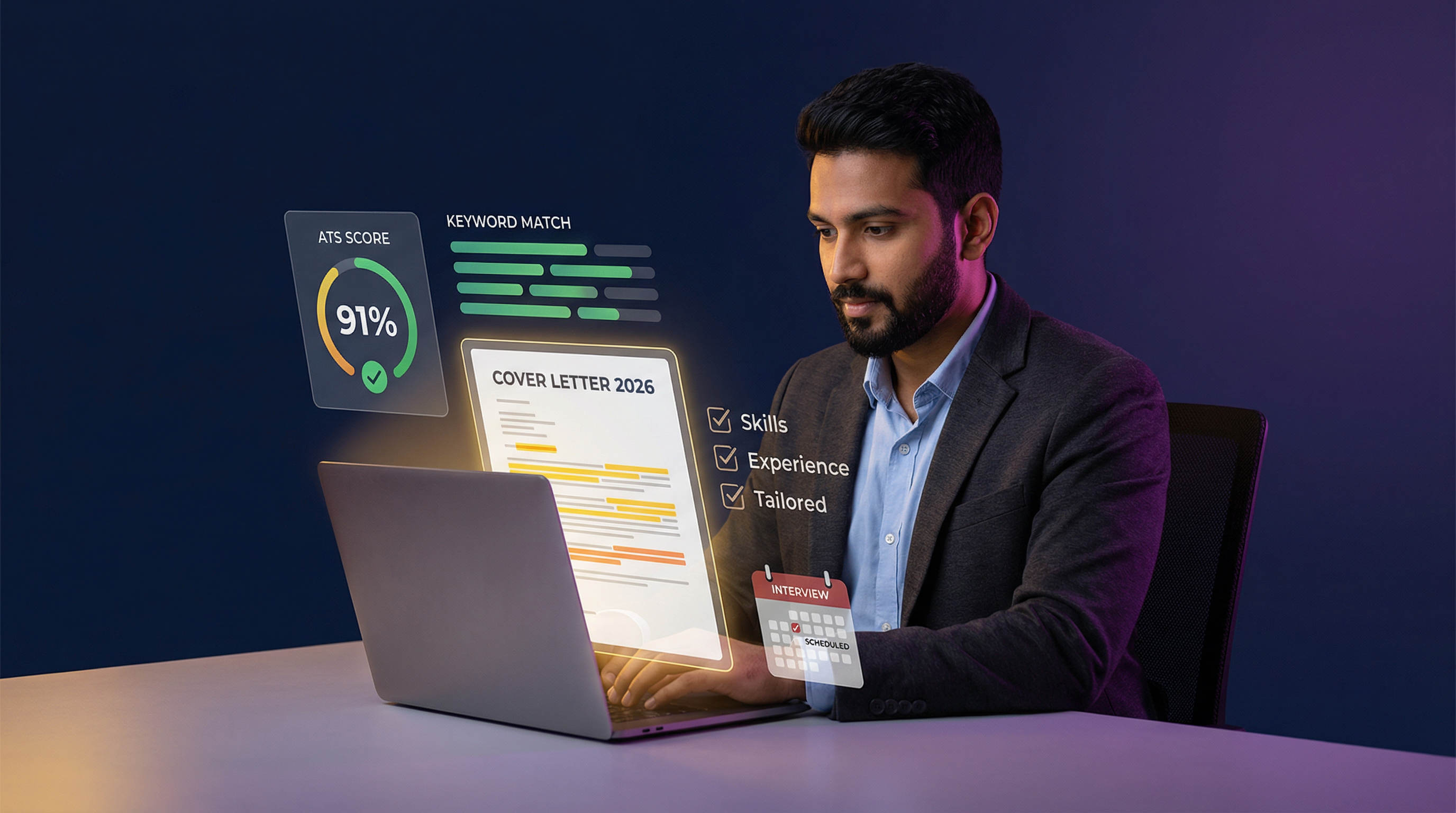
Most software engineers treat the cover letter as an afterthought — a formality to be filled with generic phrases before the resume does the real work. This is a mistake that costs real interviews. A well-written software engineer cover letter can be the difference between an ATS rejection and a recruiter call, particularly for roles where dozens of qualified candidates have near-identical technical profiles.
In 2026, the cover letter has become more important, not less. AI-generated applications have flooded hiring teams with generic, indistinguishable submissions. A specific, well-crafted cover letter now stands out precisely because so few candidates write them well. According to a 2026 survey, 83% of hiring managers say a strong cover letter can get a borderline candidate an interview — and 21% of employers have rejected candidates for submitting AI-generated cover letters without personalisation.
This guide covers the structure, language, and five complete templates for software engineer cover letters that work in 2026 — for freshers, experienced engineers, career changers, and remote roles.
What Makes a Software Engineer Cover Letter Work in 2026
Before the templates, it is worth understanding what hiring managers and ATS systems are looking for — because they are looking for different things.
What the ATS Looks For
Applicant Tracking Systems scan cover letters for keyword matches with the job description. The most important keywords to include are:
- The exact job title from the posting (e.g., "Senior Software Engineer," "Full Stack Developer")
- Programming languages mentioned in the JD (e.g., Python, Java, React, Node.js)
- Methodologies mentioned (e.g., Agile, Scrum, CI/CD, microservices)
- Soft skills mentioned (e.g., "cross-functional collaboration," "stakeholder communication")
A cover letter that contains none of these terms will score poorly in ATS systems that evaluate cover letters alongside resumes.
What the Human Recruiter Looks For
Once past the ATS, a recruiter spends an average of 7 seconds on a cover letter before deciding whether to read it fully. The elements that earn a full read are:
- A specific opening — not "I am writing to apply for the Software Engineer position" but something that immediately signals you understand the company and role
- One concrete achievement — a specific number, project, or result that demonstrates your capabilities
- A clear reason you want this specific role — not just "I am passionate about technology" but something that shows you have researched the company
| Cover Letter Element |
ATS Priority |
Human Priority |
| Job title match |
High |
Low |
| Technical keywords |
High |
Medium |
| Specific achievement with metrics |
Low |
Very High |
| Company-specific research |
None |
Very High |
| Generic enthusiasm phrases |
None |
Negative |
| Length (under 400 words) |
None |
High |
The 4-Paragraph Structure That Works
Every effective software engineer cover letter follows the same underlying structure, regardless of experience level or role type.
Paragraph 1 — The Hook (2–3 sentences): Open with the specific role you are applying for and one sentence that immediately establishes your relevance. Avoid "I am excited to apply." Instead, lead with your most relevant credential or a specific connection to the company.
Paragraph 2 — Your Best Achievement (3–4 sentences): Describe one project or achievement that is directly relevant to the role. Use the STAR format implicitly: what the situation was, what you built or did, and what the measurable result was. This is the most important paragraph — it is what the recruiter will remember.
Paragraph 3 — Why This Company (2–3 sentences): Demonstrate that you have researched the company. Reference a specific product, technology decision, engineering blog post, or company value that genuinely interests you. This paragraph separates candidates who want a job from candidates who want this job.
Paragraph 4 — The Close (2 sentences): State your availability for an interview and thank the reader. Keep it brief and confident.
Template 1: Fresher / Recent Graduate
[Your Name]
[Email] | [Phone] | [LinkedIn] | [GitHub]
[Date]
Dear Hiring Team at [Company Name],
I am applying for the Software Engineer position at [Company Name]. As a recent Computer Science graduate from [University] with a final year project in [relevant technology], I have spent the past year building production-ready applications and contributing to open-source projects that have collectively received over [X] GitHub stars.
During my internship at [Company/Project], I built a [specific feature or system] using [technologies] that reduced [metric] by [percentage]. This project taught me how to [relevant skill] in a production environment — something I am eager to continue developing at [Company Name].
I am particularly drawn to [Company Name]'s approach to [specific technical decision, product, or engineering culture element you genuinely admire]. The engineering blog post on [specific topic] directly influenced how I approached [relevant aspect of your own work].
I would welcome the opportunity to discuss how my skills align with your team's needs. I am available for an interview at your convenience.
Sincerely,
[Your Name]
What makes this work: The GitHub stars metric is specific and verifiable. The reference to the engineering blog post demonstrates genuine research. The internship achievement uses a real number.
Template 2: Experienced Engineer (3–7 Years)
[Your Name]
[Email] | [Phone] | [LinkedIn] | [GitHub]
[Date]
Dear [Hiring Manager Name or "Hiring Team"],
I am applying for the Senior Software Engineer role at [Company Name]. Over the past [X] years at [Current/Previous Company], I have built and scaled [type of systems] serving [scale — e.g., "10 million users" or "₹500 crore in annual transactions"], and I am looking for a role where I can apply that experience to [specific challenge the company is working on].
The most relevant project to this role was [Project Name], where I led the migration of [system] from [old architecture] to [new architecture]. This reduced latency by [X]%, cut infrastructure costs by [Y]%, and enabled the team to ship features [Z times] faster. I drove this project from technical design through production deployment, coordinating with [stakeholders] across [number] teams.
[Company Name]'s decision to [specific technical decision — e.g., "build on top of Kubernetes" or "invest in real-time data infrastructure"] aligns closely with the work I have been doing at [Current Company]. I am particularly interested in contributing to [specific team, product area, or technical challenge].
I would welcome the opportunity to discuss this role in more detail. Please feel free to reach me at [email] or [phone].
Sincerely,
[Your Name]
What makes this work: The achievement paragraph contains three distinct metrics (latency, cost, shipping speed). The company research is specific to a technical decision, not a generic compliment.
Template 3: Career Changer (Moving Into Software Engineering)
[Your Name]
[Email] | [Phone] | [LinkedIn] | [GitHub]
[Date]
Dear Hiring Team at [Company Name],
I am applying for the Software Engineer position at [Company Name]. After [X] years as a [previous role] at [previous company], I completed a [bootcamp/degree/self-study programme] in [technologies] and have spent the past [X months] building production applications. My background in [previous field] gives me a perspective on [relevant problem domain] that most engineers do not have — and I believe it makes me a stronger candidate for this role.
The project I am most proud of is [Project Name], which I built to solve [specific problem from your previous career]. It uses [technologies] and has [metric — users, GitHub stars, or business impact]. Building it taught me [specific technical skill] and reinforced my decision to transition into engineering.
[Company Name]'s work on [specific product or problem] is directly relevant to [your previous domain]. I am motivated not just by the engineering challenge but by the real-world impact — [specific reason related to the company's mission].
I would welcome the opportunity to discuss how my combined background in [previous field] and software engineering could contribute to your team.
Sincerely,
[Your Name]
What makes this work: It addresses the career change directly rather than hiding it. The "perspective most engineers do not have" framing turns the non-traditional background into an asset.
Template 4: Remote / International Application
[Your Name]
[Email] | [Phone] | [LinkedIn] | [GitHub] | [Time Zone]
[Date]
Dear Hiring Team at [Company Name],
I am applying for the [Role] position at [Company Name] (remote). Based in [City, Country], I have [X] years of experience building [type of systems] and have worked effectively in distributed teams across [time zones] for the past [X] years. I am available during [overlap hours] with your team's primary time zone.
At [Previous Company], I was a core contributor to [Project/System] — a remote team of [X] engineers across [countries]. My contributions included [specific achievement with metric]. Working asynchronously taught me to [specific remote work skill — e.g., "write exceptionally clear technical documentation" or "make decisions independently while keeping stakeholders informed"].
[Company Name]'s [specific product, engineering culture, or remote work policy] is what drew me to this application. [One sentence demonstrating genuine research into the company.]
I am happy to accommodate interview scheduling across time zones and can provide references from previous remote managers. I look forward to the opportunity to discuss this role.
Sincerely,
[Your Name]
What makes this work: It proactively addresses the remote work concern (time zone overlap, async communication skills) before the recruiter has to ask.
Template 5: India-Specific (Applying to Indian Companies / MNCs in India)
[Your Name]
[Email] | [Phone] | [LinkedIn] | [GitHub]
[Date]
Dear Hiring Team at [Company Name],
I am applying for the [Role] position at [Company Name]. With [X] years of experience in [technologies] at [Current Company], I am looking to join a team working on [specific type of product/problem] at scale. [Company Name]'s [specific product or achievement — e.g., "work on the UPI infrastructure" or "Series B funding for the B2B SaaS platform"] is exactly the kind of challenge I want to work on next.
At [Current Company], I built [specific system] that handles [scale — transactions per second, users, data volume]. The most technically challenging aspect was [specific problem], which I solved by [specific approach]. This resulted in [measurable outcome].
I am particularly interested in [Company Name]'s engineering culture — specifically [reference to engineering blog, tech talk, or public technical decision]. The problem of [specific technical challenge the company faces] is one I have thought about extensively in my current role.
I am available to join within [notice period] and would welcome the opportunity to discuss this role in detail.
Sincerely,
[Your Name]
What makes this work: The scale metrics (transactions per second, users) are particularly relevant for Indian product companies. The notice period mention is a practical detail Indian recruiters appreciate.
Common Mistakes to Avoid
Using AI without editing. As noted above, 21% of employers have rejected candidates for submitting unedited AI-generated cover letters. AI can draft — you must edit. Every cover letter must contain at least one specific detail (a project name, a metric, a company reference) that could not have been generated by an AI that does not know you.
Summarising your resume. A cover letter that says "As you can see from my resume, I have 5 years of experience in Java" wastes the recruiter's time. The cover letter should add information that is not in the resume — context, motivation, and personality.
Generic company research. "I admire [Company]'s commitment to innovation" is not research. Find a specific engineering blog post, a product decision, a recent news article, or a technical talk from the company and reference it specifically.
Exceeding 400 words. Hiring managers are reviewing hundreds of applications. A cover letter that requires scrolling will often not be read in full. Keep it to three to four short paragraphs.
Addressing it to "To Whom It May Concern." Spend five minutes on LinkedIn to find the hiring manager's name. "Dear [Name]" is always better than a generic salutation.
References
: "How Job Seekers Should Use AI To Get A New Job In 2026." Forbes, January 2026.
: "Software Engineering Cover Letter Examples That Get Interviews." NovoResume, February 2026.
References
- "How Job Seekers Should Use AI To Get A New Job In 2026."
- "Software Engineering Cover Letter Examples That Get Interviews."