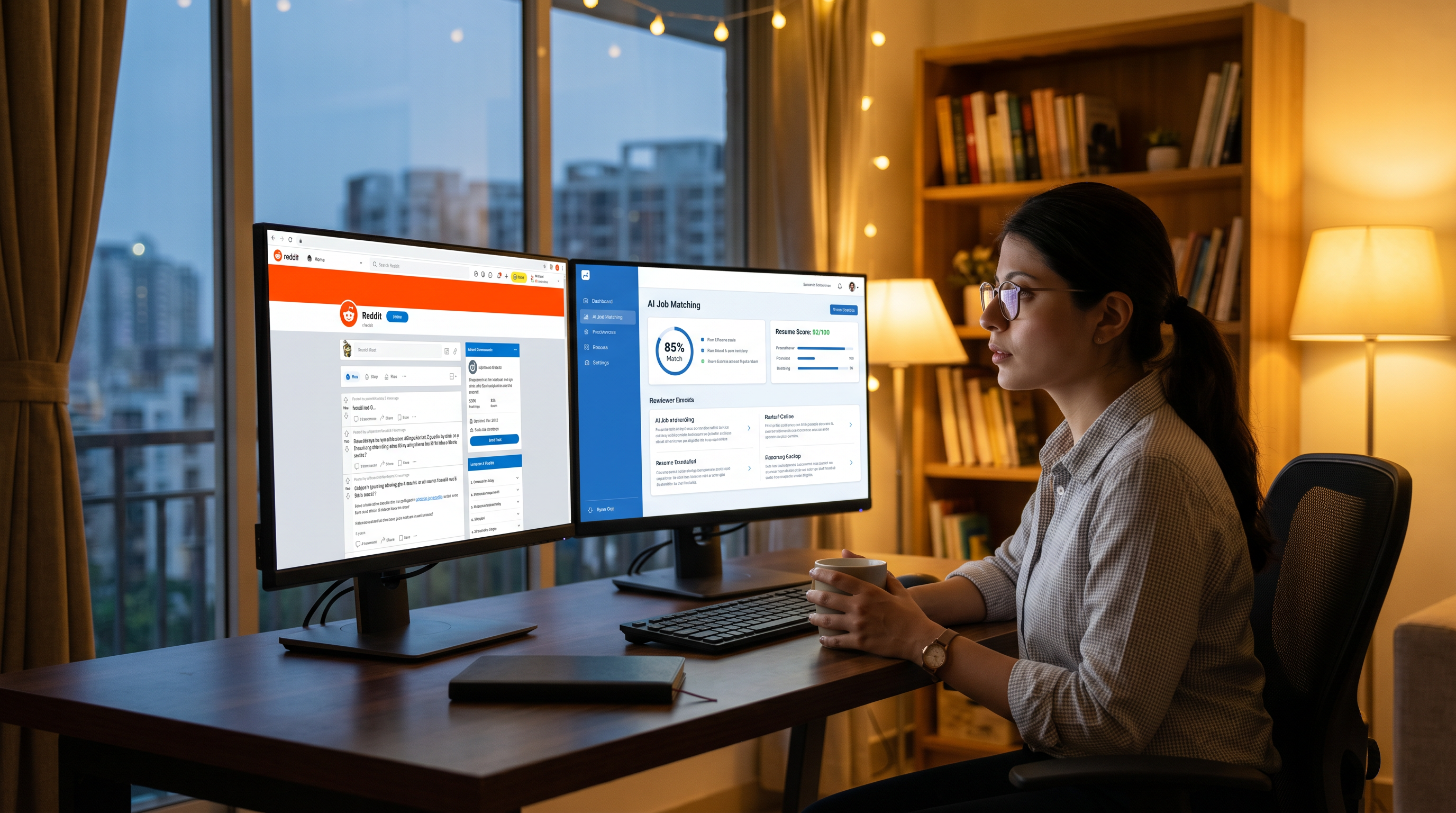
There is a quiet revolution happening in job search, and it is not happening on LinkedIn. It is happening on Reddit — in threads that are brutally honest, statistically grounded, and completely free of the performative optimism that defines most career advice. Across subreddits like r/jobsearchhacks, r/jobs, r/careerguidance, and r/recruitinghell, hundreds of thousands of job seekers are sharing what actually works — and what doesn't — in the most challenging hiring market in a decade.
This whitepaper analyses those conversations. It draws on real Reddit threads, data from over 1.6 million job applications, and the lived experiences of candidates who cracked the code in 2025 and 2026. The goal is not to give you generic advice. It is to show you, with evidence, how the smartest job seekers are combining Reddit intelligence with AI tools to cut through the noise and land interviews faster.
1. The Reality of Job Search Today: Why the Old Rules Are Broken
The numbers are stark. According to a 2025 Annual Job Search Trends Report published by Huntr, which analysed over 1.6 million applications and 1 million job postings, the median time to receive a first job offer jumped from 57 days in Q1 2025 to a punishing 83 days by Q4. That is not a blip. That is a structural shift.
On Reddit, the data matches the lived experience. A post in r/jobhunting titled "I analyzed 1.6 million job applications from 2025. If you feel like the job market is broken, this data proves it" generated thousands of upvotes and hundreds of comments, with users confirming that ghosting is now the norm rather than the exception. As the post author noted:
"Nearly 90% of seekers experienced ghosting last year. The finish line is literally moving further away."
— u/nomadicsamiam, r/jobhunting, January 2026
Three forces have converged to create this environment. First, the volume of applications has exploded. AI-powered auto-apply tools mean that a single job posting can now receive 500 to 1,000 applications within 24 hours of going live. Second, companies have responded by deploying their own AI — Applicant Tracking Systems (ATS) and AI screening tools that filter candidates before any human ever reads a resume. Third, the economic uncertainty of 2024 and 2025 pushed more qualified professionals into the active job market simultaneously, intensifying competition at every level.
The result is a paradox: more tools, more applications, and worse outcomes for most candidates. But not for all of them. The candidates who are breaking through have figured out something important — that the problem is not effort, it is targeting.
2. Why Reddit Is the Most Underrated Job Search Engine
LinkedIn is polished. Indeed is transactional. Reddit is honest. That distinction matters enormously when you are trying to understand what actually works in a job search.
On LinkedIn, career advice is filtered through personal branding. People share success stories, not failure rates. Recruiters post tips that serve their interests. The signal-to-noise ratio for genuine, actionable intelligence is low. Reddit operates differently. Anonymity removes the incentive to perform. Users share real rejection rates, real salary negotiations, real failures, and real breakthroughs. The upvote system surfaces the most useful content. The comment threads add nuance, pushback, and additional data points.
The result is a distributed intelligence network that no single career coach, recruiter, or platform can replicate. When a user in r/jobsearchhacks posts that they went from zero callbacks on 200 applications to five interviews from 25 targeted ones, and hundreds of other users confirm the same pattern, that is statistically meaningful. It is crowd-sourced A/B testing at scale.
Savvy job seekers have started treating Reddit like a search engine. Before applying to a company, they search [company name] + interview on Reddit to find real interview questions, culture insights, and red flags that no Glassdoor review would contain. Before using an AI tool, they search for honest reviews from people who have actually tested it. Before tailoring their resume, they look for threads where people in their specific field share what keywords and formats are getting them through ATS.
| Platform |
Type of Intelligence |
Reliability |
Best Use Case |
| LinkedIn |
Professional networking, job listings |
Moderate (curated, branded) |
Connecting with recruiters, applying to roles |
| Glassdoor |
Company reviews, salary data |
Moderate (can be gamed) |
Salary benchmarking, culture research |
| Reddit |
Raw strategy, failure analysis, tool reviews |
High (anonymous, crowd-validated) |
Strategy research, tool vetting, interview prep |
| Indeed |
Job listings, company ratings |
Moderate |
Volume job search, salary estimates |
3. Reddit-Proven Job Search Strategies
a. "Mass Apply Is Dead" — The Case for Targeted Applications
The most consistent finding across Reddit's job search communities in 2025 and 2026 is that volume-based job searching has collapsed as a strategy. The Huntr data confirms it quantitatively: a job-tailored resume achieves a 5.8% conversion rate compared to 3.7% for a generic one — a 1.6× improvement that, across a realistic application volume, translates to weeks of saved time.
A post in r/jobsearchhacks titled "I analyzed 500+ job applications and here's why most people waste 90% of their time applying" articulated the problem with surgical precision:
"Most people search a job title on Indeed and blast their resume to the first 50 results. Half those listings are 30+ days old (already filled), a quarter don't match your experience, and the rest have 500+ applicants. Focus on jobs posted in the last 48 hours. Look for roles where you match 70%+ of the requirements."
— u/mistygiant, r/jobsearchhacks, February 2026
The 70% match threshold is not arbitrary. It reflects the point at which ATS systems begin to score resumes favourably, and at which candidates have enough genuine qualification to pass human review. Applying below that threshold is statistically wasteful. Applying above it — with a tailored resume — is where interviews happen.
This is precisely the logic behind platforms like AI Job Search, which reads your resume and surfaces only roles where your profile scores 70% or higher against the job description. Rather than searching manually and guessing at fit, the matching is done algorithmically — the same way ATS systems evaluate candidates, but working in your favour rather than against you.
b. Networking Over Applying — The Referral Advantage
The "hidden job market" — roles filled through referrals and internal networks before ever being posted publicly — is estimated to account for 70% of all hires. A Reddit thread in r/RemoteJobs from September 2025 titled "70% of jobs in 2025 are never posted publicly" sparked a heated discussion about whether this figure is accurate, but the consensus among experienced users was clear: the best opportunities are found through people, not portals.
However, the referral landscape has also shifted. A thread in r/jobsearchhacks titled "RIP referrals, 2025 job market" noted that the referral advantage that was reliable in 2021–2023 has weakened at larger companies, where hiring freezes mean that even referred candidates are not being moved forward. The nuanced conclusion from the community was that referrals still work best at companies that are actively growing — startups, scale-ups, and mid-size firms — rather than at large enterprises managing headcount carefully.
The practical Reddit-sourced playbook for networking in 2025 involves three steps. First, identify the specific hiring manager or team lead for the role using LinkedIn, not just the recruiter. Second, send a direct message that references something specific about their work — a project, a post, a product feature — rather than a generic "I'd love to connect" message. Third, ask for a 15-minute informational conversation, not a job. The conversion rate from informational conversation to referral is dramatically higher than cold applications, and Reddit threads confirm this pattern repeatedly.
c. Resume Personalisation Hacks
The ATS optimisation conversation on Reddit has matured significantly from the early days of keyword stuffing. A thread in r/jobsearchhacks titled "I spent 8 months testing how ATS systems actually parse resumes" from February 2026 provided one of the most detailed technical analyses available outside of paid consulting services. The key findings: modern ATS systems parse for semantic relevance, not just exact keyword matches; formatting matters enormously (tables, columns, and graphics cause parsing failures); and the job title in your resume's summary section carries disproportionate weight.
The practical implication is that resume personalisation is no longer optional — it is the minimum requirement for getting through the first filter. The Reddit community has converged on a workflow: extract the five to seven most important keywords from the job description, ensure they appear naturally in your summary and experience sections, and adjust your job title in the summary to match the target role's language if your actual title is different but the work is equivalent.
d. The Hidden Jobs Strategy
Beyond networking, Reddit users have identified several tactical approaches to finding roles before they are widely posted. Monitoring company career pages directly — rather than relying on aggregators like Indeed or LinkedIn — gives a 24 to 48 hour head start, since aggregators often have a lag in indexing new postings. Setting up Google Alerts for "[company name] + hiring + [role]" captures announcements before they become formal job postings. Following company engineering blogs, product updates, and funding announcements signals where growth is happening and where roles are likely to open.
The Huntr data supports the aggregator-bypass strategy quantitatively. Google job search had an 11.3% response rate compared to LinkedIn's 3.1% and Indeed's 4.5%. The difference is largely attributable to the fact that Google surfaces company career pages directly, where applicant volume is lower and hiring managers are more likely to see your application.
4. How Job Seekers Are Using AI — With Real Reddit Insights
a. Resume Optimisation
The most common AI use case in job search is resume tailoring, and the Reddit community has developed a sophisticated understanding of how to do it well versus how to do it badly. The bad version — paste your resume and a job description into ChatGPT, ask it to rewrite — produces generic output that reads as AI-generated and fails to differentiate the candidate. The good version is more deliberate.
A post in r/jobs that generated significant engagement described the effective approach:
"Instead of asking ChatGPT to rewrite my resume, I taught it who I was first. I wrote out my entire work history — not just titles and dates, but every meaningful project, what I built, problems I solved, what I learned. Then I fed that into ChatGPT along with my actual resume and had it ask me 20 questions about how I work. Only then did I start applying. The cover letters it generated actually sounded like me."
— u/Mjs16444, r/jobs, December 2025
This approach — using AI as a thinking partner that knows your context, rather than a template generator — is the distinction that separates effective AI use from the generic output that recruiters have learned to recognise and discount.
b. Cover Letter Automation
Cover letters have not died — generic cover letters have died. The Reddit consensus is that a cover letter that references something specific about the company and connects your experience to their actual problem is still highly effective. The challenge is that writing such a letter for every application is time-consuming. AI solves this when used correctly.
The workflow that Reddit users report success with involves feeding the AI three inputs: your detailed professional background, the specific job description, and one or two specific facts about the company — a recent product launch, a funding round, a challenge mentioned in their engineering blog. The AI then generates a cover letter that is both personalised and efficient to produce. Users in r/jobsearchhacks report callback rates increasing significantly when switching from generic to AI-assisted personalised cover letters.
Tools like AI Job Search automate this step directly within the job discovery workflow — generating a tailored cover letter for each matched role without requiring the candidate to switch between tools or manually input context each time.
c. Job Matching and Discovery
The most time-consuming part of job search is not writing applications — it is finding the right roles to apply to in the first place. Manually searching across five job boards, reading dozens of job descriptions, and assessing fit is a process that can consume three to four hours per day. AI-powered job matching compresses this dramatically.
The key insight from Reddit's job search communities is that match quality matters more than match volume. A thread in r/jobsearchhacks from April 2026 titled "Some job search hacks that are actually working right now" noted that candidates who focus on roles where they genuinely meet 70% or more of the requirements — rather than applying broadly and hoping — are seeing response rates three to four times higher than the average.
Platforms that use AI to pre-filter for fit — reading your resume, understanding your actual skills and experience level, and surfacing only roles where the match is strong — address this problem directly. AI Job Search aggregates listings from five major boards simultaneously and applies this matching logic automatically, so candidates spend their time on applications that are likely to convert rather than on a broad search that yields mostly mismatches.
d. Auto-Apply Tools — The Controversial Category
No discussion of AI in job search is complete without addressing the most controversial category: tools that automatically apply to jobs on your behalf while you sleep. Tools like LazyApply, Sonara, LoopCV, and Simplify promise to submit hundreds of applications with minimal human involvement. Reddit's verdict on these tools is nuanced and worth examining carefully.
A thread in r/recruitinghell titled "Stop using AI tools that apply for you, they don't work" argued that auto-apply tools generate applications that are detectable as low-effort, damage your reputation with recruiters, and result in a flood of rejections that is demoralising rather than productive. A competing thread in r/jobsearchhacks documented a user who used LoopCV to submit 516 applications and received 66 responses — a 12.8% response rate that, while lower than targeted applications, still produced real interviews.
The honest conclusion from the data is that auto-apply tools work better for high-volume, lower-specificity roles (entry-level positions, roles with standardised requirements) and worse for senior, specialised, or competitive roles where personalisation is the differentiating factor. The Reddit community's consensus is that auto-apply is a volume play, not a quality play — and that quality wins in the current market.
5. AI Tools Reddit Users Actually Recommend
The following table summarises the AI tools that appear most frequently in positive Reddit discussions across job search communities, along with the honest caveats that the community has identified through real-world testing.
| Category |
Tool |
Reddit Consensus |
Best For |
| Job Matching |
AI Job Search |
Positive — matches resume to live jobs across 5 boards, 70%+ fit filter |
Finding high-fit roles without manual searching |
| Resume Tailoring |
Jobscan |
Positive — accurate ATS scoring, keyword gap analysis |
ATS optimisation before applying |
| Resume Tailoring |
Resume Worded |
Mixed — good for formatting feedback, less accurate on ATS scoring |
General resume quality improvement |
| AI Writing |
ChatGPT (with context) |
Positive when used with detailed personal context; negative when used as a shortcut |
Cover letters, interview prep, resume tailoring |
| Auto-Apply |
Simplify |
Mixed — saves time on form-filling but quality varies |
Entry-level and volume applications |
| Job Tracking |
Huntr |
Positive — well-designed tracker with analytics |
Managing application pipeline and follow-ups |
| Interview Prep |
ChatGPT / Claude |
Positive — mock interviews with company-specific context are highly effective |
Behavioural and technical interview preparation |
A recurring theme in Reddit discussions about AI tools is the distinction between tools that save time on mechanical tasks (form-filling, formatting, keyword matching) and tools that try to replace human judgment (auto-apply, AI-generated applications submitted without review). The former category has strong community endorsement. The latter is viewed with scepticism, particularly for competitive roles.
6. What Doesn't Work — Critical Insights from Reddit
Reddit's job search communities are as valuable for what they warn against as for what they recommend. The following patterns appear consistently in threads about failed job searches.
Overusing AI produces generic profiles. When everyone uses the same AI tools with the same prompts to write their resume and cover letter, the output converges. Recruiters have reported being able to identify AI-generated applications at a glance — not because AI writing is inherently bad, but because most people use it without providing sufficient personal context. A thread in r/jobsearchhacks from February 2026 noted that "AI made resume writing easier — but it also created a new problem: resume noise. Lots of documents now contain generic filler, keyword stuffing, and buzzwords that sound impressive but say nothing."
Blind automation backfires at scale. The data from the Huntr report is instructive here: 44% of job seekers admitted they would use AI to fabricate or exaggerate their resume to get an interview. The report's authors explicitly warned against this, noting that the interview will inevitably expose the gap. Beyond the ethical dimension, fabricated applications waste everyone's time and damage the candidate's reputation with recruiters who talk to each other within industries.
Lack of personalisation is the single biggest failure mode. Across hundreds of Reddit threads, the pattern is consistent: candidates who treat job search as a numbers game — more applications, more chances — consistently underperform candidates who treat it as a targeting problem. The data supports this. Twenty-five targeted applications with tailored materials outperform 300 generic ones in terms of interview conversion rate, and the targeted approach is less time-consuming once the workflow is established.
Ignoring the follow-up is a missed opportunity. Reddit users in r/jobsearchhacks report that following up one week after submitting an application increases response rate by approximately 30%. This is a simple, low-effort action that most candidates skip. A brief, professional email to the hiring manager — not the recruiter — referencing the specific role and adding one sentence about why you are a strong fit is the format that users report working best.
7. The Emerging Trend: AI vs. Recruiter AI — An Arms Race in Hiring
Perhaps the most consequential development in the 2025–2026 job market is the emergence of what Reddit users have started calling "the world's most expensive catfish" — a dynamic in which candidates use AI to get past ATS systems, while companies use AI to filter out candidates, with both sides escalating their tools in response to the other.
A thread in r/jobhunting titled "Candidates using AI to apply. Companies using AI to screen. Is hiring becoming the world's biggest catfish?" laid out the statistics starkly:
"75% of job seekers now use AI to write resumes and cover letters. 83% of companies will use AI to screen resumes by end of 2026. 21% of companies let AI reject candidates with zero human review. 88% of hiring managers say they can tell when AI wrote the application — but 75% can't actually identify it in blind tests."
— u/skilled231, r/jobhunting, February 2026
This arms race has several important implications for job seekers. First, the ATS optimisation strategies that worked in 2023 — keyword stuffing, white text tricks, formatting hacks — are increasingly ineffective against modern AI screening systems that evaluate semantic relevance rather than exact keyword matches. Second, the candidates who break through are those who use AI to enhance genuine human communication rather than to replace it. Third, the companies that are winning the talent war are those moving toward skills-based assessment — work samples, portfolio reviews, practical tests — that are harder to game with AI on either side.
The Reddit community's prediction for where this leads is split between three scenarios: skills-based hiring becoming the norm, credentials making a comeback as a trust signal, and an ongoing arms race where both sides keep upgrading their tools. The most pragmatic advice from experienced users is to prepare for all three — build a strong portfolio, maintain genuine credentials, and stay current with AI tools — rather than betting on any single outcome.
8. The Psychological Dimension — Job Search Burnout in 2026
No honest analysis of the 2025–2026 job market can ignore the psychological toll. A thread in r/jobsearchhacks titled "The 'Job Search Burnout' is real. How are you all staying sane in 2026?" received thousands of upvotes and hundreds of comments, with users describing symptoms that go well beyond frustration — anxiety, depression, loss of professional identity, and the particular cruelty of being ghosted after investing significant time in an application.
The strategies that Reddit's community has found most effective for managing burnout are structural rather than motivational. Setting a fixed daily time limit for job search activities — typically two hours — prevents the spiral of compulsive checking and reapplying. Using AI tools to handle the mechanical, repetitive parts of the process (form-filling, keyword matching, cover letter drafting) preserves cognitive and emotional energy for the parts that require genuine human judgment. Tracking applications in a structured system converts the experience from a series of individual rejections into a data-driven process with measurable progress.
The community has also developed a useful reframe: in a market where the average time to offer is 83 days and ghosting affects 90% of candidates, rejection is not a signal about your quality as a professional. It is a signal about the volume and randomness of the current market. The candidates who maintain this perspective — and who use the data to refine their targeting rather than to question their worth — are the ones who break through.
9. The Future of Job Search — What the Data Suggests
Synthesising the Reddit intelligence and the quantitative data, several trends appear durable enough to plan around for the remainder of 2026 and beyond.
The shift from volume to precision will continue. As AI makes it easier to generate applications at scale, the signal value of any individual application decreases. The response rate advantage of targeted, tailored applications over generic ones will widen, not narrow. Candidates who invest in understanding their own fit profile — what roles they genuinely match, what companies are likely to respond, what their competitive differentiators are — will outperform those who rely on volume.
AI tools will become table stakes, not differentiators. Using AI for resume tailoring, cover letter generation, and interview preparation will become as standard as using a spell checker. The differentiator will be how well candidates use these tools — whether they provide genuine personal context or treat AI as a shortcut — and whether they combine AI efficiency with human authenticity in their applications.
The hidden job market will become more accessible through AI. Tools that monitor company career pages, track hiring signals from funding announcements and product launches, and identify the right people to contact within target companies are making the hidden job market less hidden. Candidates who use these tools proactively — rather than waiting for roles to appear on aggregators — will consistently find better opportunities with less competition.
Skills-based hiring will grow, but slowly. The Reddit community's hope that companies will move to portfolio-based, skills-first hiring is well-founded in principle, but the pace of change at large organisations is slow. For the next two to three years, ATS optimisation and resume tailoring will remain essential skills. The candidates who invest in building genuine portfolios — GitHub repositories, published work, documented projects — will be positioned well for the shift when it accelerates.
Conclusion: The Intelligent Job Search Playbook
The job seekers who are landing roles in 2025 and 2026 are not working harder than everyone else. They are working differently. They are using Reddit to gather intelligence that no career coach or job board can provide. They are using AI tools to handle the mechanical parts of the process efficiently. And they are applying the intelligence and the efficiency together — targeting roles where they genuinely fit, personalising their materials with real context, and following up systematically.
The playbook, distilled from thousands of Reddit threads and millions of data points, is straightforward. Understand your fit profile — what roles you match at 70% or above — before you start applying. Use AI to help you communicate your genuine strengths clearly, not to fabricate a version of yourself that doesn't exist. Apply to fewer roles, with better materials, and follow up consistently. Use the hidden job market through networking and direct outreach to companies you genuinely want to work for. And manage the psychological dimension of the process with structure and data, not motivation and hope.
Platforms like AI Job Search are designed to operationalise this playbook. By reading your resume, matching it against live jobs across five boards, and surfacing only the roles where your fit score is 70% or higher, the platform eliminates the most time-consuming and demoralising part of the process — the hours spent searching through listings that were never right for you. The cover letter generator, ATS analyser, salary estimator, and interview preparation tools then support every subsequent step, from application to offer.
The job market is harder than it was. But the intelligence to navigate it — from Reddit's honest communities and from AI tools that genuinely work — has never been more accessible. The candidates who use it will find the process faster, less demoralising, and significantly more effective than those who are still playing by the old rules.
Actionable Checklist: The Reddit + AI Job Search Playbook
- Define your fit profile: List the roles, industries, and seniority levels where you genuinely match 70%+ of requirements before starting your search.
- Use AI for matching, not just writing: Use a platform like AI Job Search to surface high-fit roles automatically rather than searching manually across five boards.
- Build your AI context document: Write a detailed 5–10 page document covering your full work history, key projects, and professional values. Feed this to ChatGPT or Claude before generating any application materials.
- Check your ATS score before submitting: Run every resume through an ATS checker against the specific job description. Fix keyword gaps before applying.
- Apply to jobs posted in the last 48 hours: Older listings have more applicants and lower response rates. Prioritise recency.
- Bypass aggregators where possible: Apply directly on company career pages for a 2–3× higher response rate than LinkedIn or Indeed.
- Follow up one week after applying: A brief, professional email to the hiring manager increases response rate by approximately 30%.
- Use Reddit for company research: Search "[company name] + interview" on Reddit before every interview for real questions, culture insights, and red flags.
- Track everything: Use a spreadsheet or tool like Huntr to track every application, status, and follow-up date. Data converts a demoralising experience into a manageable process.
- Set a daily time limit: Two hours of focused job search activity per day is more effective than eight hours of anxious browsing. Protect the rest of your time for skill development and portfolio building.