Oracle Corporation is one of the most enduring names in enterprise technology. Founded in 1977 by Larry Ellison, Bob Miner, and Ed Oates, Oracle began as a database software company and has since evolved into a global cloud, AI, and enterprise applications giant with over $53 billion in annual revenue and operations in 175 countries.[^1] For Indian professionals, Oracle represents one of the most stable, well-paying, and technically rigorous employers in the country — with over 40,000 direct employees across six major cities and a hiring pipeline that has remained consistently active even through the 2023 global tech correction.
This whitepaper analyses Oracle India's historical hiring patterns, the top 10 roles most frequently posted on Oracle Careers, the skills and qualifications required for each, and a concrete 6-month roadmap to get hired. All salary data is sourced from Levels.fyi, AmbitionBox, and Glassdoor.[^2] [^3]
1. Introduction to Oracle: From Database Pioneer to Cloud and AI Giant
Oracle's story is one of the most remarkable in technology history. Larry Ellison founded the company after reading a paper by IBM researcher Edgar Codd describing a relational database model — and building a commercial product before IBM could. The Oracle Database, first released in 1979, became the world's most widely deployed enterprise database and remains so today, running the core systems of most Fortune 500 companies, global banks, telecom operators, and government agencies.
Over the following four decades, Oracle expanded aggressively through acquisition and organic growth. Key milestones include the acquisition of PeopleSoft (2005) and Siebel Systems (2006), which gave Oracle dominance in enterprise HR and CRM software; the acquisition of Sun Microsystems (2010), which brought Java and MySQL under Oracle's umbrella; and the transformative $28.3 billion acquisition of Cerner (2022), which made Oracle one of the world's largest healthcare IT companies.
The most significant strategic shift of the past decade has been Oracle's pivot to cloud. Oracle Cloud Infrastructure (OCI), launched in 2016 and rebuilt from the ground up in 2018, has emerged as a genuine competitor to AWS, Azure, and Google Cloud. OCI's differentiation lies in its performance-per-dollar advantage, particularly for database workloads — Oracle Database running on OCI is 2–3× faster than on competing clouds, a claim that has won major enterprise customers including NVIDIA, Zoom, and the US Department of Defense.[^4]
Oracle's major business segments in 2026:
| Segment |
Description |
India Relevance |
| Oracle Cloud Infrastructure (OCI) |
IaaS/PaaS cloud platform |
Fastest-growing hiring category |
| Oracle Database (19c, 23ai) |
World's most-used enterprise DB |
Core engineering and support roles |
| Oracle Fusion Cloud ERP |
Enterprise resource planning |
Large consulting and functional roles |
| Oracle HCM |
Human Capital Management |
Strong consulting demand in India |
| Oracle NetSuite |
Cloud ERP for SMBs |
Growing India sales and support |
| Java Platform (SE/EE) |
Oracle owns Java |
Core language for engineering roles |
| Oracle Analytics / AI |
Data platform and AI tools |
Growing data science roles |
| Oracle Consulting & Support |
Professional services |
Largest non-engineering category |
Oracle India presence: Oracle operates across six major cities in India, with Hyderabad and Bengaluru serving as the primary engineering and cloud hubs. The Hyderabad office in Hitech City is Oracle's largest India facility, housing engineering, OCI operations, support, and consulting teams. Bengaluru's Oracle Technology Park on Bannerghatta Road houses six separate office buildings and is the primary hub for product development. Noida, Pune, Chennai, and Gurugram handle a mix of consulting, support, finance, and sales operations.
2. Oracle India Hiring Trends (2020–2026)
The chart below shows estimated Oracle India job postings by category from 2020 to 2026, based on data aggregated from Oracle.com/careers, LinkedIn, Naukri.com, and industry hiring reports.
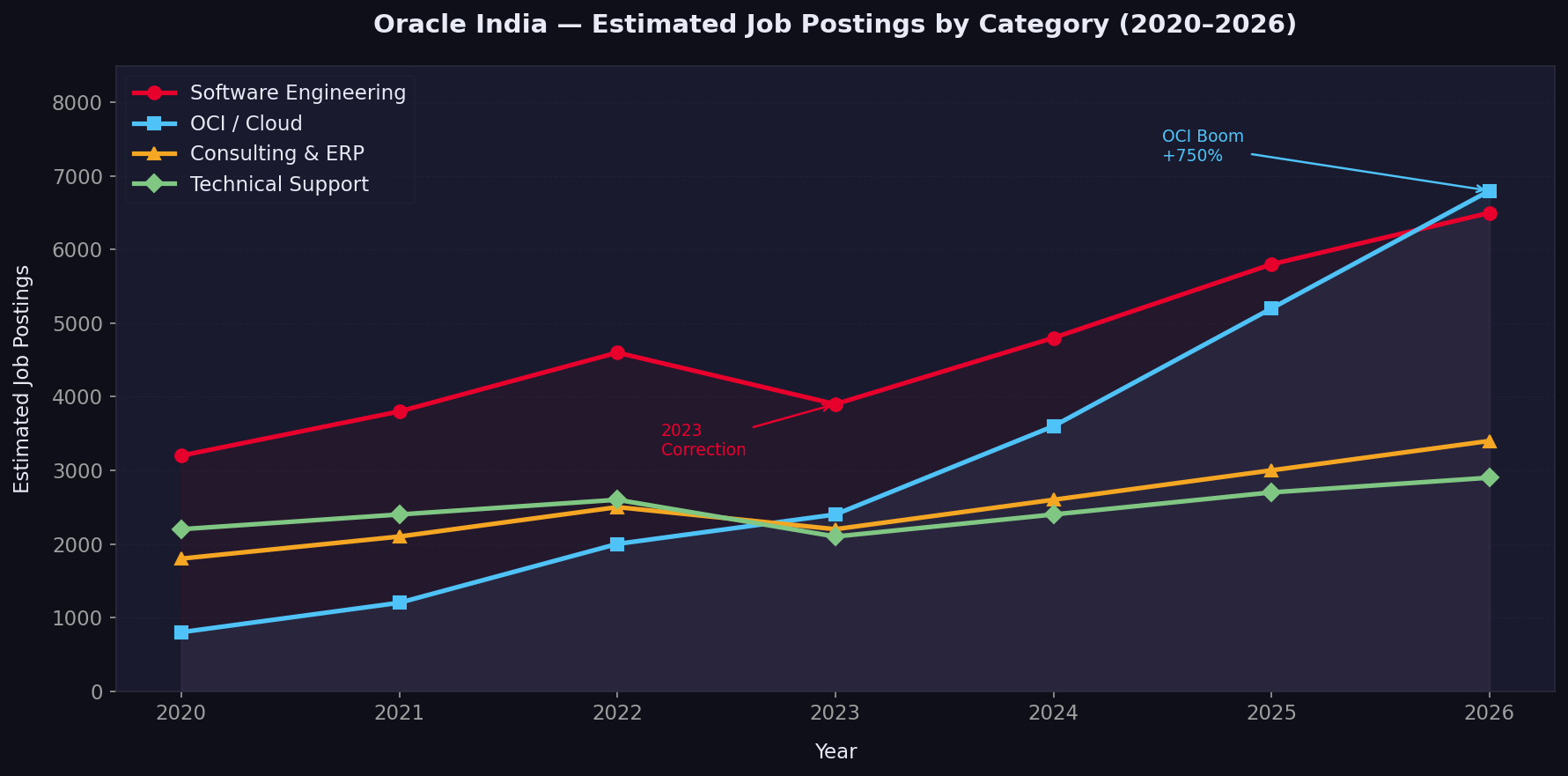
Four trends define Oracle India's hiring trajectory. First, Software Engineering has been the largest category throughout, with a notable correction in 2023 (reflecting Oracle's global hiring freeze following the Cerner acquisition integration) and a strong recovery from 2024 onwards. Second, OCI and Cloud roles have grown the fastest — from approximately 800 postings in 2020 to an estimated 6,800 in 2026, a 750% increase driven by Oracle's aggressive cloud market share push. Third, Consulting and ERP roles have grown steadily as Oracle Fusion Cloud ERP replaces legacy on-premise systems across Indian enterprises. Fourth, Technical Support has remained stable, reflecting Oracle's large installed base of database and ERP customers who require ongoing support.
A notable development in early 2026 was Oracle's announcement of layoffs affecting approximately 10% of its Indian workforce — primarily in back-office, support, and legacy product teams — as the company restructures around OCI and AI.[^5] This means the hiring focus in 2026 is sharply concentrated on OCI engineering, AI/ML, and cloud consulting roles.
3. Location-wise Hiring Distribution
The chart below shows Oracle India's estimated annual job openings by city and category for 2025.
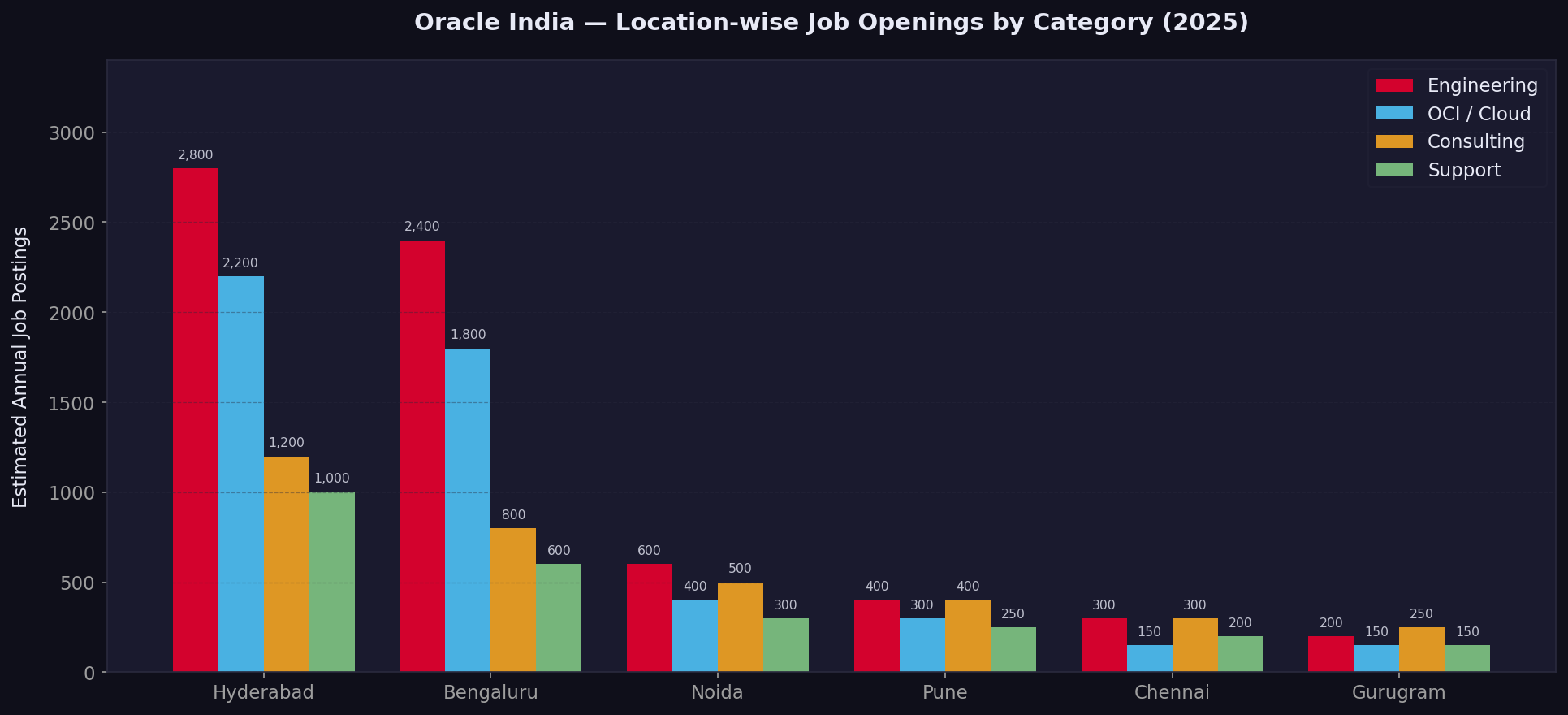
Hyderabad and Bengaluru together account for approximately 72% of all Oracle India job postings. Hyderabad leads in OCI and cloud roles (Oracle's cloud data centres for India are located here), while Bengaluru leads in product engineering. Noida is the primary hub for consulting and ERP roles serving North India clients. Pune, Chennai, and Gurugram handle a mix of support, sales, and regional consulting.
4. Top 10 Most Frequently Posted Roles
The chart below ranks the 10 most frequently posted roles on Oracle India's careers portal, indexed to Software Developer = 100 as the baseline.
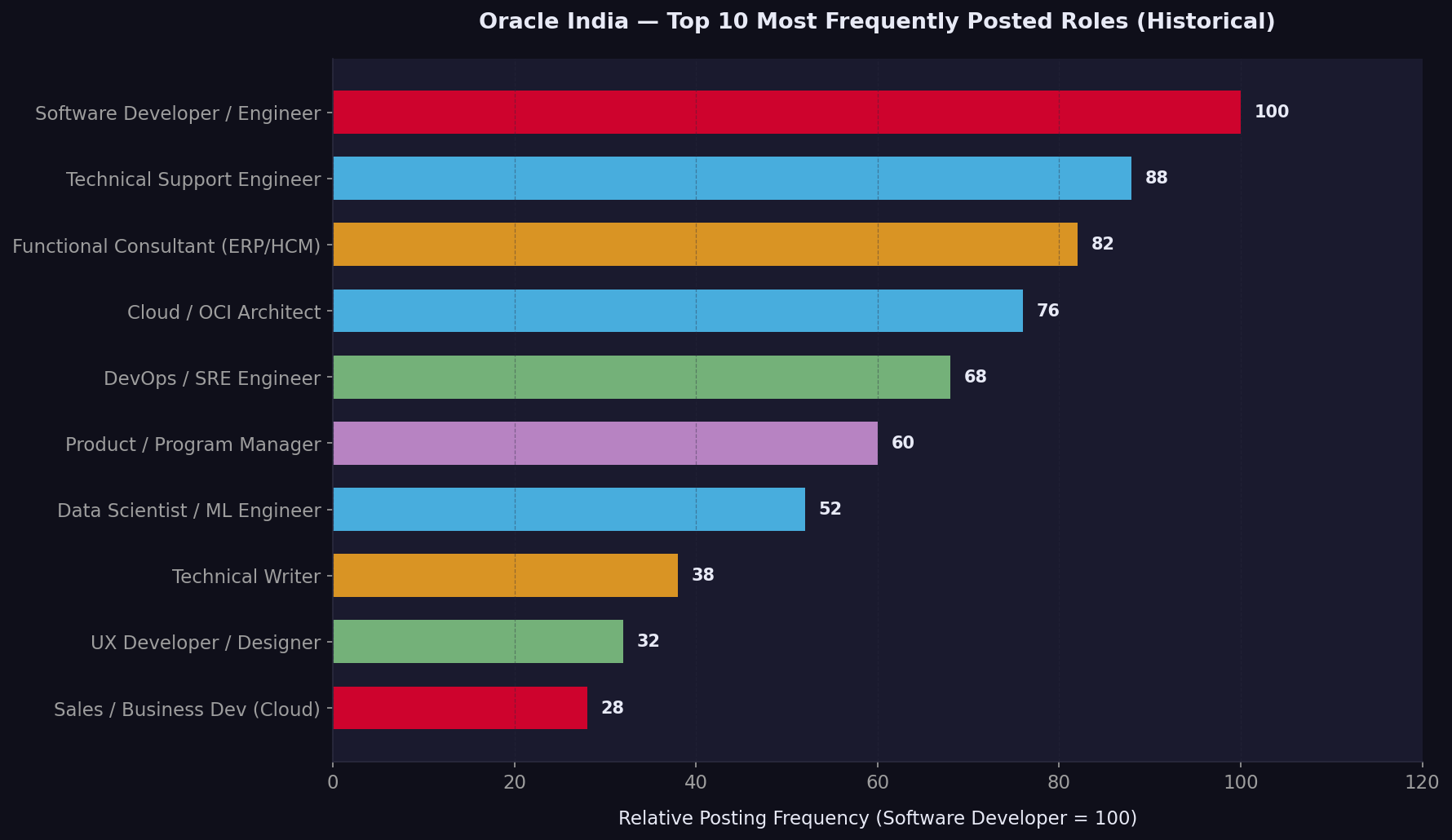
The following sections cover each of these 10 roles in depth — including salary ranges, required qualifications, skills, and career path.
5. Role-by-Role Breakdown
Role 1: Software Developer / Software Engineer — Posting Frequency: 100
Oracle's software engineering roles span the full stack — from core database kernel development to cloud-native microservices, Java platform engineering, and AI/ML platform development. In India, Oracle engineers work on globally deployed products: Oracle Database 23ai, OCI services, Oracle Fusion Applications, and Oracle Health (Cerner). The engineering culture at Oracle is product-focused and long-term — Oracle engineers often work on the same product for 5–10 years, building deep expertise.
| Level |
Total Compensation (India) |
Base |
Stock (RSU/yr) |
| IC-1 (Associate SDE) |
₹22–25 LPA |
₹17–20 LPA |
₹4–6 LPA |
| IC-2 (SDE / MTS) |
₹25–30 LPA |
₹20–24 LPA |
₹5–7 LPA |
| IC-3 (Senior SDE) |
₹36–42 LPA |
₹33–38 LPA |
₹8–11 LPA |
| IC-4 (Principal SDE) |
₹55–65 LPA |
₹44–50 LPA |
₹18–24 LPA |
| IC-5+ (Distinguished) |
₹70–90 LPA |
₹55–65 LPA |
₹22–30 LPA |
Source: Levels.fyi, April 2026. Oracle RSU vesting: 40% / 30% / 20% / 10% over 4 years.[^2]
Qualifications: B.Tech/B.E. in Computer Science, IT, or Electronics. M.Tech preferred for IC-3+. Oracle does not require IIT/NIT credentials — demonstrated coding ability and product thinking matter more.
Skills required: Java (primary language at Oracle), Python, C/C++ (for database kernel), SQL and PL/SQL, data structures and algorithms, distributed systems, and Linux fundamentals.
Courses:
Role 2: Technical Support Engineer — Posting Frequency: 88
Oracle's Technical Support Engineers (TSEs) are the frontline problem-solvers for Oracle's global customer base. In India, TSE roles are concentrated in Hyderabad and Bengaluru, supporting Oracle Database, Oracle ERP, OCI, and Oracle Health customers across APAC, EMEA, and the Americas. The role requires deep technical knowledge of Oracle products combined with strong customer communication skills. Oracle's support organisation is one of the largest in the world, making TSE one of the highest-volume hiring categories.
| Level |
Salary Range (India) |
| TSE (Entry) |
₹6–10 LPA |
| Senior TSE |
₹12–18 LPA |
| Principal TSE |
₹20–28 LPA |
Qualifications: B.Tech/B.E./MCA. Oracle values Oracle Database certifications (OCA, OCP) for TSE roles.
Skills required: Oracle Database (SQL, PL/SQL, RMAN, Data Guard), Linux/Unix administration, networking basics, troubleshooting methodology, and customer communication.
Courses:
Role 3: Functional Consultant (ERP / HCM) — Posting Frequency: 82
Oracle Functional Consultants implement and configure Oracle Fusion Cloud ERP, Oracle HCM, Oracle SCM, and Oracle Financials for enterprise clients. This is one of the highest-demand roles in India's Oracle ecosystem — not just within Oracle itself, but across the hundreds of Oracle partner firms (Deloitte, Accenture, Wipro, TCS, Infosys) that implement Oracle products. Within Oracle, Functional Consultants work in the Oracle Consulting division, engaging directly with clients during implementation projects.
| Level |
Salary Range (India) |
| Associate Consultant |
₹8–14 LPA |
| Consultant |
₹14–22 LPA |
| Senior Consultant |
₹22–35 LPA |
| Principal Consultant |
₹35–55 LPA |
Qualifications: B.Tech, MBA, or MCA. Domain expertise in finance, HR, or supply chain is valued. Oracle Fusion certifications (Oracle Cloud ERP Foundations Associate) are strongly preferred.
Skills required: Oracle Fusion ERP/HCM modules, SQL for data validation, business process knowledge (P2P, O2C, R2R), stakeholder management, and client-facing communication.
Courses:
Role 4: Cloud / OCI Architect — Posting Frequency: 76
OCI Architects design and deploy cloud infrastructure solutions on Oracle Cloud Infrastructure. This is Oracle's fastest-growing role category — OCI is Oracle's primary growth engine, and the company needs architects who can help enterprise customers migrate from on-premise Oracle systems to OCI. The role combines deep technical knowledge of cloud infrastructure with customer-facing consulting skills.
| Level |
Salary Range (India) |
| Cloud Engineer (Associate) |
₹12–20 LPA |
| OCI Solutions Architect |
₹22–40 LPA |
| Principal Cloud Architect |
₹45–70 LPA |
Qualifications: B.Tech/B.E. in CS or IT. OCI certifications are strongly preferred: OCI Foundations Associate, OCI Architect Associate, OCI Architect Professional.
Skills required: OCI services (Compute, Storage, Networking, Database), Kubernetes, Terraform, Docker, DevOps pipelines, and cloud security fundamentals.
Courses:
Role 5: DevOps / SRE Engineer — Posting Frequency: 68
Oracle's DevOps and Site Reliability Engineers maintain the reliability, scalability, and performance of Oracle's cloud services and internal systems. As OCI grows, Oracle needs engineers who can build and operate CI/CD pipelines, automate infrastructure provisioning, and ensure 99.99% uptime for cloud services used by thousands of enterprise customers.
| Level |
Salary Range (India) |
| DevOps Engineer |
₹15–25 LPA |
| Senior DevOps / SRE |
₹28–45 LPA |
| Principal SRE |
₹50–70 LPA |
Qualifications: B.Tech/B.E. in CS or IT. Experience with cloud platforms and container orchestration is essential.
Skills required: Kubernetes, Docker, Terraform, Jenkins, GitHub Actions, Python/Bash scripting, Linux, monitoring tools (Prometheus, Grafana), and OCI DevOps services.
Courses:
Role 6: Product Manager / Program Manager — Posting Frequency: 60
Oracle's Product Managers own the roadmap and strategy for specific Oracle Cloud products and features. Program Managers coordinate large-scale engineering programmes across multiple teams. Both roles require a combination of technical depth and business acumen — Oracle PMs are expected to understand the Oracle Database architecture, OCI infrastructure, and enterprise customer needs simultaneously.
| Level |
Salary Range (India) |
| Associate PM |
₹18–28 LPA |
| Product Manager |
₹30–50 LPA |
| Senior PM / Group PM |
₹55–80 LPA |
Qualifications: B.Tech + MBA preferred. Oracle values PMs with prior engineering experience in database or cloud systems.
Skills required: Product roadmap management, SQL, data analysis, stakeholder communication, agile/scrum, and Oracle product knowledge.
Courses:
Role 7: Data Scientist / ML Engineer — Posting Frequency: 52
Oracle's AI and data science teams build the machine learning capabilities embedded in Oracle's cloud products — from AI-powered ERP anomaly detection to Oracle Analytics Cloud's natural language query interface to Oracle Database 23ai's built-in vector search. This is a growing category, with Oracle investing heavily in AI following the launch of Oracle Database 23ai and Oracle's partnership with NVIDIA for AI infrastructure on OCI.
| Level |
Salary Range (India) |
| Data Scientist (Entry) |
₹14–22 LPA |
| Senior Data Scientist |
₹28–45 LPA |
| Principal ML Engineer |
₹50–75 LPA |
Qualifications: B.Tech/M.Tech in CS, Statistics, or Mathematics. A Master's degree in ML/AI is increasingly preferred for senior roles.
Skills required: Python, TensorFlow/PyTorch, SQL, Oracle Analytics Cloud, statistical modelling, and experience with large language models or vector databases.
Courses:
Role 8: Technical Writer — Posting Frequency: 38
Oracle's Technical Writers produce documentation for Oracle's entire product portfolio — from Oracle Database reference manuals to OCI API documentation to Oracle Fusion ERP user guides. Oracle is one of the largest employers of technical writers in the technology industry, and India is a major hub for this function. The role requires strong writing skills combined with the ability to understand complex technical systems.
| Level |
Salary Range (India) |
| Technical Writer |
₹6–12 LPA |
| Senior Technical Writer |
₹14–22 LPA |
| Principal Technical Writer |
₹25–35 LPA |
Qualifications: B.Tech, B.Sc., or BA in English/Journalism. Strong written English is the primary requirement.
Skills required: Technical writing, XML/DITA authoring tools, understanding of software documentation standards, and basic SQL knowledge for database documentation roles.
Role 9: UX Developer / Designer — Posting Frequency: 32
Oracle's UX team designs the interfaces for Oracle's cloud applications — Oracle Fusion ERP, Oracle HCM, Oracle Analytics Cloud, and OCI Console. Oracle uses the Oracle Redwood Design System, its proprietary design language, across all cloud products. UX roles in India are concentrated in Bengaluru and Hyderabad.
| Level |
Salary Range (India) |
| UX Designer |
₹10–18 LPA |
| Senior UX Designer |
₹20–32 LPA |
| Principal UX Designer |
₹35–55 LPA |
Qualifications: B.Des, B.Tech, or equivalent. Proficiency in Figma and a strong portfolio are essential.
Skills required: Figma, Oracle Redwood Design System, user research, prototyping, accessibility standards (WCAG), and basic HTML/CSS for developer-facing UX roles.
Courses:
Role 10: Sales / Business Development (Cloud) — Posting Frequency: 28
Oracle's Cloud Sales team sells OCI, Oracle Fusion ERP, and Oracle HCM to enterprise customers across India. This is a high-earning role with significant variable compensation — top Oracle Cloud sales representatives in India earn ₹50–1.5 Cr/year in total compensation (base + commission). The role requires deep product knowledge combined with enterprise sales skills.
| Level |
Salary Range (India) |
| Cloud Sales Representative |
₹12–20 LPA base + commission |
| Senior Cloud Sales |
₹20–35 LPA base + commission |
| Cloud Sales Director |
₹40–60 LPA base + commission |
6. Qualifications Required by Role Category
Oracle hires across a wide range of academic backgrounds. The following table summarises the typical educational requirements by role category:
| Role Category |
Preferred Degree |
Certifications That Help |
| Software Engineering |
B.Tech/M.Tech CS/IT |
OCI Developer, Java SE Certified |
| OCI / Cloud |
B.Tech CS/IT |
OCI Foundations, OCI Architect |
| DevOps / SRE |
B.Tech CS/IT |
Kubernetes (CKA), Terraform Associate |
| Technical Support |
B.Tech/MCA |
OCA/OCP (Oracle Certified Associate/Professional) |
| Consulting (ERP/HCM) |
B.Tech/MBA/MCA |
Oracle Fusion Cloud Foundations |
| Data Science / ML |
B.Tech/M.Tech CS/Stats |
TensorFlow Developer, Oracle Analytics |
| Product Management |
B.Tech + MBA |
PMP, Agile/Scrum certifications |
| Technical Writing |
B.Tech/BA English |
DITA certification |
| UX Design |
B.Des/B.Tech |
Google UX Certificate, Figma certification |
7. Skills Required by Role Category
Engineering Roles
The core technical stack for Oracle engineering roles is Java (Oracle's primary language across all product lines), Python (data science and automation), SQL and PL/SQL (database roles), C/C++ (database kernel and performance-critical components), Linux (all server-side development), and distributed systems design (for cloud and database roles). System design proficiency — the ability to design scalable, fault-tolerant distributed systems — is the key differentiator for IC-3+ roles.
OCI / Cloud Roles
Cloud roles require proficiency in OCI core services (Compute, Block Storage, Object Storage, VCN, Load Balancer, Autonomous Database), Kubernetes for container orchestration, Terraform for infrastructure-as-code, Docker for containerisation, networking fundamentals (TCP/IP, DNS, VPN, firewalls), and DevOps pipeline tools (Jenkins, GitHub Actions, Oracle DevOps).
Support Roles
Technical Support Engineers need deep knowledge of Oracle Database (SQL, PL/SQL, RMAN backup/recovery, Data Guard, RAC), Linux/Unix system administration, networking troubleshooting, Oracle Enterprise Manager (OEM), and strong customer communication skills. The ability to read and interpret Oracle trace files and alert logs is a specific skill that Oracle values highly in TSE candidates.
Consulting Roles
Functional Consultants need expertise in specific Oracle Fusion Cloud modules (Financials, HCM, SCM, or Projects), SQL for data validation and reporting, business process knowledge (Procure-to-Pay, Order-to-Cash, Record-to-Report), Oracle OTBI and BI Publisher for reporting, and stakeholder management skills for client-facing project delivery.
8. How to Crack a Job at Oracle
Resume Preparation
An Oracle-targeted resume must be ATS-optimised and product-focused. Oracle's ATS scans for specific keywords: Java, Python, SQL, PL/SQL, OCI, Kubernetes, Oracle Database, Oracle Fusion, Terraform, and Linux. Beyond keywords, Oracle values quantified achievements — not "developed backend APIs" but "designed and deployed 8 RESTful APIs in Java/Spring Boot serving 2M+ daily requests with 99.9% uptime." Use the ATS Analyser at aijobsearch.in/ats-analyser to check your resume against Oracle job descriptions before applying.
Key resume elements for Oracle roles:
- Oracle or OCI certifications (even entry-level ones signal commitment)
- Open-source contributions or personal projects using Java/Python
- Database project experience (even academic projects using Oracle XE or MySQL)
- Cloud project experience (OCI Free Tier has $300 in free credits for building portfolio projects)
Oracle's Interview Process
Oracle's hiring process typically follows this sequence:
1. Recruiter Screening (30 minutes): A phone call with an Oracle recruiter to verify basic qualifications, salary expectations, and availability. Be prepared to discuss your resume in detail and articulate why you want to work at Oracle specifically.
2. Technical Round 1 — Coding (60–90 minutes): A live coding session on HackerRank or a shared IDE. For engineering roles, expect 2–3 LeetCode medium-level problems focused on arrays, strings, trees, and graphs. For support and consulting roles, expect SQL queries and scenario-based troubleshooting questions.
3. Technical Round 2 — System Design / Product Knowledge (60 minutes): For IC-3+ engineering roles, a system design interview (design a distributed cache, design Oracle's Autonomous Database auto-scaling system). For consulting roles, a functional scenario (walk through an Oracle ERP implementation for a manufacturing company). For support roles, a troubleshooting scenario (diagnose an Oracle Database performance issue from a given AWR report).
4. Managerial Round (45 minutes): Behavioural questions using the STAR format. Oracle values engineers who can work independently, communicate clearly, and own problems end-to-end. Common questions: "Tell me about a time you debugged a production issue under pressure," "Describe a project where you had to learn a new technology quickly."
5. HR Discussion (30 minutes): Salary negotiation, joining timeline, and cultural fit. Oracle's compensation is negotiable — always counter-offer, as Oracle typically has 15–20% flexibility above the initial offer.
9. 6-Month Roadmap to Crack Oracle India
The following month-wise plan is designed for both freshers (targeting IC-1/IC-2 roles) and experienced professionals (targeting IC-3/IC-4 roles). Adjust the depth of each topic based on your current skill level.
| Month |
Focus Area |
Weekly Hours |
Key Milestones |
| Month 1 |
Java fundamentals + SQL |
15 hrs/week |
Complete Java Masterclass (Udemy); solve 50 LeetCode Easy problems; set up Oracle XE locally |
| Month 2 |
Data Structures & Algorithms |
15 hrs/week |
Complete DSA course; solve 100 LeetCode problems (Easy + Medium); focus on arrays, trees, graphs |
| Month 3 |
Oracle Database + OCI Basics |
12 hrs/week |
Complete Oracle DBA course; earn OCI Foundations Associate certification (free exam voucher available); build one OCI project |
| Month 4 |
System Design (IC-3+) or Oracle Fusion (Consulting) |
12 hrs/week |
Read "Designing Data-Intensive Applications"; complete 20 system design mock interviews; or complete Oracle Fusion ERP course |
| Month 5 |
Resume + Applications + Mock Interviews |
10 hrs/week |
Optimise resume with ATS Analyser; apply to 20 Oracle India roles; complete 10 mock technical interviews |
| Month 6 |
Interview Preparation + Negotiation |
10 hrs/week |
Prepare 15 STAR stories; research Oracle's latest OCI announcements; practice salary negotiation |
Key resources for the 6-month journey:
Conclusion
Oracle India in 2026 is a company in transition — moving aggressively from its legacy database and on-premise ERP business toward OCI and AI-powered cloud applications. For job seekers, this transition creates a clear opportunity: the candidates who invest in OCI certifications, Java proficiency, and Oracle Fusion knowledge today are positioning themselves for roles that will be in high demand for the next decade.
The key insight from Oracle's hiring data is that Technical Support and Consulting roles are far more accessible entry points than Engineering roles — and they pay well (₹8–35 LPA), offer Oracle product expertise that is highly valued across the industry, and provide a clear path to senior consulting and architecture roles. For freshers without strong competitive programming backgrounds, these roles are worth serious consideration.
For engineering roles, the combination of Java proficiency, Oracle Database knowledge, and OCI certification creates a profile that very few candidates in India have — and that Oracle actively seeks. The 6-month roadmap above is a realistic path to building that profile from scratch.
References
[^1]: Oracle Corporation Annual Report 2025, oracle.com/investor
[^2]: Levels.fyi Oracle India Salary Data, April 2026 — levels.fyi/companies/oracle/salaries/software-engineer/locations/india
[^3]: AmbitionBox Oracle India Salaries, 2026 — ambitionbox.com/salaries/oracle-salaries
[^4]: Oracle OCI vs AWS Performance Benchmarks, Oracle.com, 2025
[^5]: Economic Times, "Oracle Layoffs 2026: 12,000 employees affected globally," April 2026