Microsoft India Jobs 2026: Top 10 Roles, Skills, Salaries & How to Get Hired
Category: Company Hiring Guides | Reading time: 14 min | Published: April 2026
Microsoft India is one of the most sought-after employers in the country — and for good reason. With its largest R&D campus outside the United States located in Hyderabad, and a rapidly growing engineering hub in Bengaluru, Microsoft India employs over 20,000 professionals and posts thousands of new roles every year.[^1] For Indian engineers, data scientists, and product managers, a Microsoft offer represents not just a premium salary but access to world-class engineering culture, global product impact, and a career trajectory that few other employers can match.
This guide is built on historical hiring data from Microsoft's careers portal, LinkedIn, Glassdoor, and AmbitionBox. It covers the top 10 most frequently posted roles at Microsoft India, the exact skills and qualifications required for each, salary benchmarks, and — critically — the specific courses and certifications that will help you build those skills and pass Microsoft's rigorous interview process.
Microsoft India: The Hiring Landscape
Microsoft India operates across four primary locations, each with a distinct hiring focus:
| Location |
Primary Focus |
Relative Hiring Volume |
| Hyderabad (GTSC Campus) |
Engineering, R&D, Cloud, AI |
Highest (~46% of India postings) |
| Bengaluru |
Cloud Sales, Engineering, AI |
High (~35%) |
| Noida / Gurgaon |
Sales, Customer Success, Enterprise |
Medium (~11%) |
| Mumbai |
BFSI Sales, Enterprise Accounts |
Lower (~8%) |
Hyderabad hosts Microsoft's Global Technology and Sales Center (GTSC) — the largest Microsoft campus outside Redmond — making it the primary destination for engineering and research roles. Bengaluru has grown significantly in recent years, particularly for cloud architecture and AI roles tied to Microsoft's Azure and Copilot product lines.
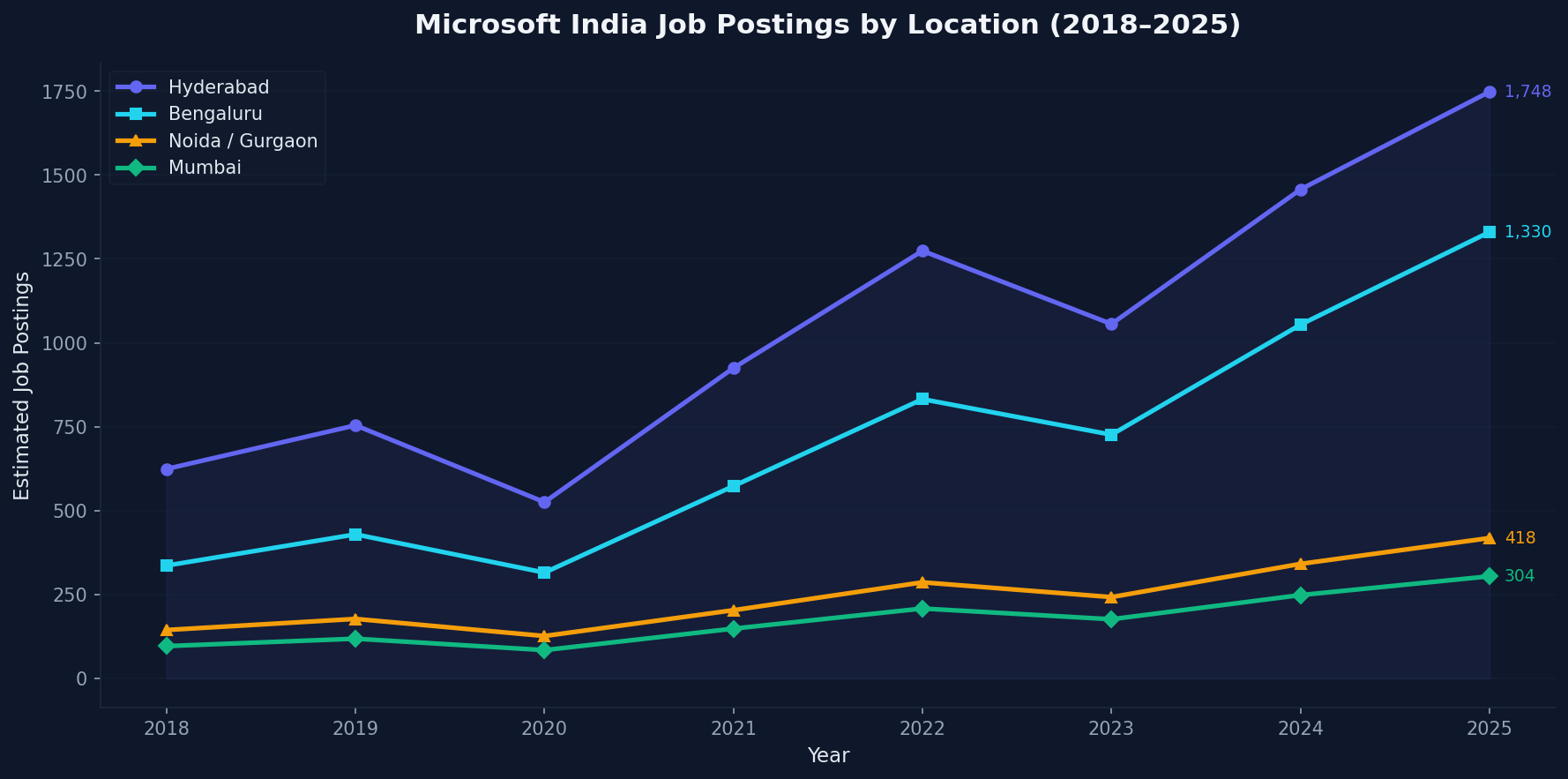 Figure 1: Estimated Microsoft India job postings by city, 2018–2025. The dip in 2020 reflects COVID-19 hiring freezes; the 2023 dip reflects the global tech industry correction. Both Hyderabad and Bengaluru have resumed strong growth through 2025.
The overall trend is clear: Microsoft India's hiring has more than tripled over the seven-year period from 2018 to 2025, with the steepest growth in Bengaluru driven by Azure cloud adoption across Indian enterprises.
The Top 10 Most Frequently Posted Roles at Microsoft India
The chart below shows the relative posting frequency of the top 10 roles, indexed to Software Engineer (SDE) as the baseline.
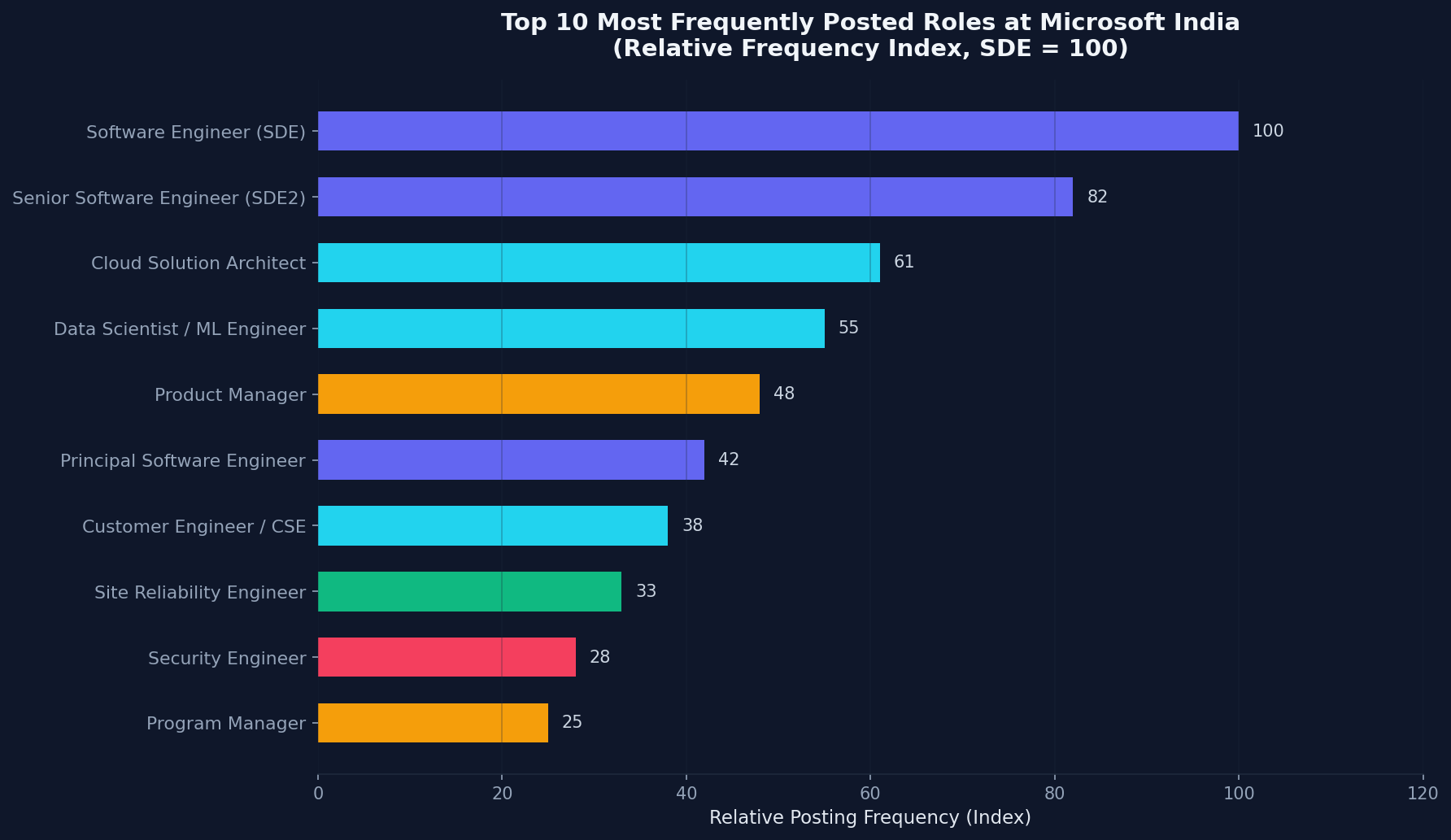 Figure 2: Relative posting frequency of the top 10 roles at Microsoft India. SDE is set to 100 as the baseline. Data aggregated from LinkedIn, Glassdoor, and Microsoft Careers portal (2022–2025).
Role 1: Software Engineer (SDE / SDE1)
Posting frequency: Highest — consistently the most common role across all Microsoft India locations.
What the role involves: SDEs at Microsoft build, test, and maintain software systems across Microsoft's product portfolio — Windows, Azure, Microsoft 365, Xbox, Bing, and increasingly Copilot. In India, SDE roles are concentrated in Hyderabad and Bengaluru, working on both product development and platform engineering.
Required qualifications:
- Bachelor's or Master's degree in Computer Science, Engineering, or a related field
- Strong proficiency in at least one of: C++, C#, Java, Python, or TypeScript
- Data structures and algorithms (DSA) — this is the primary filter in Microsoft's coding interviews
- Understanding of object-oriented design and system design principles
Microsoft's interview process for SDE:
Microsoft conducts 4–5 rounds for SDE roles: an online assessment (coding), followed by technical interviews covering DSA, system design, and behavioural questions using the STAR method. Microsoft places significant weight on the "growth mindset" cultural fit — be prepared to discuss how you learn from failure.
Salary range (India, 2026):[^2]
- SDE1 (fresher / 0–2 years): ₹30–36 LPA
- SDE2 (2–5 years): ₹44–50 LPA
- Senior SDE (5–8 years): ₹65–90 LPA
Courses to build these skills:
Role 2: Senior Software Engineer (SDE2)
Posting frequency: Second highest — Microsoft India has a large population of SDE2s who lead feature development and mentor junior engineers.
What the role involves: SDE2s own end-to-end feature development, lead design reviews, and are expected to operate with significant autonomy. This is the level at which Microsoft expects engineers to start influencing product direction.
Required qualifications:
- 3–7 years of software engineering experience
- Deep expertise in distributed systems, cloud-native development, or a specific product domain
- Experience leading technical design discussions and code reviews
- Strong system design skills — this is the primary differentiator between SDE1 and SDE2 interviews
Salary range (India, 2026):[^2]
- SDE2: ₹44–50 LPA base + stock (RSUs) + bonus
- Total compensation (TC) typically ₹60–80 LPA for mid-level SDE2
Courses to build these skills:
Role 3: Cloud Solution Architect (CSA)
Posting frequency: Third highest and growing fastest year-over-year — Azure's rapid adoption across Indian enterprises has created enormous demand for CSAs.
What the role involves: Cloud Solution Architects work directly with enterprise customers to design and implement Azure cloud solutions. This is a customer-facing technical role that combines deep Azure expertise with the ability to communicate complex architectures to business stakeholders. CSAs in India are primarily based in Bengaluru and Hyderabad.
Required qualifications:
- 5+ years of experience in cloud infrastructure, solution architecture, or enterprise IT
- Azure certifications (AZ-900, AZ-104, AZ-305 are the most relevant)
- Experience with at least one cloud workload: data & analytics, AI/ML, security, or application modernisation
- Strong presentation and stakeholder communication skills
Salary range (India, 2026):[^3]
- Mid-level CSA: ₹35–55 LPA
- Senior CSA: ₹60–90 LPA
- Principal CSA: ₹90–130 LPA
Courses and certifications:
Role 4: Data Scientist / Machine Learning Engineer
Posting frequency: Fourth highest and accelerating — Microsoft's AI-first strategy under Satya Nadella has made data science and ML engineering central to nearly every product team.
What the role involves: Data Scientists at Microsoft India work on everything from building recommendation systems for Microsoft 365 to training large language models for Copilot. ML Engineers focus on productionising models — building the pipelines, infrastructure, and monitoring systems that take models from research to production.
Required qualifications:
- Master's or PhD in Computer Science, Statistics, Mathematics, or a related quantitative field (preferred for research-adjacent roles)
- Proficiency in Python, with strong experience in ML frameworks (PyTorch, TensorFlow, scikit-learn)
- Experience with Azure ML, Azure Databricks, or similar cloud ML platforms
- Strong statistical foundations: probability, hypothesis testing, regression, and model evaluation
Salary range (India, 2026):[^3]
- Data Scientist (3–5 years): ₹28–45 LPA
- Senior Data Scientist (5–8 years): ₹50–75 LPA
- Principal Data Scientist: ₹80–120 LPA
Courses to build these skills:
Role 5: Product Manager (PM)
Posting frequency: Fifth highest — Microsoft India's PM roles are highly competitive and among the most coveted positions in the Indian tech industry.
What the role involves: PMs at Microsoft own the vision, roadmap, and success metrics for specific product features or entire product areas. In India, PM roles are concentrated in Hyderabad (for Microsoft 365, Azure, and Windows product teams) and increasingly in Bengaluru (for AI and cloud products). Microsoft's PM culture is deeply data-driven — PMs are expected to write detailed specifications, run A/B tests, and make decisions backed by user research and metrics.
Required qualifications:
- Bachelor's degree in Engineering, Computer Science, or Business (MBA preferred for senior roles)
- 3–7 years of product management experience, ideally in enterprise software or cloud products
- Strong analytical skills — SQL proficiency is often tested in PM interviews
- Experience with agile development and cross-functional team leadership
Salary range (India, 2026):[^2]
- PM2 (3–5 years): ₹40–60 LPA
- Senior PM (5–8 years): ₹65–95 LPA
- Principal PM: ₹100–150 LPA
Courses to build these skills:
Role 6: Principal Software Engineer
Posting frequency: Sixth — Principal Engineers are senior individual contributors who set technical direction for entire product areas.
What the role involves: Principal Engineers (L65–L67 at Microsoft) are expected to have deep expertise in a technical domain and to influence engineering decisions across multiple teams. They write architecture documents, mentor senior engineers, and represent Microsoft's technical perspective in customer and partner conversations.
Required qualifications:
- 10+ years of software engineering experience
- Demonstrated technical leadership — patents, publications, open-source contributions, or significant product impact
- Deep expertise in a specific domain: distributed systems, compilers, security, ML infrastructure, or similar
Salary range (India, 2026):[^4]
- Principal SDE (L65): ₹90–130 LPA
- Senior Principal (L66–L67): ₹130–200+ LPA
Role 7: Customer Engineer / Cloud Solution Engineer (CSE)
Posting frequency: Seventh — CSEs are the technical face of Microsoft for enterprise customers, providing hands-on implementation support for Azure and Microsoft 365.
What the role involves: Customer Engineers work on-site or remotely with enterprise customers to implement, troubleshoot, and optimise Microsoft solutions. Unlike CSAs (who focus on design), CSEs focus on implementation and support. This role requires both technical depth and strong customer communication skills.
Required qualifications:
- 3–7 years of experience in technical support, consulting, or implementation roles
- Azure certifications (AZ-104, AZ-900 minimum; AZ-305 preferred)
- Experience with Microsoft Purview, Microsoft Defender, or Microsoft 365 security products is increasingly valued
- Strong troubleshooting and root-cause analysis skills
Salary range (India, 2026):[^2]
- Customer Engineer: ₹18–30 LPA
- Senior Customer Engineer: ₹30–50 LPA
Role 8: Site Reliability Engineer (SRE)
Posting frequency: Eighth — SREs have become critical as Microsoft's Azure infrastructure scales to serve billions of users globally.
What the role involves: SREs at Microsoft India are responsible for the reliability, availability, and performance of Azure services. They build automation tools, define SLOs/SLAs, conduct incident response, and work with engineering teams to eliminate toil. This role sits at the intersection of software engineering and operations.
Required qualifications:
- 3–7 years of experience in DevOps, infrastructure engineering, or software engineering
- Proficiency in Python, Go, or PowerShell for automation
- Experience with Kubernetes, Docker, Terraform, and Azure DevOps
- Strong understanding of distributed systems reliability concepts (SLOs, error budgets, chaos engineering)
Salary range (India, 2026):[^3]
- SRE: ₹25–40 LPA
- Senior SRE: ₹40–65 LPA
Courses to build these skills:
Role 9: Security Engineer
Posting frequency: Ninth — Microsoft's Secure Future Initiative, announced in 2023, has significantly increased security engineering hiring across all India locations.[^5]
What the role involves: Security Engineers at Microsoft India work on Microsoft's security products (Defender, Sentinel, Purview, Entra) and on securing Microsoft's own infrastructure. This includes threat modelling, vulnerability research, penetration testing, and building security automation tools.
Required qualifications:
- 3–8 years of experience in cybersecurity, security engineering, or related fields
- Certifications: SC-900 (Security Fundamentals), SC-200 (Security Operations Analyst), or AZ-500 (Azure Security Engineer)
- Experience with SIEM tools, threat intelligence, and incident response
- Knowledge of compliance frameworks (ISO 27001, SOC 2, GDPR)
Salary range (India, 2026):[^3]
- Security Engineer: ₹22–38 LPA
- Senior Security Engineer: ₹38–65 LPA
Courses to build these skills:
Role 10: Program Manager (PgM)
Posting frequency: Tenth — Program Managers at Microsoft coordinate complex, multi-team engineering programmes and are distinct from Product Managers (who own product vision).
What the role involves: Program Managers at Microsoft India manage the execution of large-scale engineering projects — coordinating timelines, dependencies, and communication across multiple engineering teams. This role requires strong organisational skills, technical literacy (enough to understand engineering constraints), and stakeholder management.
Required qualifications:
- 5–10 years of experience in programme management, project management, or engineering management
- PMP certification or equivalent is valued
- Experience with agile methodologies and large-scale software delivery
- Strong communication and executive stakeholder management skills
Salary range (India, 2026):[^2]
- Program Manager: ₹25–45 LPA
- Senior Program Manager: ₹45–75 LPA
Role Category Mix: How Microsoft India's Hiring Has Shifted
The composition of Microsoft India's hiring has changed significantly over the past five years, reflecting the company's strategic pivot to cloud and AI.
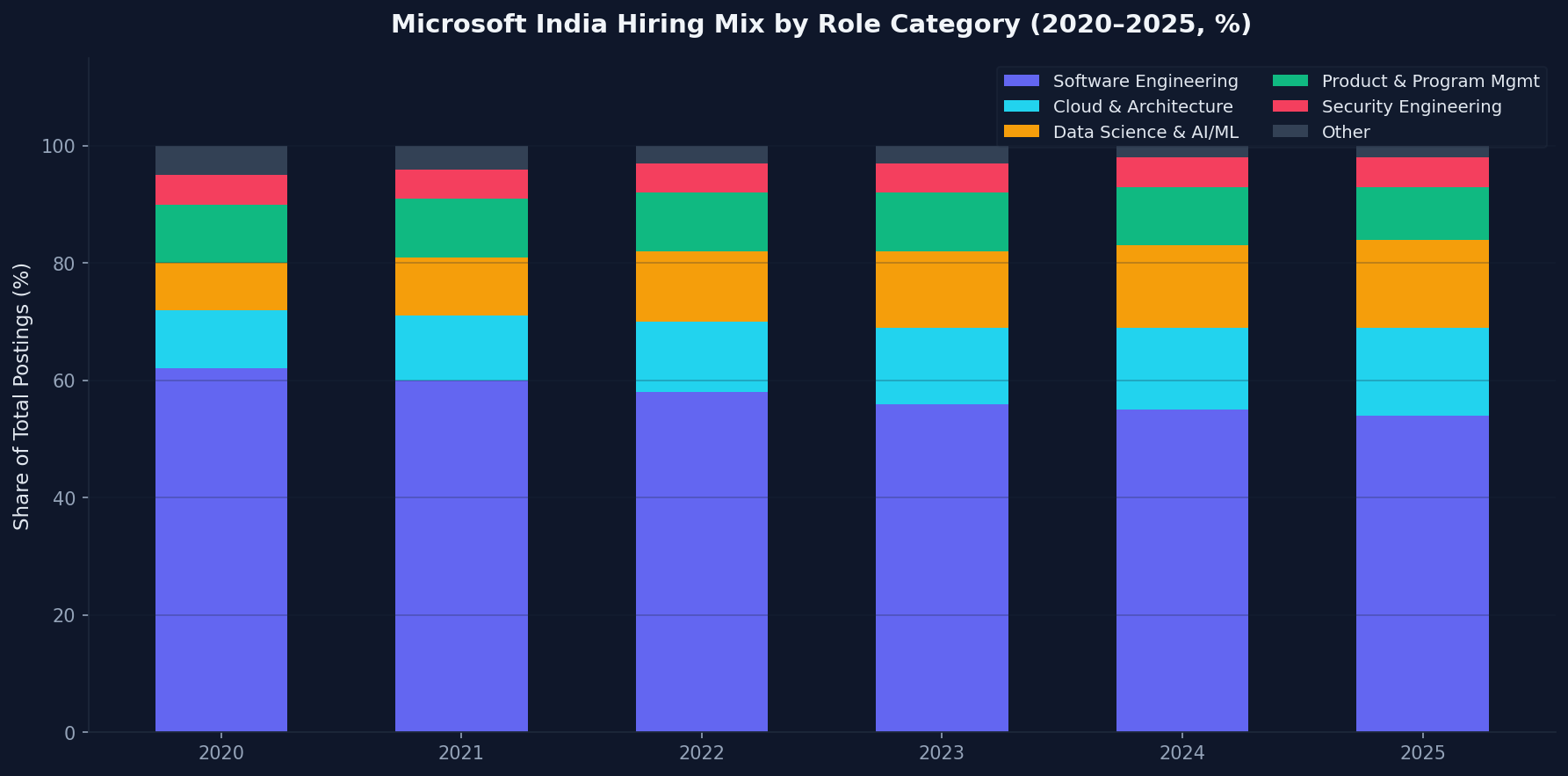 Figure 3: Estimated share of Microsoft India job postings by role category, 2020–2025. Software engineering remains dominant but has declined as a share of total hiring, while Cloud & Architecture and Data Science/AI have grown significantly.
The most significant trend is the growth of Cloud & Architecture (from ~10% to ~15% of postings) and Data Science & AI/ML (from ~8% to ~15%) at the expense of pure software engineering. This reflects Microsoft's Azure-first strategy and the integration of AI capabilities across all products.
How to Crack a Microsoft Interview: The Complete Process
Microsoft's interview process is rigorous but predictable. Understanding the structure gives you a significant advantage.
Stage 1: Online Assessment (OA)
For most SDE roles, the process begins with a 90-minute online assessment on HackerRank or Codility. The OA typically contains 2–3 coding problems of medium to hard difficulty. The problems test:
- Array and string manipulation
- Dynamic programming
- Graph traversal (BFS/DFS)
- Binary search and two-pointer techniques
Preparation: Solve 150–200 LeetCode problems, focusing on Microsoft-tagged questions. The LeetCode Microsoft problem set is the most direct preparation resource available.
Stage 2: Technical Screening (Phone/Video)
A 45–60 minute call with a Microsoft engineer. Expect one coding problem (medium difficulty) and questions about your past projects. The interviewer will probe the depth of your technical decisions — not just what you built, but why you made specific architectural choices.
Stage 3: On-Site / Virtual Loop (4–5 Rounds)
The loop consists of:
- 2–3 coding rounds: DSA problems, similar to LeetCode medium/hard
- 1 system design round: Design a distributed system (e.g., URL shortener, notification service, rate limiter). For SDE2+, this round is the primary differentiator.
- 1 behavioural round: Microsoft uses the STAR method and specifically tests for "growth mindset" — the ability to learn from failure, seek feedback, and adapt.
Stage 4: As-Appropriate (AA) Review
Microsoft's hiring process includes an "As-Appropriate" review where a senior leader evaluates the candidate. This is not an additional interview — it is a review of the interview feedback to ensure consistency and fairness.
Microsoft's Most Valued Certifications for India Roles
| Certification |
Relevant Roles |
Difficulty |
Cost |
| AZ-900: Azure Fundamentals |
All technical roles |
Beginner |
₹3,500 |
| AZ-104: Azure Administrator |
SRE, CSE, Cloud Arch |
Intermediate |
₹4,200 |
| AZ-305: Azure Solutions Architect |
Cloud Solution Architect |
Advanced |
₹4,200 |
| DP-203: Azure Data Engineer |
Data Scientist, Data Engineer |
Intermediate |
₹4,200 |
| SC-200: Security Operations Analyst |
Security Engineer |
Intermediate |
₹4,200 |
| AZ-204: Azure Developer Associate |
SDE, SRE |
Intermediate |
₹4,200 |
| AI-102: Azure AI Engineer |
ML Engineer, AI roles |
Intermediate |
₹4,200 |
Microsoft certifications are available through Microsoft Learn and can be taken at Pearson VUE test centres across India.
Apply Directly at Microsoft India
Microsoft India hires through three channels:
1. Microsoft Careers Portal (Primary): All open roles are listed at careers.microsoft.com/v2/global/en/locations/hyderabad.html for Hyderabad and careers.microsoft.com/v2/global/en/locations/bengaluru.html for Bengaluru. Set up job alerts for your target roles — Microsoft posts new roles every week.
2. LinkedIn: Microsoft India's LinkedIn page at linkedin.com/company/microsoft lists all open roles and allows you to apply with your LinkedIn profile. Recruiters also actively search LinkedIn for candidates — ensure your profile is optimised for your target role.
3. Employee Referrals: Microsoft's employee referral programme is one of the most effective paths into the company. A referral does not guarantee an interview, but it ensures your resume is reviewed by a human recruiter rather than filtered by ATS. If you know anyone at Microsoft India, a referral is worth pursuing.
4. Campus Recruitment: For freshers, Microsoft recruits from IITs, NITs, BITS Pilani, and select other engineering colleges through on-campus placement drives. The Explore Microsoft internship programme is specifically designed for first- and second-year students.
References
[^1]: "Jobs in India — Microsoft Careers." Microsoft Careers, 2026.
[^2]: "Microsoft Corporation Salaries in India (Updated 2026)." AmbitionBox, 2026.
[^3]: "Microsoft Salaries 2026 in India, Average salary ₹53 lakhs." 6figr, April 2026.
[^4]: "Microsoft 62 Software Engineer Salary in India." Levels.fyi, 2026.
[^5]: "Jobs in Hyderabad — Microsoft Careers." Microsoft Careers, 2026.