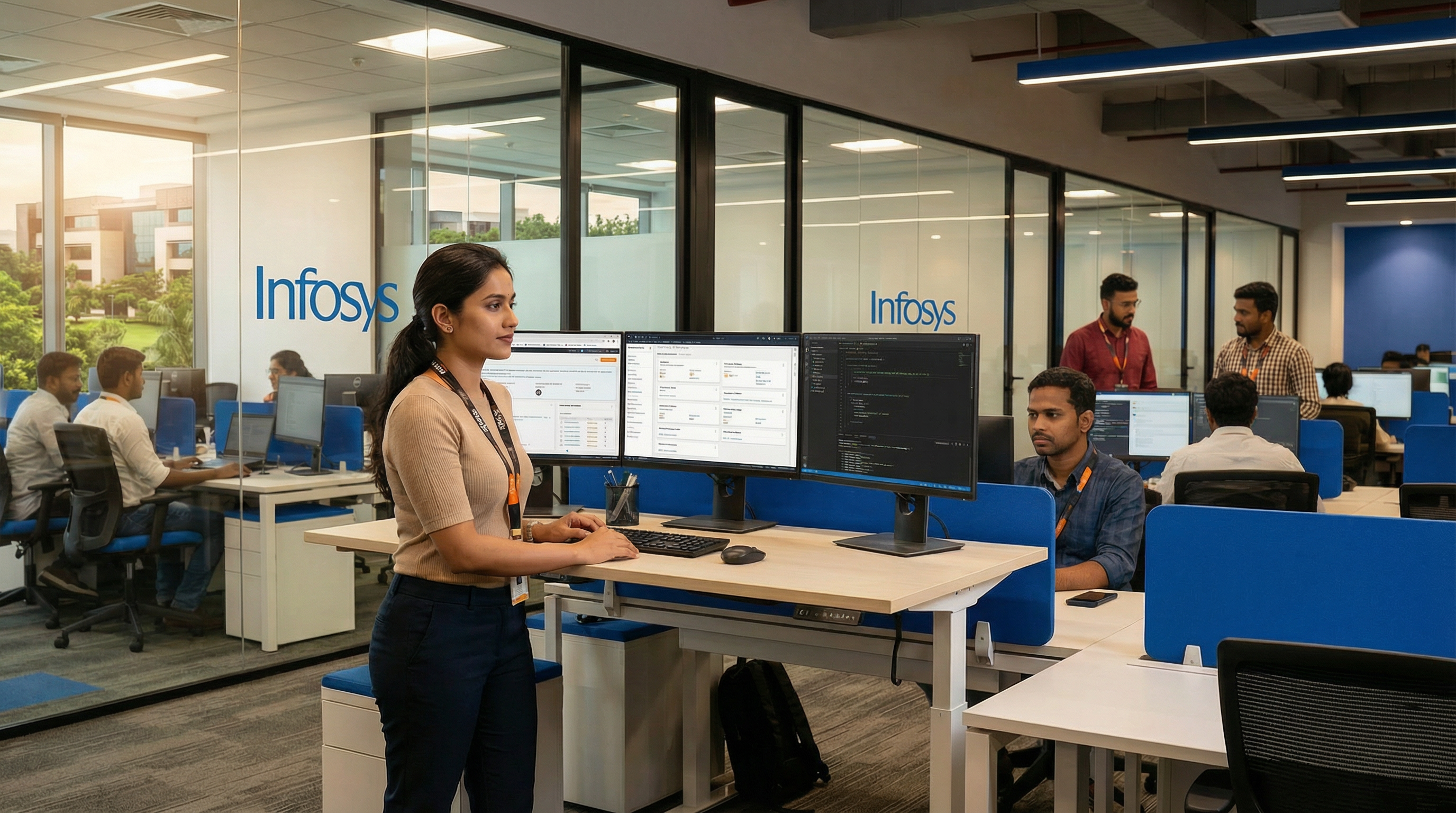
Infosys is the company that taught India what a software career could look like. Founded in 1981 by Narayana Murthy and six co-founders with ₹10,000 in seed capital, Infosys grew into a $19 billion global technology giant that employs over 300,000 people and serves clients in 56 countries. For Indian engineering graduates, Infosys has been — and remains — one of the most important first employers in the country. Understanding how to get in, what to expect, and how to grow there is essential knowledge for anyone entering the Indian IT job market in 2026.
This guide covers everything: the top roles Infosys is hiring for, salary structures across all levels, the InfyTQ and Instep hiring processes in detail, what the interview actually looks like, and a preparation roadmap that has helped thousands of candidates clear the Infosys selection process.
Infosys at a Glance: 2026
| Metric | Figure |
|---|
| Total Employees | 300,000+ |
| Fresher Hiring (FY2025–26) | 15,000–20,000 (projected) |
| Revenue (FY2025) | $19.1 billion |
| Presence | 56 countries, 250+ delivery centres |
| India Offices | Bengaluru, Pune, Hyderabad, Chennai, Mysuru, Chandigarh, Bhubaneswar, Mangaluru |
| Key Verticals | BFSI, Retail, Manufacturing, Energy, Communications, Hi-Tech |
| Training Centre | Infosys Global Education Centre (GEC), Mysuru — world's largest corporate training campus |
Infosys is often compared directly to TCS, and the comparison is fair — both are large Indian IT services companies that hire in volume, train freshers extensively, and serve global enterprise clients. The key differences are in scale (TCS is roughly twice the size), training culture (Infosys's Mysuru campus is legendary), and recent strategic direction (Infosys has been more aggressive in acquiring digital capabilities and AI-focused companies).
Top 10 Roles Infosys Is Hiring For in 2026
1. Systems Engineer (SE) — Fresher Role
The entry-level role for engineering graduates. New Systems Engineers join the Infosys Global Education Centre in Mysuru for a 4–5 month residential training programme — one of the most comprehensive fresher training programmes in the Indian IT industry. After training, you are deployed to a project based on your performance and business demand.
Salary: ₹3.6 LPA (base) | Eligibility: BE/BTech/MCA/MSc with 60% throughout (no active backlogs at time of joining)
2. Senior Systems Engineer (SSE)
The next level after SE, typically reached after 2–3 years. Senior Systems Engineers lead modules, mentor junior team members, and take on more complex technical responsibilities. Many freshers who join via the Digital Specialist Engineer track are placed at SSE level.
Salary: ₹5–8 LPA | Experience: 2–4 years
3. Technology Analyst
Mid-level technical role for professionals with 4–6 years of experience. Technology Analysts are expected to work independently, design solutions, and interact with clients on technical matters.
Salary: ₹8–14 LPA | Experience: 4–7 years
4. Technical Lead
Senior technical role requiring deep expertise in a specific technology stack. Technical Leads architect solutions, review code, and mentor a team of 5–10 engineers. This is a critical role in Infosys's delivery model.
Salary: ₹14–22 LPA | Experience: 7–10 years
5. Data Engineer / Big Data Engineer
One of the highest-demand roles at Infosys in 2026. Data Engineers build data pipelines, work with cloud data platforms, and support analytics initiatives for clients across BFSI, retail, and manufacturing. Infosys's data practice has grown significantly with the rise of enterprise AI projects.
Salary: ₹7–20 LPA | Skills: Python, SQL, Spark, Hadoop, Azure Synapse, AWS Glue, Databricks
6. Cloud Engineer / DevOps Engineer
Infosys has invested heavily in cloud capabilities, including its Infosys Cobalt cloud services platform. Cloud and DevOps Engineers are among the most in-demand profiles, working on AWS, Azure, and GCP migrations and implementations.
Salary: ₹8–22 LPA | Certifications valued: AWS Solutions Architect, Azure Administrator, GCP Professional, Kubernetes (CKA)
7. Full Stack Developer
Infosys's digital transformation projects require engineers who can build end-to-end applications. The most valued stack in 2026 is React or Angular (frontend) + Java Spring Boot or Node.js (backend) + cloud deployment on AWS or Azure.
Salary: ₹6–18 LPA | Skills: React, Angular, Java, Node.js, REST APIs, Docker, Kubernetes, CI/CD
8. AI/ML Engineer
Infosys's AI practice, branded as Infosys Topaz, has become a major growth driver. The company is actively hiring ML Engineers, NLP specialists, and AI solution architects to build and deploy AI solutions for enterprise clients.
Salary: ₹12–35 LPA | Skills: Python, TensorFlow/PyTorch, LLMs, RAG architectures, MLOps, cloud AI services (AWS SageMaker, Azure ML)
9. Salesforce Consultant / Developer
Infosys is one of the largest Salesforce implementation partners globally. Salesforce Developers and Consultants work on CRM implementations for clients across industries. Salesforce certifications significantly increase your hiring chances and salary.
Salary: ₹7–25 LPA | Certifications valued: Salesforce Administrator, Salesforce Developer, Salesforce Architect
10. Cybersecurity Analyst / Consultant
As enterprise clients face increasing regulatory and threat pressures, Infosys's cybersecurity practice has expanded. Analysts work on threat detection, compliance frameworks (ISO 27001, SOC 2), and security architecture.
Salary: ₹8–22 LPA | Certifications valued: CISSP, CEH, CompTIA Security+, CISM
Infosys Salary Structure: Complete Breakdown for 2026
| Role / Level | Years of Experience | CTC (LPA) | Take-Home (Monthly Est.) |
|---|
| Systems Engineer (SE) | 0–2 | ₹3.6 | ₹24,000–26,000 |
| Digital Specialist Engineer (DSE) | 0 | ₹9.5 | ₹63,000–68,000 |
| Senior Systems Engineer (SSE) | 2–4 | ₹5–8 | ₹34,000–54,000 |
| Technology Analyst | 4–7 | ₹8–14 | ₹55,000–95,000 |
| Technical Lead | 7–10 | ₹14–22 | ₹95,000–1,50,000 |
| Principal Technology Architect | 10–14 | ₹22–35 | ₹1,50,000–2,40,000 |
| Senior Principal / Associate VP | 14+ | ₹35–60 | ₹2,40,000–4,10,000 |
| Data Engineer (Mid) | 3–5 | ₹10–18 | ₹68,000–1,22,000 |
| AI/ML Engineer (Mid) | 3–6 | ₹14–28 | ₹95,000–1,90,000 |
Note on Infosys DSE (Digital Specialist Engineer): Infosys runs two fresher hiring tracks. The standard SE track pays ₹3.6 LPA. The Digital Specialist Engineer (DSE) track pays ₹9.5 LPA and is for candidates with strong programming skills. Both tracks use the same InfyTQ platform for assessment — your score and performance in the coding round determine which track you qualify for.
The Infosys Hiring Process: Step-by-Step
For Freshers: InfyTQ Route
Infosys hires freshers primarily through its InfyTQ platform (infytq.infosys.com) and through campus placement drives. InfyTQ is both a learning platform and a hiring channel — candidates who complete InfyTQ courses and pass the certification exam are eligible to apply for Infosys jobs directly through the platform.
Step 1: Register on InfyTQ
Create an account at infytq.infosys.com. The platform is free. Complete your profile with your academic details. You can start learning on the platform before the hiring window opens.
Step 2: InfyTQ Certification Exam
The InfyTQ exam tests your programming fundamentals, logical reasoning, and mathematical ability. It is conducted online and proctored. The exam has two sections:
| Section | Topics | Duration |
|---|
| Foundations of Programming | Programming concepts, data types, control flow, functions, OOP basics | 90 minutes |
| Applied Programming | Coding problems in Python or Java (2 problems of varying difficulty) | 60 minutes |
Candidates who pass the InfyTQ certification are invited to apply for Infosys positions. Those who score in the top percentile are additionally considered for the DSE track.
Step 3: Hackathon / Coding Challenge (for DSE track)
DSE candidates are invited to participate in a coding challenge. This is a competitive round where you solve 2–3 algorithmic problems within a time limit. Performance here determines whether you proceed to the DSE interview.
Step 4: Technical Interview
The technical interview covers your programming language of choice (Java or Python), data structures and algorithms, OOP concepts, and your final year project. For DSE candidates, the technical interview is more rigorous — expect to solve a coding problem on the spot and explain your approach.
Step 5: HR Interview
Standard HR questions covering your background, motivation for joining Infosys, willingness to relocate, and career goals. This round is largely a formality for candidates who have passed the technical rounds.
For Experienced Professionals
Infosys hires experienced professionals through its careers portal (infosys.com/careers) and LinkedIn. The process typically involves:
- Resume shortlisting by a recruiter (often within 1–2 weeks)
- A telephonic screening call with HR (30 minutes)
- 1–2 technical interviews (panel-based, domain-focused)
- An HR discussion covering notice period, compensation, and location preferences
For roles at the Technical Lead level and above, Infosys often conducts an additional architecture or design round where you are asked to design a system or solution for a given business problem.
Infosys Interview Questions: What to Expect
Technical Round — Most Frequently Asked Topics
Based on thousands of interview reports from Glassdoor, AmbitionBox, and Reddit, these topics appear most consistently in Infosys technical interviews:
Programming Fundamentals: String manipulation, array operations, recursion, basic sorting and searching algorithms. For DSE candidates: dynamic programming, graph algorithms, tree traversals.
Object-Oriented Programming: Four pillars (encapsulation, inheritance, polymorphism, abstraction), difference between abstract class and interface, constructor chaining, static vs instance methods, design patterns (Singleton, Factory, Observer).
Database Management: SQL queries (complex joins, subqueries, window functions), normalisation, ACID properties, indexing strategies, difference between SQL and NoSQL databases.
Java / Python Specifics: Java: JVM internals, garbage collection, collections framework, multithreading basics, Spring Boot concepts. Python: list comprehensions, generators, decorators, pandas/numpy basics for data roles.
System Design (for senior roles): Designing scalable systems, microservices architecture, API design principles, caching strategies, database sharding.
Sample Technical Questions from Recent Infosys Interviews
"Write a program to find the second largest element in an array without sorting it."
"What is the difference between HashMap and Hashtable in Java? When would you use one over the other?"
"Explain the concept of polymorphism with a real-world example."
"Write a SQL query to find the department with the highest average salary."
"What is the difference between REST and SOAP? When would you use SOAP?"
"Explain how garbage collection works in Java. What are the different GC algorithms?"
HR Round — Most Frequently Asked Questions
"Why Infosys specifically?" — Mention Infosys's training culture (the Mysuru campus), its global client base, the Infosys Topaz AI practice, and specific programmes like InfyTQ and Lex (the internal learning platform).
"Tell me about your final year project." — Prepare a 3-minute explanation of your project: problem statement, your approach, technologies used, results, and what you would do differently.
"Are you comfortable with the bond period?" — Infosys requires freshers to sign a service agreement (typically 1 year). Be prepared to confirm you understand and accept this.
"How do you handle pressure and tight deadlines?" — Use a specific example from your academic or internship experience.
Infosys Benefits and Perks: What You Actually Get
| Benefit | Details |
|---|
| Health Insurance | ₹3 lakh cover for employee; family floater available at additional cost |
| Provident Fund | 12% of basic salary contributed by Infosys |
| Gratuity | Eligible after 5 years of service |
| Lex Learning Platform | Access to 20,000+ courses, certifications, and learning paths |
| Certification Reimbursement | Infosys reimburses costs for approved certifications |
| Infosys Mysuru Campus | World-class residential training facility for freshers |
| Employee Stock Options | Available for senior employees (Technical Lead and above) |
| Sabbatical Leave | Available for employees with 5+ years of service |
| Work From Home | Hybrid model — 3 days office, 2 days remote for most roles |
The Infosys Mysuru Training Experience
Infosys's Global Education Centre (GEC) in Mysuru is one of the most talked-about aspects of joining Infosys as a fresher. The campus spans 337 acres and can accommodate 15,000 trainees at a time. It has residential blocks, cafeterias, sports facilities, swimming pools, and a full-service bank branch on campus.
The training programme, called the Foundation Programme, lasts 4–5 months and covers:
- Core programming (Java or Python, depending on your track)
- Database concepts and SQL
- Web technologies and frameworks
- Software engineering practices (Agile, version control, testing)
- Soft skills, communication, and client interaction
- Domain-specific modules based on your deployment vertical
At the end of the Foundation Programme, you take an assessment. Your score determines your project deployment. High scorers get first preference for their preferred location and technology stack. The training is rigorous — some candidates describe it as more demanding than their engineering coursework — but it is also genuinely valuable. Many Infosys alumni credit the Mysuru training as the foundation of their technical career.
Infosys Career Growth: The Honest Picture
Infosys's career ladder is structured similarly to TCS, but with some important differences. The company has been more aggressive about performance differentiation — high performers can move from SE to SSE in 18 months, while average performers may take 3–4 years. The annual performance review (called the iCount system) rates employees on a 1–5 scale, with ratings directly influencing increment percentages and promotion eligibility.
Years 0–2 (SE): Foundation Programme, first project deployment, learning the tools and processes of your team. Focus on getting a good performance rating in your first review cycle.
Years 2–4 (SE → SSE): Take on module ownership, get at least one certification (AWS, Azure, or a domain-specific cert), and build a relationship with your manager. Lateral moves to different technologies are possible at this stage if you proactively seek them.
Years 4–7 (SSE → Technology Analyst): This transition requires demonstrating the ability to work independently and interact with clients. Engineers who develop strong communication skills alongside technical depth move faster.
One important note: Infosys's salary increments have historically been in the 6–10% range for average performers. Like TCS, many engineers use Infosys as a 2–3 year foundation before moving to product companies or startups for better compensation. This is a well-understood dynamic within the company.
6-Month Infosys Preparation Roadmap
This roadmap is designed for engineering students who want to clear the InfyTQ certification and qualify for the DSE track. It assumes 2–3 hours of daily preparation.
Month 1: Programming Fundamentals
Choose either Java or Python as your primary language (Python is recommended for its versatility). Master the basics: variables, data types, control flow, functions, and file handling. Move to OOP concepts: classes, objects, inheritance, polymorphism, encapsulation. Use HackerRank's 30 Days of Code challenge as a structured starting point. Target: complete 30 problems in 30 days.
Month 2: Data Structures
Work through the core data structures: arrays, strings, linked lists, stacks, queues, trees (binary trees, BSTs), and hash maps. For each structure, understand: how it works, when to use it, and its time/space complexity. Use GeeksforGeeks for concept explanations and practice problems. Target: 3–4 problems per day on HackerRank (Easy to Medium).
Month 3: Algorithms and Problem Solving
Focus on sorting algorithms (bubble, selection, insertion, merge, quick), searching (binary search), recursion, and basic dynamic programming (Fibonacci, coin change, longest common subsequence). Practice on LeetCode — start with Easy problems and move to Medium. Target: 2–3 problems per day, with a focus on understanding the approach rather than memorising solutions.
Month 4: Core CS Subjects and InfyTQ Preparation
Revise DBMS (SQL queries, normalisation, transactions), OOP concepts in depth, and basic computer networks (HTTP, TCP/IP, DNS). Register on InfyTQ and complete the available learning modules. Take the practice assessments on the platform — they closely mirror the actual certification exam. Target: complete all InfyTQ learning modules and score 80%+ on practice tests.
Month 5: Mock Tests and Weak Area Focus
Take 2–3 full InfyTQ mock tests per week. Use PrepInsta's Infosys mock series for additional practice. After each mock, identify your weakest section and spend focused time on it. By the end of this month, you should be consistently scoring 75%+ on mock tests.
Month 6: Interview Preparation
Prepare your "tell me about yourself" answer (2 minutes, covering education, skills, projects, and motivation). Revise your final year project in detail — be ready to explain the problem, your solution, the technologies used, and the results. Practice explaining technical concepts out loud. Research Infosys: its recent acquisitions, key clients, the Infosys Topaz AI platform, and the Mysuru campus. Prepare 5 thoughtful questions to ask the interviewer.
How to Apply to Infosys in 2026
Freshers: Register on InfyTQ and complete the certification process. The hiring window typically opens 2–3 times a year. Check the InfyTQ platform and the Infosys careers portal (infosys.com/careers) regularly for announcements.
Experienced Professionals: Apply directly through infosys.com/careers or LinkedIn. Infosys recruiters are active on LinkedIn — a well-crafted profile with relevant keywords (cloud, AI, Java, Python, specific certifications) will get you noticed.
Referrals: Infosys has an active employee referral programme. If you know someone at Infosys, ask them to refer you. Referred candidates are prioritised in the screening process.
Infosys vs TCS vs Other IT Companies: How to Choose
| Factor | Infosys | TCS | Wipro | Accenture |
|---|
| Fresher CTC | ₹3.6 / ₹9.5 LPA | ₹3.36 / ₹7 LPA | ₹3.5 / ₹6.5 LPA | ₹4.5 / ₹8 LPA |
| Training Quality | Excellent (Mysuru) | Very Good (ILP) | Good | Good |
| Fresher Hiring Volume | 15,000–20,000 | 40,000–50,000 | 10,000–15,000 | 20,000–25,000 |
| AI/Digital Focus | High (Infosys Topaz) | High (WisdomNext) | Moderate | High |
| Work Culture | Process-driven, structured | Very structured | Flexible | Consulting-oriented |
| Growth Speed | Moderate–Fast | Moderate | Moderate | Faster |
The honest verdict: Infosys is the best choice for freshers who want world-class training (the Mysuru experience is genuinely excellent), a globally recognised brand, and a structured career path. The DSE track at ₹9.5 LPA is one of the best fresher packages available in the Indian IT services industry. For experienced professionals, Infosys offers good opportunities in cloud, AI, and digital transformation — particularly for those with certifications in AWS, Azure, or Salesforce.
Frequently Asked Questions
What is the InfyTQ cutoff score for 2026?
Infosys does not publish official cutoffs. Based on candidate reports, a score of 65%+ in the InfyTQ certification is typically sufficient for SE shortlisting. For DSE, you need to score in the top 20–25% and perform well in the coding challenge.
Is there a bond/service agreement at Infosys?
Yes. Infosys requires freshers to sign a service agreement, typically for 1 year. If you leave before completing the bond period, you may be required to pay a penalty (usually ₹50,000–1,00,000). The bond period applies to the training cost recovery.
How long does the Infosys hiring process take?
From InfyTQ certification to offer letter, the process typically takes 2–4 months. The joining date is usually 3–6 months after the offer letter, depending on the training batch schedule.
What is the Infosys work-from-home policy in 2026?
Infosys follows a hybrid model for most roles — typically 3 days in office and 2 days remote per week. Client-facing roles and some projects may require full on-site presence. The policy varies by project and client requirement.
Can I join Infosys with a backlog?
Infosys requires no active backlogs at the time of joining. Having a history of backlogs (now cleared) is generally acceptable, but you must have cleared all backlogs before your joining date. Some recruiters may ask about backlogs during the HR round.
What is the difference between Infosys SE and DSE tracks?
Both tracks use the same InfyTQ certification process. SE (Systems Engineer) is the standard track at ₹3.6 LPA. DSE (Digital Specialist Engineer) is the premium track at ₹9.5 LPA, reserved for candidates with strong programming skills who perform well in the coding challenge. DSE candidates are typically deployed to more technically demanding projects from day one.
Is the Mysuru training mandatory?
Yes, the Foundation Programme at Mysuru is mandatory for all freshers joining as SE or DSE. You are required to stay at the campus for the duration of the training (4–5 months). Infosys provides accommodation, meals, and a stipend during the training period.