Category: Company Hiring Guides | Reading time: 18 min | Published: April 2026
Section 1: Introduction to Google as a Company
Google, a subsidiary of Alphabet Inc., is not merely a search engine — it is one of the most consequential technology organisations in human history, and arguably the most desirable employer in the global technology industry. Founded in 1998 by Larry Page and Sergey Brin at Stanford University, Google has grown from a two-person search project into a $2 trillion enterprise spanning search, cloud computing, artificial intelligence, autonomous vehicles, hardware, healthcare, and venture capital.[^1]
Alphabet's business is organised into several major units: Google Services (Search, YouTube, Maps, Gmail, Play Store, Chrome, Android), Google Cloud (GCP, Workspace, and enterprise AI), Google DeepMind (foundational AI research), and Other Bets (Waymo, Verily, Wing, and others). Each of these units has a significant engineering and operations presence in India, making the country one of Google's most strategically important locations outside the United States.
Google's work culture is built on three foundational principles: psychological safety (the freedom to take risks without fear of punishment), data-driven decision-making (every product decision is backed by experimentation and metrics), and the growth mindset (a concept borrowed from Carol Dweck's research, which Google calls "Googleyness"). The company consistently ranks among the top three most desirable employers globally in surveys by LinkedIn, Glassdoor, and Fortune.[^2]
Google's Presence in India
India is Google's second-largest engineering hub globally, and the company has been investing aggressively in the country. In 2020, Google announced a $10 billion India Digitisation Fund. In 2024, it announced an additional $15 billion AI investment in Visakhapatnam — one of the largest single technology investments in Indian history.[^3] The company currently employs over 10,000 professionals across India, with its largest concentration in Bengaluru.
| Location |
Primary Function |
Key Teams |
| Bengaluru (Ananta Campus) |
AI, Engineering, R&D |
SWE, ML, Cloud, Product, UX |
| Hyderabad (HITEC City) |
Engineering, Operations, Support |
SWE, SRE, gTech, Finance |
| Gurugram (NCR) |
Business, Policy, Sales |
Sales, Marketing, Government Affairs |
| Mumbai |
Media, Enterprise Sales |
Ads, YouTube, Enterprise |
| Pune |
Engineering, Cloud |
SWE, Cloud, Support |
The Ananta campus in Bengaluru, opened in early 2025, is Google's largest office in India at 1.6 million square feet, housing over 5,000 employees and serving as the primary hub for AI and engineering work.[^4] Google is also constructing what will be its largest campus outside the United States in Hyderabad's Gachibowli Financial District, signalling a long-term commitment to India as a core engineering location.
Section 2: Top 10 Roles Historically Frequently Posted on Google Careers
The chart below shows the relative posting frequency of the top 10 roles at Google India, indexed to Software Engineer (SWE) as the baseline of 100.
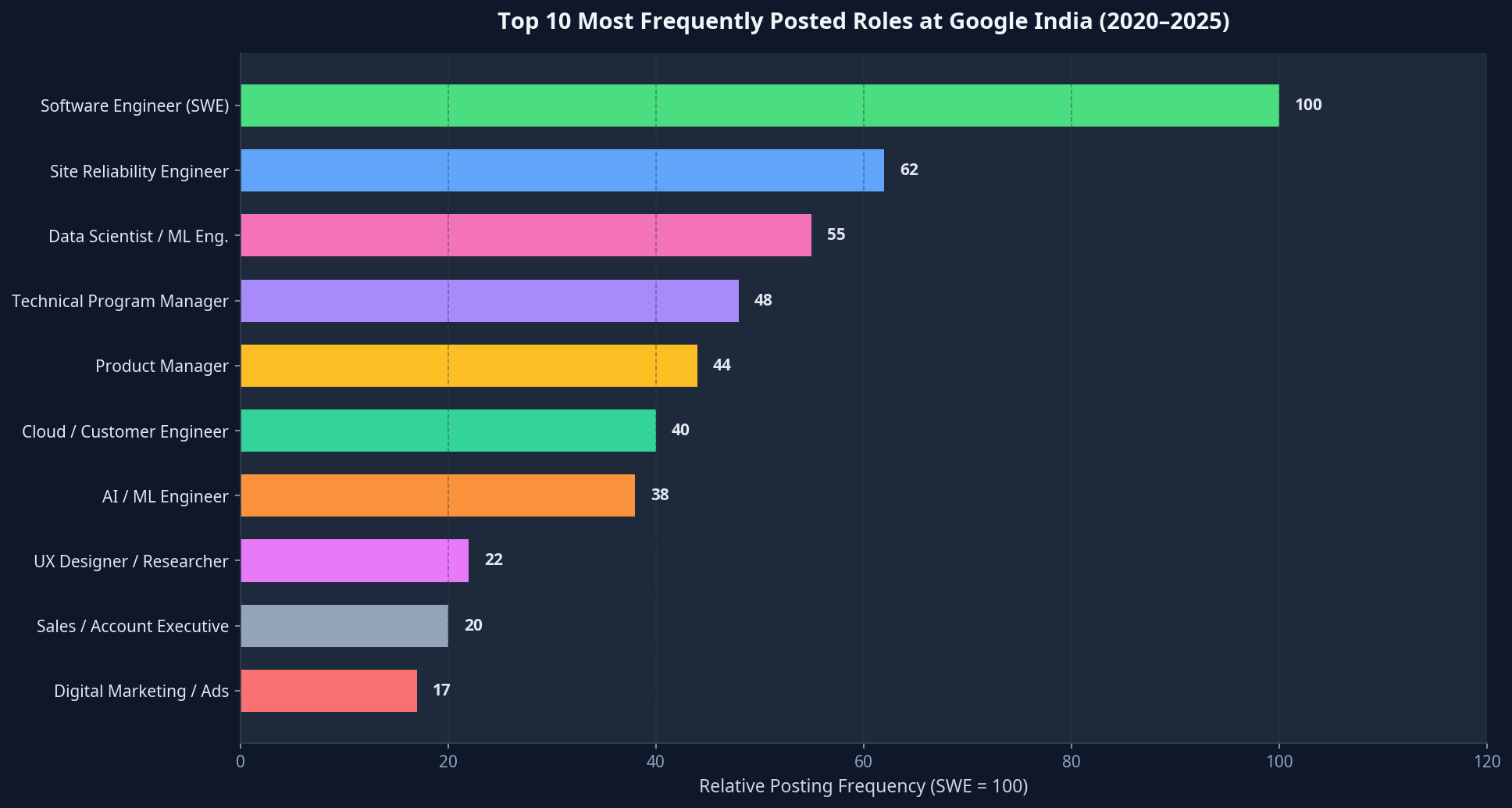 Figure 1: Relative posting frequency of the top 10 roles at Google India. SWE is set to 100 as the baseline. Data aggregated from Google Careers portal, LinkedIn, and Glassdoor (2020–2025).
Role 1: Software Engineer (SWE)
Posting frequency: Highest — the SWE role is consistently the most posted position across all Google India locations, accounting for approximately 35–40% of all India postings.
Software Engineers at Google India work on some of the world's most used products — Search ranking algorithms, YouTube recommendation systems, Google Maps routing, Android platform development, and increasingly, Gemini AI integrations across the product suite. The role spans the full spectrum from frontend and backend development to infrastructure, compilers, and ML systems.
Experience required: 0–12+ years (L3 entry-level to L7 Staff Engineer). Freshers are hired through the STEP internship and campus placement programmes.
Key skills: Proficiency in Python, Java, C++, or Go; strong data structures and algorithms (DSA); distributed systems design; experience with large-scale systems; code quality and testing discipline.
Qualifications: B.Tech / M.Tech / MCA in Computer Science or related field from a recognised institution. Google does not require a degree from a specific tier of college — demonstrated ability matters more than pedigree.
Salary range (India, 2026):[^5]
| Level |
Title |
Total Compensation (INR) |
| L3 |
SWE II (Entry) |
₹37–42 LPA |
| L4 |
SWE III |
₹65–80 LPA |
| L5 |
Senior SWE |
₹100–130 LPA |
| L6 |
Staff SWE |
₹170–220 LPA |
| L7 |
Senior Staff SWE |
₹250–320 LPA |
Career growth path: L3 → L4 → L5 (Senior) → L6 (Staff) → L7 (Senior Staff) → L8 (Principal) → L9 (Distinguished Engineer) → L10 (Google Fellow).
Role 2: Site Reliability Engineer (SRE)
Posting frequency: Second highest — Google invented the SRE discipline, and its India teams are among the most active SRE hiring organisations in the world.
SREs at Google India are responsible for the availability, latency, performance, efficiency, and capacity of Google's production systems. Unlike traditional operations roles, Google SREs are software engineers who write code to automate away operational toil. They define SLOs (Service Level Objectives), manage error budgets, and lead incident response for systems serving billions of users.
Experience required: 3–8 years. Google also hires SREs directly from campus for strong candidates.
Key skills: Python, Go, or Java for automation; deep Linux/Unix systems knowledge; Kubernetes, Borg (Google's internal container orchestration), and distributed systems; on-call incident management; capacity planning and performance analysis.
Salary range (India, 2026): ₹45–90 LPA (L4–L5 range), with senior SREs at L6 earning ₹150–200 LPA total compensation.
Career growth path: SRE → Senior SRE → Staff SRE → SRE Manager or Principal SRE.
Role 3: Data Scientist / Machine Learning Engineer
Posting frequency: Third highest and growing fastest — Google's AI-first strategy has made data science and ML engineering central to every product team.
Data Scientists at Google India analyse large-scale datasets to derive product insights, build recommendation systems, and improve ranking algorithms. ML Engineers focus on building and productionising machine learning models — from data pipelines and feature engineering to model training, evaluation, and serving infrastructure.
Experience required: 2–8 years. PhD preferred for research-adjacent roles in Google DeepMind and Google Research India.
Key skills: Python (NumPy, Pandas, scikit-learn); TensorFlow and JAX (Google's primary ML frameworks); BigQuery and SQL for large-scale data analysis; statistical modelling, A/B testing, and causal inference; experience with Vertex AI (Google's managed ML platform).
Salary range (India, 2026):[^6]
| Seniority |
Total Compensation (INR) |
| Mid-level Data Scientist (3–5 yrs) |
₹40–75 LPA |
| Senior Data Scientist (5–8 yrs) |
₹80–130 LPA |
| Principal / Research Scientist |
₹150–250 LPA |
Role 4: Technical Program Manager (TPM)
Posting frequency: Fourth highest — Google India has a large TPM population that manages the execution of complex, multi-team engineering programmes.
TPMs at Google own the end-to-end delivery of large technical projects — coordinating engineering teams, managing dependencies, tracking milestones, and communicating progress to senior leadership. Unlike Product Managers (who own the "what"), TPMs own the "how" and "when." This role requires both technical depth (enough to understand engineering constraints) and strong programme management discipline.
Experience required: 5–10 years of software engineering or programme management experience.
Key skills: Project management methodologies (Agile, Scrum, OKRs); technical literacy in distributed systems and cloud infrastructure; stakeholder management and executive communication; risk identification and mitigation; data-driven progress tracking.
Salary range (India, 2026): ₹35–60 LPA (mid-level), ₹65–100 LPA (senior), ₹100–150 LPA (principal TPM).
Role 5: Product Manager (PM)
Posting frequency: Fifth highest — Google India's PM roles are among the most competitive in the Indian technology industry, with acceptance rates comparable to IIT admissions.
Product Managers at Google own the vision, strategy, and roadmap for specific product areas. In India, PMs work on Google Search, YouTube, Google Pay, Google Maps, and Google Cloud products. Google's PM culture is deeply analytical — PMs are expected to run A/B experiments, write detailed product requirement documents (PRDs), and make decisions backed by user research and quantitative data.
Experience required: 3–8 years (APM programme for freshers with strong analytical backgrounds).
Key skills: SQL and data analysis; user research and usability testing; product strategy and roadmap planning; cross-functional leadership; strong written communication (Google PMs write extensively).
Salary range (India, 2026):[^7]
| Level |
Total Compensation (INR) |
| APM / PM2 (3–5 yrs) |
₹40–65 LPA |
| Senior PM (5–8 yrs) |
₹70–100 LPA |
| Group PM / Director of PM |
₹100–180 LPA |
Role 6: Cloud Engineer / Customer Engineer
Posting frequency: Sixth — Google Cloud's rapid growth in India has created significant demand for both Cloud Engineers (who build and maintain GCP infrastructure) and Customer Engineers (who help enterprise clients adopt GCP).
Customer Engineers at Google Cloud India are the technical face of Google Cloud for enterprise customers. They design cloud architectures, conduct proof-of-concept implementations, and work alongside sales teams to close large enterprise deals. Cloud Engineers on the product side build and maintain GCP services themselves.
Experience required: 3–8 years in cloud infrastructure, solution architecture, or enterprise IT.
Key skills: Google Cloud Platform (GCP) — Compute Engine, GKE, BigQuery, Cloud Run, Vertex AI; Terraform and infrastructure-as-code; Kubernetes and container orchestration; enterprise architecture and solution design; strong customer-facing communication skills.
Salary range (India, 2026): ₹25–50 LPA (Customer Engineer), ₹50–90 LPA (Senior Customer Engineer / Cloud Architect).
Role 7: AI / ML Engineer
Posting frequency: Seventh and the fastest-growing role category — Google's Gemini AI product line and the integration of AI across all Google products has created an unprecedented demand for AI/ML engineers.
AI/ML Engineers at Google India work on the full AI development lifecycle — from data collection and labelling to model architecture design, training, fine-tuning, and production deployment. Roles span Google DeepMind (foundational research), Google Research India (applied research), and product teams (integrating AI into Search, Maps, YouTube, and Workspace).
Experience required: 2–8 years. PhD strongly preferred for research roles.
Key skills: Python; TensorFlow, JAX, and PyTorch; large language model (LLM) fine-tuning and RLHF; MLOps and model serving infrastructure; distributed training on TPUs; strong mathematical foundations (linear algebra, probability, optimisation).
Salary range (India, 2026): ₹50–100 LPA (mid-level), ₹100–200 LPA (senior/principal), ₹200+ LPA (research scientist/distinguished researcher).
Role 8: UX Designer / UX Researcher
Posting frequency: Eighth — Google's design-driven culture means UX roles are consistently posted across all India locations, particularly in Bengaluru.
UX Designers at Google India design the interfaces for products used by billions of people — from the Search results page to Google Maps navigation to the Pixel phone UI. UX Researchers conduct qualitative and quantitative user research to inform product decisions. Google's design language (Material Design) originated from its India and US design teams.
Experience required: 2–7 years. Portfolio is the primary hiring filter.
Key skills: Figma, Sketch, Adobe XD for design; user research methods (interviews, usability testing, surveys); interaction design and information architecture; data analysis for UX metrics; strong visual communication and presentation skills.
Salary range (India, 2026): ₹20–45 LPA (UX Designer), ₹25–55 LPA (Senior UX Designer), ₹30–60 LPA (UX Researcher).
Role 9: Sales / Account Executive / Customer Engineering
Posting frequency: Ninth — Google's Gurugram and Mumbai offices are primarily sales and business development hubs, with significant hiring for enterprise sales, media sales, and YouTube partnerships.
Sales roles at Google India span Google Ads sales (helping businesses grow through Search, Display, and YouTube advertising), Google Cloud enterprise sales (selling GCP to large Indian enterprises), and YouTube partnerships (working with content creators and media companies). These roles require a blend of technical knowledge and business development skills.
Experience required: 2–8 years in B2B sales, digital marketing, or enterprise technology sales.
Key skills: Digital advertising platforms (Google Ads, DV360, Campaign Manager); enterprise sales methodology; CRM tools (Salesforce); data-driven sales analysis; strong relationship management and negotiation skills.
Salary range (India, 2026): ₹18–35 LPA (Account Executive), ₹35–60 LPA (Senior Account Executive / Account Manager).
Role 10: Digital Marketing / Ads Specialist (gTech)
Posting frequency: Tenth — Google's gTech (Google Technical Services) team in Hyderabad is one of the largest technical support and digital marketing advisory teams in the world.
gTech Ads Specialists help Google's largest advertising clients optimise their campaigns, implement measurement solutions, and adopt new Google Ads products. This role sits at the intersection of digital marketing expertise, data analysis, and customer success.
Experience required: 1–5 years in digital marketing, performance marketing, or advertising technology.
Key skills: Google Ads, Google Analytics 4 (GA4), Google Tag Manager, Display & Video 360, Search Ads 360; data analysis with BigQuery and Looker; strong client communication and presentation skills.
Salary range (India, 2026): ₹12–25 LPA (Specialist), ₹25–45 LPA (Senior Specialist / Manager).
Section 3: Historical Hiring Trends and Job Posting Patterns
Google India's hiring has undergone a remarkable transformation over the past decade, driven by three macro forces: the exponential growth of the internet in India, the global shift to cloud computing, and the current AI revolution.
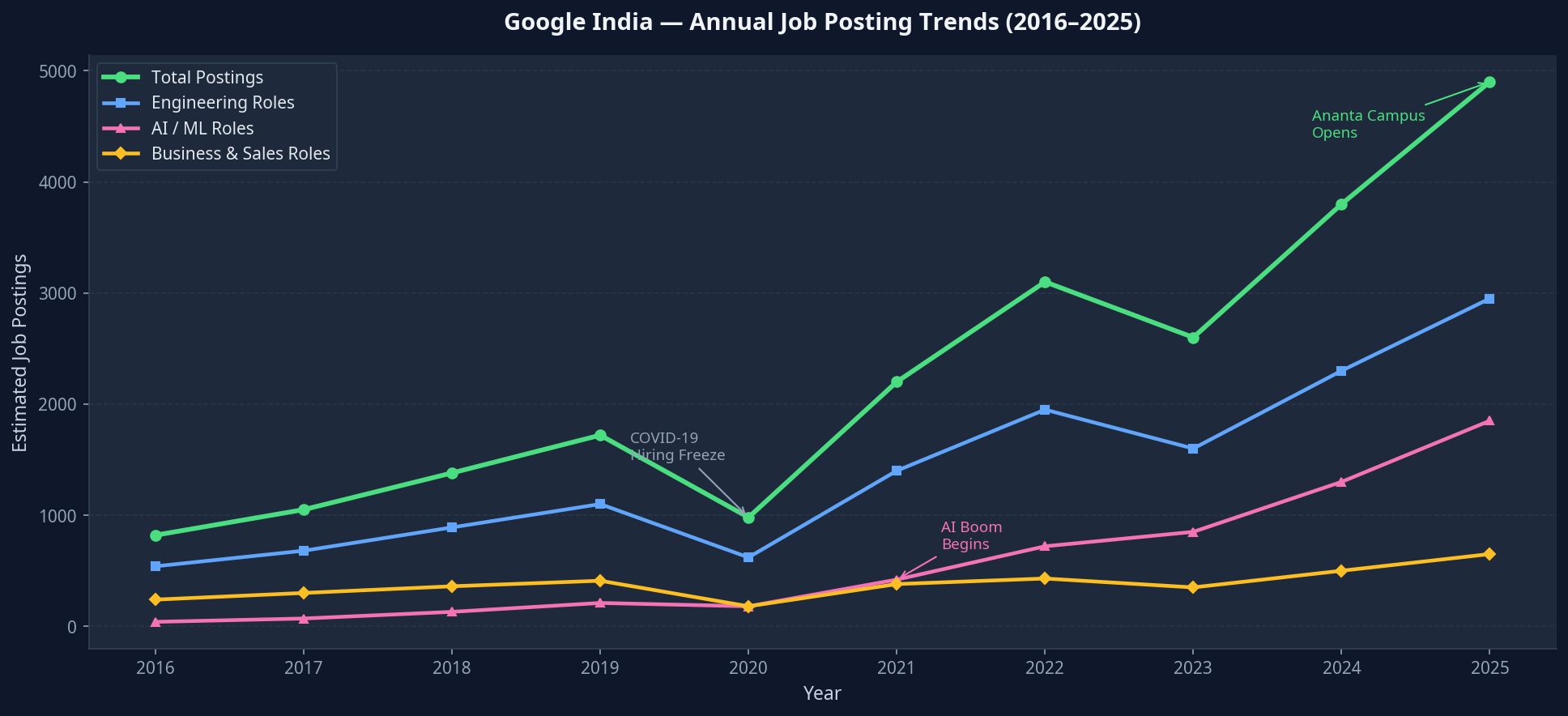 Figure 2: Estimated Google India job postings by category, 2016–2025. The COVID-19 dip in 2020 was followed by a sharp recovery in 2021–2022. The 2023 correction reflects the global tech industry slowdown. 2024–2025 shows the strongest growth in Google India's history, driven by the Ananta campus opening and the AI investment announcement.
The most significant trend is the exponential growth of AI/ML roles — from approximately 40 postings in 2016 to nearly 1,850 in 2025, a 46× increase over nine years. This growth has accelerated sharply since 2022, when Google began integrating large language model capabilities into its core products and expanding Google DeepMind's India presence.
Engineering roles have grown steadily but their share of total postings has declined slightly — from 66% in 2016 to 60% in 2025 — as business, sales, and cloud roles have grown proportionally faster. This reflects Google Cloud's aggressive expansion in India, where it competes directly with AWS and Azure for enterprise cloud market share.
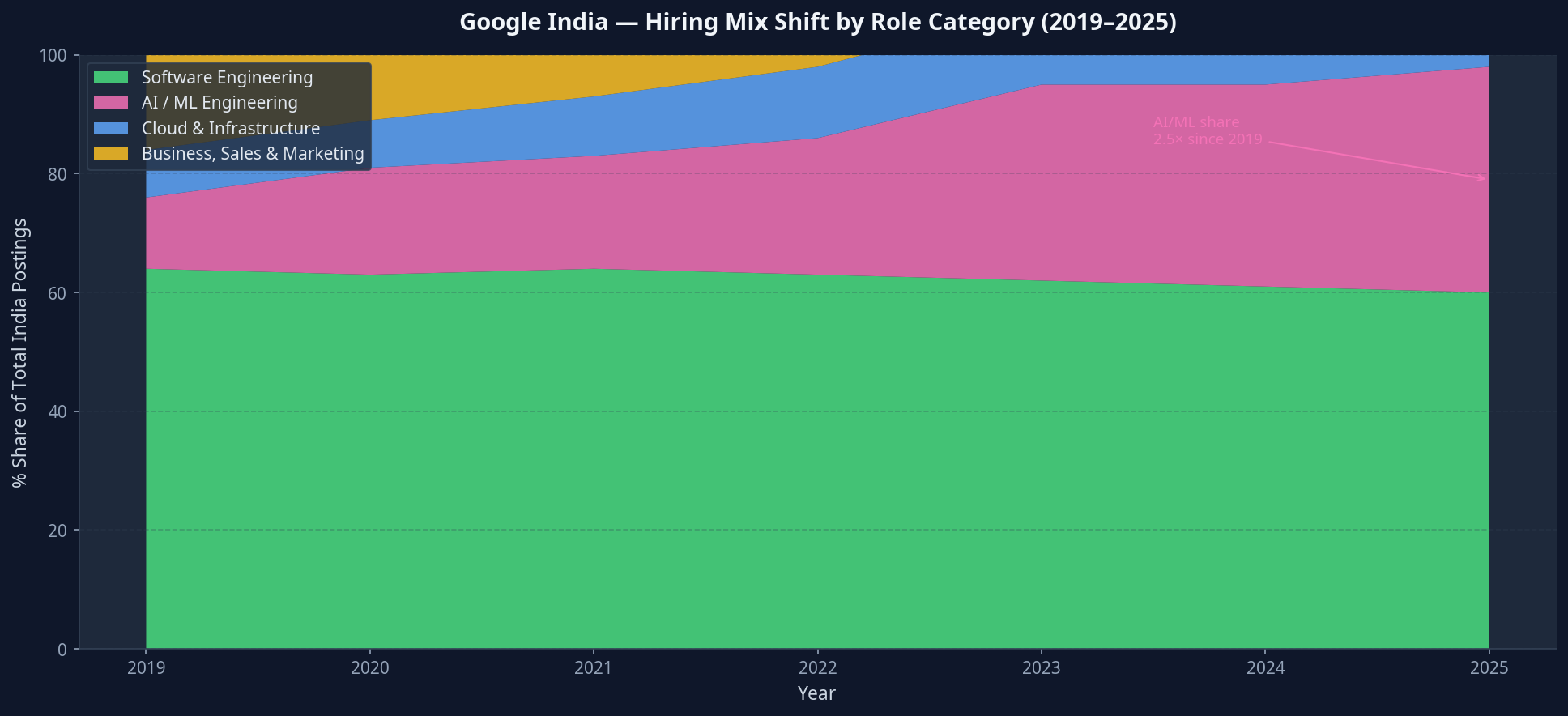 Figure 3: Stacked area chart showing the shift in Google India's hiring mix from 2019 to 2025. AI/ML roles have grown from 12% to 38% of total engineering postings — a 2.5× increase in six years.
The 2023 correction — visible in both charts — reflects the global technology industry's response to rising interest rates and a post-pandemic normalisation of growth expectations. Google laid off approximately 12,000 employees globally in January 2023 (about 6% of its workforce). However, India was less affected than the US, and hiring resumed strongly in 2024 with the Ananta campus opening.
Section 4: City-wise Hiring Distribution in India
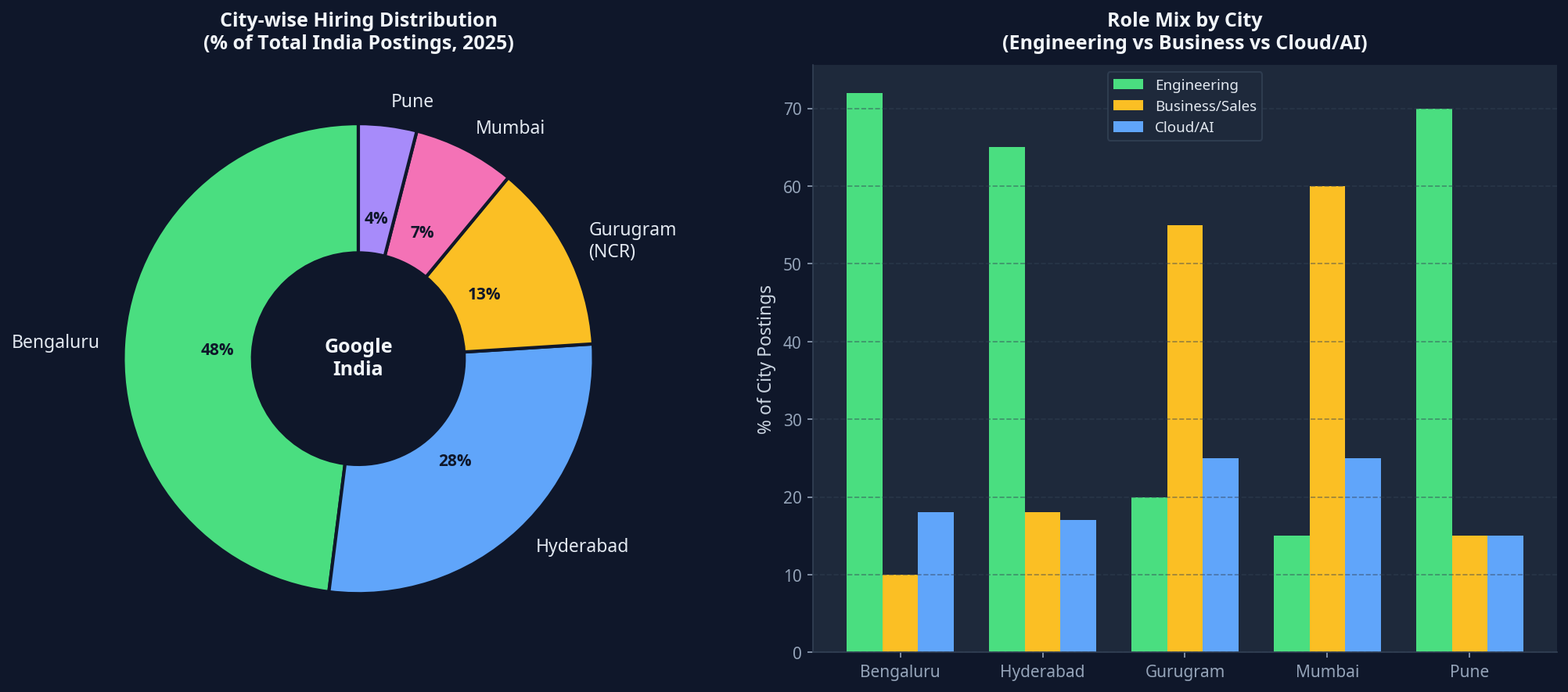 Figure 4: Left — City-wise distribution of Google India job postings (2025). Right — Role mix by city, showing the engineering-heavy nature of Bengaluru and Pune versus the business/sales focus of Gurugram and Mumbai.
Bengaluru dominates Google India's hiring at approximately 48% of all postings, driven by the Ananta campus and the city's deep talent pool in software engineering and AI. Hyderabad accounts for 28%, primarily in engineering, operations, and gTech roles. Gurugram (NCR) at 13% is primarily a business and policy hub, with the highest concentration of sales, marketing, and government affairs roles. Mumbai at 7% focuses on media sales and enterprise accounts, while Pune at 4% has a growing engineering presence.
For job seekers targeting Google India, Bengaluru is the primary destination for engineering and AI roles, while Gurugram is the best entry point for business, sales, and marketing roles.
Section 5: Skills Required to Crack Google Jobs
Google's hiring is fundamentally skills-based, not credential-based. While a degree from an IIT or BITS Pilani is helpful for campus recruitment, Google's lateral hiring process evaluates candidates on demonstrated ability — not the name of their college.
Technical Skills
Programming languages: Python is the most universally required language across all technical roles. Java and C++ are critical for core SWE roles. Go is increasingly important for infrastructure and SRE roles. TypeScript/JavaScript is required for frontend roles.
Data structures and algorithms: This is the primary filter in Google's coding interviews. Google expects candidates to solve medium-to-hard LeetCode problems under time pressure. The key topics are: arrays and strings, trees and graphs, dynamic programming, binary search, two-pointer techniques, and sliding window algorithms.
System design: Required for L5+ (Senior SWE) and all SRE, TPM, and Cloud Architect roles. Google's system design interviews test the ability to design large-scale distributed systems — URL shorteners, notification services, YouTube-scale video streaming, Google Maps routing, and similar systems.
Cloud and AI tools: GCP proficiency is increasingly expected for all technical roles. Key services include Compute Engine, GKE (Kubernetes Engine), BigQuery, Vertex AI, Cloud Run, and Pub/Sub. For AI/ML roles, TensorFlow, JAX, and Vertex AI are the primary tools.
Problem-Solving and Analytical Skills
Google places exceptional weight on first-principles thinking — the ability to break down complex problems into their fundamental components and reason from the ground up. This is tested in coding interviews (through novel problem variations, not just memorised solutions), in system design (through open-ended architecture questions), and in behavioural interviews (through "tell me about a time you had to solve a problem with no clear answer" questions).
SQL and data analysis are expected for Product Manager, Data Scientist, and TPM roles. Google's PM interviews often include a data analysis component where candidates are given a dataset and asked to derive insights.
Communication and Leadership
Google's "Googleyness" assessment evaluates candidates on four dimensions: intellectual humility (the ability to acknowledge when you are wrong), comfort with ambiguity (the ability to make decisions with incomplete information), collaboration (the ability to work effectively across teams and functions), and a bias for action (the tendency to move forward rather than waiting for perfect information).
| Skill Category |
Key Tools / Frameworks |
Relevant Roles |
| Programming |
Python, Java, C++, Go, TypeScript |
SWE, SRE, ML Eng. |
| DSA |
LeetCode, CLRS, Competitive Programming |
SWE, SRE, ML Eng. |
| System Design |
Distributed systems, CAP theorem, Consistent hashing |
SWE L5+, SRE, TPM |
| Cloud & Infrastructure |
GCP, Kubernetes, Terraform, Docker |
SRE, Cloud Eng., SWE |
| AI / ML |
TensorFlow, JAX, Vertex AI, BigQuery ML |
ML Eng., Data Scientist |
| Data Analysis |
SQL, BigQuery, Looker, Python (Pandas) |
PM, Data Scientist, TPM |
| Product Thinking |
PRDs, A/B testing, OKRs, user research |
PM, UX Researcher |
| Ads & Marketing |
Google Ads, GA4, DV360, GTM |
gTech, Sales, Marketing |
Section 6: Qualifications and Certifications
Educational Qualifications
For engineering roles, Google accepts B.Tech, M.Tech, B.E., M.E., and MCA degrees from any recognised institution. For research and AI/ML roles, an M.Tech or PhD in Computer Science, Mathematics, Statistics, or a related quantitative field is strongly preferred. For product and business roles, an MBA from a top institution (IIM, ISB, or equivalent) is valued but not required.
Google's campus recruitment programme targets IITs, NITs, BITS Pilani, IIITs, and select private engineering colleges. However, the majority of Google India's hiring is lateral — experienced professionals who apply through the careers portal or via referrals.
Recommended Certifications
Google Cloud certifications are the most directly relevant for technical roles at Google India, and they carry significant weight in the hiring process for Cloud Engineer, Customer Engineer, and SRE roles.
| Certification |
Level |
Relevant Roles |
Cost (INR) |
| Google Cloud Digital Leader |
Foundational |
All technical roles |
₹7,500 |
| Associate Cloud Engineer |
Associate |
SRE, Cloud Eng., SWE |
₹15,000 |
| Professional Cloud Architect |
Professional |
Cloud Architect, TPM |
₹15,000 |
| Professional Data Engineer |
Professional |
Data Scientist, ML Eng. |
₹15,000 |
| Professional ML Engineer |
Professional |
ML Eng., AI roles |
₹15,000 |
| Google Analytics Certification |
Free |
PM, Marketing, gTech |
Free |
| Google Ads Certifications |
Free |
Sales, gTech, Marketing |
Free |
| TensorFlow Developer Certificate |
Intermediate |
ML Eng., AI roles |
₹10,000 |
All Google Cloud certifications can be prepared for through Google Cloud Skills Boost (formerly Qwiklabs), which offers free learning paths and hands-on labs.
Section 7: Learning Roadmap — How to Acquire These Skills
Software Engineering Roadmap
Beginner (0–6 months): Learn Python or Java fundamentals. Complete a data structures and algorithms course. Solve 50 LeetCode easy problems. Build 2–3 small projects (web app, CLI tool, API).
Intermediate (6–18 months): Solve 150+ LeetCode medium problems. Study system design fundamentals (read "Designing Data-Intensive Applications" by Martin Kleppmann). Learn Git, Docker, and basic cloud concepts. Contribute to open-source projects.
Advanced (18–36 months): Solve 50+ LeetCode hard problems. Deep-dive into distributed systems (Raft consensus, consistent hashing, CAP theorem). Obtain Google Cloud Associate Cloud Engineer certification. Build a production-grade system with monitoring, alerting, and CI/CD.
AI / ML Engineering Roadmap
Beginner: Python, NumPy, Pandas, Matplotlib. Andrew Ng's Machine Learning Specialisation on Coursera. Build a simple classification model.
Intermediate: Deep learning with TensorFlow or PyTorch. Kaggle competitions. Natural language processing (NLP) fundamentals. Vertex AI hands-on labs.
Advanced: Large language model fine-tuning. MLOps with Vertex AI Pipelines. Research paper implementation. Google Professional ML Engineer certification.
Product Management Roadmap
Beginner: Read "Inspired" by Marty Cagan. Learn SQL basics. Study Google's product design principles through case studies.
Intermediate: Complete a product management course (Coursera PM specialisation). Build a product portfolio (case studies, product teardowns). Learn A/B testing and experimentation frameworks.
Advanced: Apply for Google's APM programme (for freshers) or prepare for PM interviews using "Cracking the PM Interview" by Gayle McDowell. Practice product design, estimation, and metrics questions.
Cloud Engineering Roadmap
Beginner: Google Cloud Digital Leader certification. GCP fundamentals on Cloud Skills Boost.
Intermediate: Associate Cloud Engineer certification. Hands-on labs with GKE, BigQuery, and Cloud Run.
Advanced: Professional Cloud Architect certification. Terraform for infrastructure-as-code. Multi-cloud architecture design.
Section 8: Recommended Courses (with Learning Platforms)
Data Structures and Algorithms
System Design
Google Cloud Platform (GCP) Certifications
Machine Learning and AI
Product Management
UX Design
Digital Marketing and Google Ads
Section 8: How to Crack a Job at Google
Resume Optimisation
Google receives millions of applications annually. Your resume must pass two filters before a human reads it: an ATS (Applicant Tracking System) scan and a 30-second human review by a recruiter. The most effective Google resume format is a single-page, achievement-focused document using the XYZ formula: "Accomplished [X] as measured by [Y], by doing [Z]."
Every bullet point should quantify impact. "Improved system performance" is weak. "Reduced API latency by 40% (from 250ms to 150ms) by implementing a Redis caching layer, reducing infrastructure costs by ₹12 lakhs per year" is what Google recruiters look for.
For technical roles, include a GitHub profile link with active repositories. For product roles, include links to case studies or product teardowns you have published.
LinkedIn Strategy
Google recruiters actively source candidates on LinkedIn. Optimise your profile for the role you are targeting by including the exact keywords from Google's job descriptions in your headline, about section, and experience descriptions. Set your profile to "Open to Work" (visible to recruiters only) and follow Google India's LinkedIn page for job alerts.
Referrals
A referral from a Google employee is the single most effective way to get your resume reviewed. Google's internal referral programme gives referred candidates priority review. If you know anyone at Google India, ask for a referral — it does not guarantee an interview, but it ensures your application is seen by a human recruiter.
If you do not know anyone at Google, LinkedIn is the best tool to find and connect with Google India employees in your target team. A personalised, concise message explaining why you are interested in Google and asking for a 15-minute informational call is the most effective approach.
Coding Interview Preparation
Google's coding interviews are among the most rigorous in the industry. The preparation strategy that consistently works:
Solve 200+ LeetCode problems with a focus on Google-tagged questions. The LeetCode Google problem set contains the most representative sample of questions asked in Google interviews.
Practice explaining your thought process aloud — Google interviewers evaluate not just whether you solve the problem, but how you approach it. Narrate your reasoning as you code.
Master these topic areas in order of priority: Arrays and strings → Trees and graphs → Dynamic programming → Binary search → Heaps and priority queues → Tries → Graph algorithms (BFS/DFS/Dijkstra).
System Design Preparation (for L5+ roles)
Study the following systems in depth, understanding how to design each from scratch: URL shortener, notification service, rate limiter, distributed cache, YouTube-scale video streaming, Google Maps, and a distributed key-value store. The book "Designing Data-Intensive Applications" by Martin Kleppmann is the single best preparation resource for Google system design interviews.
Behavioural Interviews and Googleyness
Google's behavioural interview assesses "Googleyness" — the cultural and leadership attributes that predict success at Google. Prepare 8–10 STAR stories (Situation, Task, Action, Result) that demonstrate: handling ambiguity, learning from failure, influencing without authority, working across teams, and taking initiative.
The most common Googleyness questions:
- "Tell me about a time you had to make a decision with incomplete information."
- "Describe a situation where you had to change someone's mind."
- "Tell me about a project that failed and what you learned from it."
- "Give an example of a time you went above and beyond your role."
30 / 60 / 90 Day Interview Preparation Plan
| Phase |
Focus |
Weekly Hours |
| Days 1–30 |
DSA fundamentals, solve 60 LeetCode easy/medium problems, revise CS fundamentals (OS, networks, databases) |
15–20 hrs/week |
| Days 31–60 |
System design study, solve 60 more LeetCode medium/hard problems, mock interviews (2–3 per week) |
15–20 hrs/week |
| Days 61–90 |
Google-specific preparation — study Google's engineering blog, prepare Googleyness stories, full mock interview loops, apply and schedule interviews |
10–15 hrs/week |
Section 9: Conclusion
Google India in 2026 represents one of the most compelling career opportunities available to Indian technology professionals. The company is investing at an unprecedented scale — the Ananta campus, the $15 billion AI investment in Visakhapatnam, and the new Hyderabad mega-campus signal a long-term commitment to India as a core engineering and innovation hub.
The most in-demand roles in 2026 are Software Engineer (SWE), AI/ML Engineer, and Cloud Engineer / Customer Engineer — all three are growing faster than Google's overall hiring rate. For freshers, the STEP internship and APM programmes are the most accessible entry points. For experienced professionals, lateral hiring through the Google Careers portal and employee referrals are the most effective paths.
The future hiring opportunities at Google India are concentrated in three areas: Generative AI (Gemini integrations, AI agents, multimodal systems), Google Cloud (enterprise cloud adoption is still in early stages in India), and India-specific products (Google Pay, Google Maps India, YouTube India, and the upcoming AI-powered Search experiences for Indian languages).
For India-based professionals, the clearest career path to Google is: build strong DSA and system design skills, obtain a relevant Google Cloud or ML certification, contribute to open-source projects, build a strong LinkedIn presence, and pursue referrals from Google employees. The interview process is rigorous but predictable — and with the right preparation, it is absolutely achievable.
Apply directly at careers.google.com/jobs/results?location=India and follow Google India on LinkedIn for the latest openings.
References
[^1]: "Alphabet Inc. Annual Report 2025." Alphabet Investor Relations, 2025.
[^2]: "Best Places to Work 2026." Glassdoor, 2026.
[^3]: "Google India Hiring: 400+ Tech and Non-Tech Openings." Unstop, 2026.
[^4]: "Google Offices in India: Address, Contact & Services." Profito Interactive, January 2026.
[^5]: "Google Software Engineer Salary in India." Levels.fyi, April 2026.
[^6]: "Google Data Scientist Salaries 2026 in India." 6figr, 2026.
[^7]: "Google Product Manager Salaries in India." AmbitionBox, 2026.