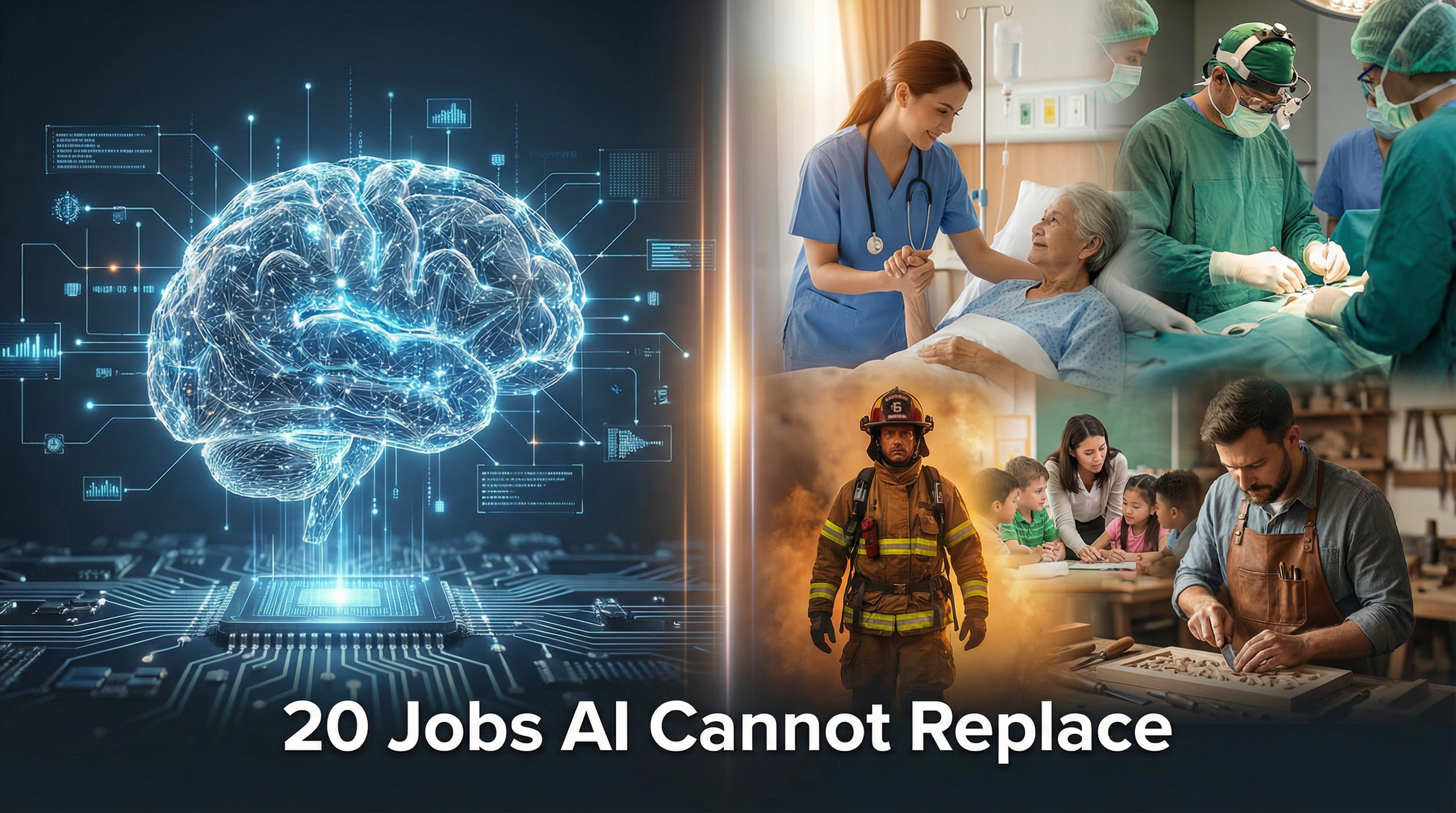
Let's be honest about what is actually happening in the job market right now.
AI is replacing tasks. It is not replacing most careers. That distinction matters enormously — and it is the one that most "AI will take your job" headlines get completely wrong.
BCG's April 2026 microeconomic analysis found that while 50–55% of US jobs will be reshaped by AI over the next two to three years, only 10–15% of jobs face genuine elimination risk over the next five years. The WEF Future of Jobs Report 2025 puts the number at 85 million jobs displaced globally by 2030 — but also 97 million new roles created. That is a net positive of 12 million jobs.
The question is not "will AI take jobs?" It is "which jobs is AI structurally incapable of replacing — and why?"
This article answers that question with specifics. Not vague reassurances, but a clear breakdown of 20 roles, why each one resists automation, what the demand data shows, and what the India-specific picture looks like.
What Makes a Job AI-Resistant?
Before the list, the framework matters. BCG's model identifies three characteristics that make a role resistant to AI substitution:
Physical presence and manual dexterity. AI cannot yet operate robotic hands with the precision, adaptability, and contextual judgment of a trained human in an unpredictable environment. Plumbers, surgeons, electricians, and construction workers operate in physical spaces that change constantly.
High interpersonal and emotional judgment. Therapy, teaching, crisis negotiation, and caregiving require reading human emotion, building trust over time, and responding to unspoken cues. These are not tasks — they are relationships. AI can simulate empathy but cannot feel it, and people know the difference.
Complex, non-routine judgment under uncertainty. Judges, senior lawyers, strategic consultants, and emergency physicians make decisions where the stakes are high, the context is unique, and the consequences of error are severe. AI can assist with research and pattern recognition but cannot own the outcome.
The 57% of jobs that BCG identifies as "less likely to be disrupted" all share at least one of these three characteristics. The 20 roles below share all three — or have structural reasons why automation is decades away.
The 20 Jobs AI Cannot Replace in 2026
1. Registered Nurse and ICU Nurse
Why AI cannot replace it: Nursing is not just administering medication. It is reading a patient's face at 3 a.m. and deciding whether something is wrong before the monitors show it. It is holding a hand during a difficult diagnosis. It is making real-time decisions in a physical environment where conditions change every minute.
AI is being used in healthcare — for diagnostic imaging, drug interaction checks, administrative documentation. But the physical, emotional, and ethical core of nursing is irreplaceable. The Indian Nursing Council reports a shortage of over 2 million nurses in India, and demand is growing at 8–10% annually as the population ages.
India salary range: ₹3.5–₹12 LPA (government hospitals to private ICUs in metro cities)
2. Surgeon (Especially Reconstructive and Cardiac)
Why AI cannot replace it: Robotic surgery exists — but it is controlled by a human surgeon. The robot is a tool, not a replacement. Surgical judgment — knowing when to deviate from the plan, when tissue is unexpectedly fragile, when to stop — requires years of embodied experience that cannot be encoded into an algorithm.
AIIMS and major private hospital chains are expanding surgical capacity, not reducing it. India faces a shortage of 600,000 doctors, and surgical specialists are among the most critically undersupplied.
India salary range: ₹15–₹60 LPA (government to private sector)
3. Mental Health Therapist and Counsellor
Why AI cannot replace it: AI chatbots like Woebot and Wysa can provide CBT-based exercises and emotional support at scale. They are genuinely useful for mild anxiety and stress. But they cannot replace a licensed therapist for clinical depression, trauma, personality disorders, or suicidal ideation — because therapy is not information delivery. It is a relationship built over months, where the therapist's own humanity is the instrument.
India has one of the worst mental health professional-to-population ratios in the world: approximately 0.3 psychiatrists per 100,000 people (WHO recommends 3). The National Mental Health Survey 2023 found that 150 million Indians need mental health care but only a fraction receive it.
India salary range: ₹4–₹18 LPA (clinical psychologists in private practice can earn significantly more)
4. Plumber, Electrician, and HVAC Technician
Why AI cannot replace it: These are the most underrated AI-proof careers in India. Every plumbing problem is different. Every electrical fault is in a different wall, in a different building, with different wiring. The physical dexterity, problem-solving, and contextual judgment required cannot be automated with current or near-future robotics.
Urban India's construction boom — 11 cities adding metro rail, millions of new apartments, data centre infrastructure expansion — is creating massive demand for skilled tradespeople. Yet the National Skill Development Corporation (NSDC) consistently identifies plumbers, electricians, and HVAC technicians as critically undersupplied.
India salary range: ₹2.5–₹8 LPA (certified professionals with 5+ years experience earn significantly more)
5. Special Education Teacher
Why AI cannot replace it: Teaching children with autism, dyslexia, ADHD, cerebral palsy, or intellectual disabilities requires constant adaptation, emotional attunement, and individualised relationship-building that changes daily. AI can provide supplementary tools — adaptive learning software, speech therapy apps — but the teacher who knows that a particular child responds to a specific tone of voice, or needs a five-minute break before a new concept, is irreplaceable.
India's Right to Education Act mandates inclusive education, and the demand for trained special educators far exceeds supply in every state.
India salary range: ₹3–₹10 LPA
6. Emergency Medical Technician (EMT) and Paramedic
Why AI cannot replace it: EMTs work in chaotic, unpredictable environments — accident scenes, homes, public spaces — where they must simultaneously stabilise a patient, communicate with a hospital, manage bystanders, and make triage decisions in seconds. No robot can do this in 2026. India's emergency medical services sector is expanding rapidly under the National Health Mission, with significant hiring across state ambulance networks.
India salary range: ₹2.5–₹6 LPA
7. Cybersecurity Analyst and Ethical Hacker
Why AI cannot replace it: This is the one tech role that is genuinely AI-proof — because AI is the threat. As AI-powered cyberattacks become more sophisticated, the humans defending against them must be equally sophisticated. AI tools can detect known attack patterns, but novel zero-day exploits, social engineering campaigns, and nation-state attacks require human creativity and adversarial thinking to counter.
NASSCOM estimates India needs 1 million cybersecurity professionals but has only 220,000. The government's CERT-In and private sector demand are both growing at 30%+ annually.
India salary range: ₹6–₹35 LPA (ethical hackers and security architects command premium salaries)
8. Civil Engineer (Site and Infrastructure)
Why AI cannot replace it: AI can generate structural designs and run simulations. But the civil engineer who walks a construction site, identifies a soil condition that the survey missed, negotiates with contractors, and makes real-time decisions about material substitutions cannot be replaced by software. India's infrastructure pipeline — ₹111 lakh crore under the National Infrastructure Pipeline — ensures demand for site engineers for decades.
India salary range: ₹4–₹20 LPA
9. Social Worker and Child Protection Officer
Why AI cannot replace it: Social work involves entering homes, building trust with vulnerable families, making judgments about child safety, and navigating complex bureaucratic and legal systems on behalf of people who cannot advocate for themselves. It requires emotional resilience, cultural competence, and ethical judgment that no algorithm can replicate.
India salary range: ₹3–₹8 LPA (NGO sector) to ₹5–₹12 LPA (government)
10. Dentist
Why AI cannot replace it: AI can analyse X-rays and flag cavities. It cannot hold a drill, manage a patient's anxiety, adapt to unexpected anatomy mid-procedure, or make the split-second decisions that a root canal requires. India has a dentist-to-population ratio of approximately 1:10,000 against the WHO recommendation of 1:7,500, meaning demand significantly exceeds supply.
India salary range: ₹5–₹30 LPA (private practice owners can earn significantly more)
11. Occupational Therapist
Why AI cannot replace it: Occupational therapists help people recover the ability to perform daily tasks after injury, stroke, or disability. The work is intensely physical and relational — teaching someone to button a shirt again after a stroke, or helping a child with sensory processing disorder navigate a classroom. India's rehabilitation sector is growing rapidly as awareness of occupational therapy increases and the ageing population expands.
India salary range: ₹3.5–₹12 LPA
12. Veterinarian
Why AI cannot replace it: Animals cannot describe their symptoms. Veterinary diagnosis requires physical examination, behavioural observation, and clinical intuition built over years of practice. India's livestock sector — the world's largest — and the growing urban pet care market both drive strong demand.
India salary range: ₹4–₹18 LPA
13. Yoga Instructor and Physiotherapist
Why AI cannot replace it: Physical rehabilitation and movement therapy require hands-on assessment, real-time correction of form, and the motivational relationship between practitioner and patient. AI apps can guide yoga sequences, but they cannot observe that a patient is compensating for knee pain by shifting weight incorrectly, or that a client's breathing pattern suggests anxiety rather than physical fatigue. India's wellness industry is growing at 12% annually.
India salary range (physiotherapist): ₹3.5–₹15 LPA
14. Judge and Magistrate
Why AI cannot replace it: Judicial decisions involve interpreting law in context, weighing competing rights, assessing credibility, and making determinations that affect human lives and liberty. India's judiciary is constitutionally independent, and the legal and ethical barriers to AI decision-making in courts are insurmountable in the near term. The Supreme Court of India has explicitly stated that AI cannot replace judicial discretion. India's courts face a backlog of 50 million cases — demand for judges is not declining.
India salary range: ₹8–₹25 LPA (district courts to High Courts)
15. AI/ML Engineer and Prompt Engineer
Why AI cannot replace it: Someone has to build, train, fine-tune, and maintain the AI systems. As AI adoption accelerates, demand for the humans who understand how these systems work at a deep level is growing faster than supply. Naukri's JobSpeak Report (February 2026) showed AI/ML hiring in India grew 34% year-on-year in January 2026 alone.
India salary range: ₹8–₹45 LPA (senior ML engineers and AI architects command ₹30–₹80 LPA at MNCs)
16. Firefighter
Why AI cannot replace it: Firefighting involves entering burning buildings, making split-second decisions in zero-visibility environments, carrying people, and operating heavy equipment in conditions that change every second. The physical demands alone rule out automation for decades. India's fire services are chronically understaffed — the National Disaster Management Authority estimates India needs three times its current number of trained firefighters.
India salary range: ₹3–₹8 LPA (government fire services)
17. Chef and Culinary Artist (Senior Level)
Why AI cannot replace it: Robotic kitchens can assemble standardised meals. They cannot taste, improvise, respond to the quality of today's produce, or create a dish that tells a story. India's hospitality sector — growing at 15% annually — demands chefs who can innovate, manage teams, and create experiences. The distinction between a production cook and a culinary artist is exactly the distinction between what AI can and cannot do.
India salary range: ₹4–₹25 LPA (executive chefs at five-star properties earn significantly more)
18. Geologist and Environmental Scientist (Field-Based)
Why AI cannot replace it: Field geology requires physical presence in remote locations, the ability to read rock formations in three dimensions, and the judgment to interpret what the data means in context. Environmental scientists assessing contamination, conducting ecological surveys, or managing disaster response work in conditions that no remote system can replicate.
India salary range: ₹4–₹18 LPA
19. Human Resources Business Partner (HRBP)
Why AI cannot replace it: AI can screen resumes, schedule interviews, and analyse engagement survey data. It cannot sit across from an employee who is considering leaving and understand — from tone, body language, and context — what is actually wrong. Senior HR professionals who manage organisational culture, handle sensitive employee relations issues, and advise business leaders on people strategy are doing work that is fundamentally human.
India salary range: ₹8–₹25 LPA
20. Entrepreneur and Founder
Why AI cannot replace it: Entrepreneurship is the act of seeing a problem that others have not yet named, building a team that believes in an unproven idea, and persisting through failure on the basis of conviction rather than data. AI can help entrepreneurs move faster — with market research, product development, and marketing — but it cannot replace the human who decides to start something from nothing. India produces more startups than almost any country in the world, and the AI era is creating more entrepreneurial opportunities, not fewer.
India salary range: Variable — but the upside is unlimited.
The Common Thread: What These 20 Jobs Share
Looking across this list, a clear pattern emerges. The jobs that AI cannot replace in 2026 share at least one of the following:
| Characteristic | Examples |
|---|
| Physical presence in unpredictable environments | Surgeon, Firefighter, Plumber, EMT, Civil Engineer |
| Emotional and relational intelligence | Therapist, Nurse, Social Worker, Special Education Teacher |
| High-stakes judgment under uncertainty | Judge, Cybersecurity Analyst, HRBP, Entrepreneur |
| Creative and sensory expertise | Chef, Geologist, Yoga Instructor |
| Building and maintaining AI itself | ML Engineer, Prompt Engineer |
The Harvard Mignone Center for Career Success put it well in April 2026: "AI may be replacing certain tasks, but it isn't replacing careers. This is an important distinction."
What This Means for Indian Job Seekers Right Now
India is at a unique inflection point. The country adds 10–12 million young people to the workforce every year. AI is compressing entry-level white-collar hiring — fresher IT hiring is down 50% from pre-pandemic levels. But the 20 roles above are growing, not shrinking.
The strategic move for Indian job seekers in 2026 is not to compete with AI at tasks it does better. It is to build expertise in domains where human presence, judgment, and relationships are the product.
If you are choosing a career path, or considering a pivot, the question to ask is not "will AI replace this job?" but "does this job require something that AI structurally cannot do?" The 20 roles above all answer yes.
Frequently Asked Questions
Which jobs are 100% safe from AI in 2026?
No job is 100% safe from AI in the sense that AI will change how almost every job is done. But the 20 roles listed above — including nurses, surgeons, therapists, cybersecurity analysts, skilled tradespeople, and judges — have structural characteristics (physical presence, emotional judgment, high-stakes decision-making) that make full automation impossible with current and near-future AI capabilities.
Will AI replace doctors in India?
AI is already assisting Indian doctors with diagnostic imaging, drug interaction checks, and administrative documentation. But AI will not replace doctors — especially surgeons, emergency physicians, and specialists — because medical practice requires physical examination, real-time judgment, and ethical accountability that AI cannot provide. India faces a shortage of 600,000 doctors, making this one of the most secure career paths available.
Are IT jobs safe from AI in India?
It depends on the role. Junior coding, basic testing, and data entry IT roles face significant automation pressure. But senior software engineers, cybersecurity analysts, AI/ML engineers, and system architects are in growing demand. Naukri's February 2026 data shows AI/ML hiring in India grew 34% year-on-year. The key is moving up the value chain within IT, not out of it.
What skills should I build to be AI-proof?
According to Harvard Business School Online and McKinsey's 2026 State of Organizations report, the most AI-resistant skills are: critical thinking and complex problem-solving, emotional intelligence and empathy, creative judgment, physical dexterity and hands-on expertise, and the ability to work with and direct AI systems.
Is cybersecurity a good career in India in 2026?
Yes — it is one of the best. NASSCOM estimates India needs 1 million cybersecurity professionals but has only 220,000. Salaries range from ₹6 LPA for entry-level analysts to ₹35+ LPA for senior architects and ethical hackers. As AI-powered cyberattacks become more sophisticated, the humans defending against them become more valuable, not less.
What is the best AI-proof career for freshers in India?
For freshers entering the workforce in 2026, the highest-growth AI-proof paths are: nursing and allied health (8–10% annual demand growth), cybersecurity (30%+ annual demand growth), AI/ML engineering (34% hiring growth in January 2026 alone), skilled trades (critical shortage across India), and mental health counselling (150 million Indians need care, only a fraction receive it).
References
- AI Will Reshape More Jobs Than It Replaces — BCG, April 2026
- Future of Jobs Report 2025 — World Economic Forum, 2025
- AI-Proof Jobs for 2026: Careers Technology Still Can't Replace — Harvard FAS Mignone Center, April 2026
- AI/ML Hiring in India Grew 34% in January 2026 — Naukri JobSpeak / India Today, February 2026
- The Most Important Human Skills AI Can't Replace — Harvard Business School Online, February 2026
- India's Cybersecurity Talent Gap — NASSCOM
- National Mental Health Survey 2023 — NIMHANS / Ministry of Health, India