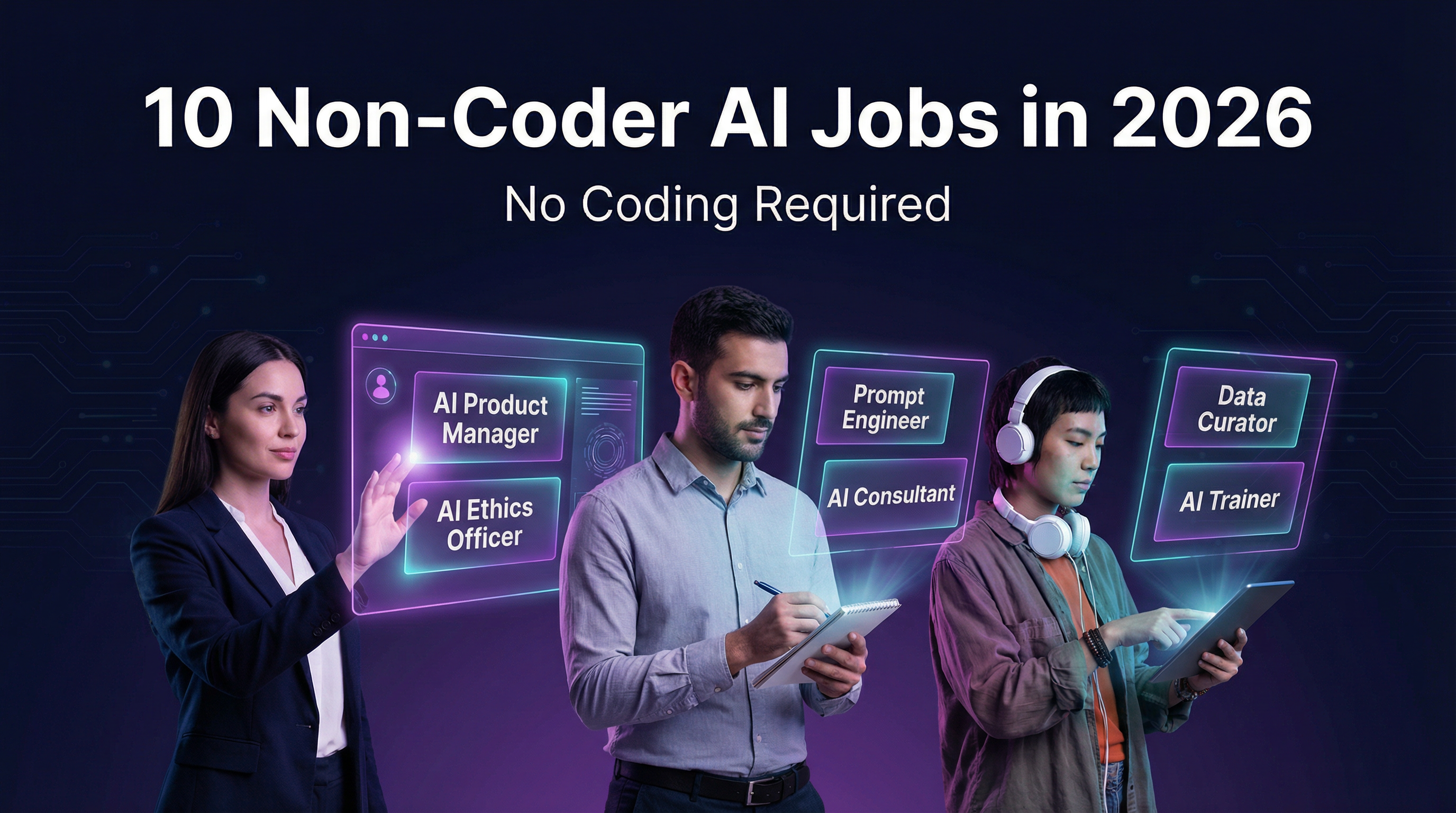
10 Non-Technical AI Jobs in 2026 (No Coding Required)
You do not need to write a single line of code to build a career in artificial intelligence in 2026.
That statement would have seemed absurd five years ago. AI was the domain of machine learning engineers, data scientists, and researchers with advanced degrees in mathematics and computer science. If you could not read a Python script or understand a neural network architecture, the door was closed.
That door is now wide open — and the roles on the other side pay exceptionally well.
Companies like Google, Microsoft, OpenAI, Accenture, and thousands of fast-growing startups are actively hiring for AI roles that require no programming background whatsoever. What they need instead is domain expertise, communication skills, business judgment, creative thinking, and the ability to work with AI tools rather than build them from scratch.
This guide covers 10 of the best non-coder AI jobs available in 2026, with salary data for both India and global markets, the skills each role requires, and how to get started — even if your background is in arts, commerce, or a non-technical field.
Why Non-Technical AI Jobs Are Exploding in 2026
The AI industry is not just growing — it is restructuring the entire workforce. According to the World Economic Forum's Future of Jobs Report, AI is expected to create 97 million new roles globally by 2025, and a significant portion of those roles are not engineering positions. They are strategy, communication, ethics, content, and operations roles that happen to sit at the intersection of business and AI.
In India specifically, the demand for AI-adjacent non-technical talent has grown sharply. A 2025 LinkedIn India report found that job postings requiring "AI literacy" — the ability to use and understand AI tools without building them — grew by 74% year-on-year. Companies are not just looking for people who can build AI. They are looking for people who can deploy it, manage it, explain it, sell it, and ensure it behaves responsibly.
The shift is structural, not temporary. As AI tools become more capable and more embedded in every business function, the ratio of "AI builders" to "AI users" will continue to widen. The opportunity for non-coders is not a short-term trend — it is the defining career shift of this decade.
The 10 Best Non-Coder AI Jobs in 2026
1. Prompt Engineer
India Salary: ₹6–10 LPA (entry) | ₹20–36 LPA (experienced)
Global Salary: $90,000–$180,000/year
If you are good with words and understand how to communicate clearly, prompt engineering may be the most accessible entry point into the AI industry. Prompt engineers write, test, and refine the instructions — called "prompts" — that guide AI models like ChatGPT, Claude, and Gemini to produce accurate, useful, and on-brand outputs.
The role requires no coding. What it demands is a deep understanding of how language models think, what kinds of instructions produce good results versus poor ones, and how to systematically test and improve prompt quality. Think of it as writing — but instead of writing for a human audience, you are writing for an AI system.
Companies hiring prompt engineers include OpenAI, Anthropic, Scale AI, and virtually every large enterprise that has deployed AI in its customer service, marketing, or operations functions. In India, companies like Infosys, Wipro, and TCS have all created dedicated prompt engineering teams as part of their AI transformation practices.
How to get started: Build a portfolio of prompt templates across different use cases — customer support, content generation, data extraction, summarisation. Platforms like PromptBase allow you to publish and sell prompts, which also serves as proof of work.
2. AI Product Manager
India Salary: ₹18–45 LPA
Global Salary: $120,000–$200,000/year
The AI Product Manager is one of the most respected and highest-compensated non-technical roles in the AI industry. This person decides what AI products get built, why they get built, and for whom. They sit between the engineering team and the business, translating user needs and market opportunities into product requirements that engineers can execute.
You do not need to know how to train a model to be an AI PM. What you need is strong product intuition, the ability to understand user pain points deeply, and enough AI literacy to have informed conversations with technical teams about what is feasible, what is not, and what trade-offs exist.
The role is particularly well-suited to people who have prior experience in product management, business analysis, or management consulting and want to transition into the AI space. In India, companies like Flipkart, Swiggy, Zepto, and every major IT services firm are actively hiring AI PMs at all levels of seniority.
How to get started: Take a product management course (PM School, Reforge, or Coursera's Google PM Certificate) and supplement it with AI literacy training. Build a case study where you define the product requirements for a hypothetical AI feature — this is your portfolio piece.
3. AI Content Specialist / AI Copywriter
India Salary: ₹8–25 LPA
Global Salary: $60,000–$120,000/year
Content is one of the most immediate and practical applications of AI in business, and companies need specialists who can use AI writing tools effectively while maintaining quality, brand voice, and accuracy. The AI Content Specialist uses tools like ChatGPT, Jasper, Copy.ai, and Claude to produce blogs, social media posts, email campaigns, product descriptions, and marketing copy — faster and at greater scale than traditional content teams.
The critical distinction between this role and simply "using ChatGPT" is editorial judgment. AI-generated content requires a human with strong writing instincts to evaluate, edit, fact-check, and shape the output into something that genuinely serves the reader. Companies are not hiring people to press a button — they are hiring people who can tell the difference between good AI output and mediocre AI output, and who can consistently produce the former.
In India, this role has seen particularly strong growth in the e-commerce, edtech, and D2C sectors, where content volume requirements are high and AI tools offer a significant efficiency advantage.
How to get started: Build a portfolio of 10–15 pieces across different formats — blog posts, product descriptions, email sequences — that demonstrate your ability to use AI tools and produce polished, publication-ready content. Platforms like LinkedIn and Medium are free publishing channels to build your public portfolio.
4. AI Business Analyst
India Salary: ₹10–25 LPA
Global Salary: $70,000–$130,000/year
Every organisation implementing AI needs someone who can bridge the gap between what the business needs and what the technology can deliver. The AI Business Analyst studies existing business processes, identifies inefficiencies and automation opportunities, and recommends AI solutions that address them — without writing a single line of code.
This role is ideal for people with backgrounds in business analysis, operations, consulting, or finance who want to add AI expertise to their existing skill set. The core competencies — process mapping, stakeholder communication, requirements documentation, and ROI analysis — are the same as traditional business analysis. The new layer is understanding which AI tools and approaches are appropriate for which business problems.
In India, the consulting arms of Deloitte, EY, KPMG, and Accenture are among the largest employers of AI Business Analysts, alongside the IT services giants who are building AI transformation practices for their enterprise clients.
How to get started: Learn the landscape of enterprise AI tools (Microsoft Copilot, Salesforce Einstein, ServiceNow AI, Google Workspace AI) and practice writing business cases for AI adoption in specific industries. A certification in business analysis (CBAP or PMI-PBA) combined with an AI literacy course is a strong credential combination.
5. AI Trainer / Data Annotator
India Salary: ₹3–8 LPA (entry) | ₹10–18 LPA (senior/specialised)
Global Salary (remote): $15–$30/hour
AI models learn from labelled data — and someone has to do the labelling. AI Trainers and Data Annotators review AI outputs, label images, transcribe audio, classify text, and provide the human feedback that teaches AI models to improve. This is one of the most accessible entry points into the AI industry, requiring no technical background and often no prior experience.
The work ranges from basic annotation (labelling images as "cat" or "not cat") to highly specialised tasks that require domain expertise — medical image annotation, legal document classification, or evaluating the quality of AI-generated code. The more specialised the domain, the higher the pay.
Companies like Scale AI, Appen, Lionbridge, and iMerit are major employers globally. In India, iMerit (based in Kolkata) is one of the largest data annotation companies in the world, employing thousands of annotators across the country. Remote work is common in this field, making it accessible to candidates outside major metro areas.
How to get started: Sign up for platforms like Scale AI Remotasks, Appen, or Toloka to begin earning immediately while building experience. Specialise in a domain where you have existing knowledge — if you have a medical background, medical annotation pays significantly more than general annotation.
6. AI UX Researcher
India Salary: ₹12–30 LPA
Global Salary: $80,000–$160,000/year
As AI products proliferate, the need to understand how real users interact with them has become critical. AI UX Researchers conduct user interviews, usability studies, and behavioural analysis to understand how people experience AI-powered products — and where those products fail, confuse, or frustrate users.
This role sits at the intersection of psychology, design thinking, and AI product development. It requires no coding, but it does require strong research methodology skills, the ability to synthesise qualitative and quantitative data, and comfort working closely with product and engineering teams to translate research findings into actionable design improvements.
The role is particularly important for AI products that interact directly with consumers — chatbots, AI assistants, recommendation systems, and AI-powered healthcare or financial tools — where user trust and comprehension are critical to adoption.
How to get started: A background in psychology, sociology, human-computer interaction, or design is a strong foundation. Build a portfolio of UX research case studies — even self-initiated projects studying how people interact with existing AI tools like ChatGPT or Google Bard are valid portfolio pieces.
7. AI Ethics Officer / Responsible AI Specialist
India Salary: ₹40–85 LPA (senior)
Global Salary: $120,000–$160,000/year
As AI systems make increasingly consequential decisions — in hiring, lending, healthcare, and law enforcement — the question of whether those decisions are fair, transparent, and accountable has become urgent. AI Ethics Officers and Responsible AI Specialists are the professionals who ensure that AI systems are developed and deployed in ways that are ethical, legally compliant, and socially responsible.
This is one of the highest-paying non-technical roles in the AI industry, and one of the most intellectually demanding. It requires deep knowledge of AI policy, data privacy law (GDPR, India's DPDP Act), algorithmic bias, and fairness frameworks — but not programming. The role is well-suited to professionals with backgrounds in law, philosophy, public policy, social science, or compliance.
In India, the role is emerging rapidly as the government's Digital Personal Data Protection Act (DPDPA) 2023 creates new compliance requirements for AI systems. Large IT companies, banks, and healthcare organisations are all building Responsible AI teams.
How to get started: The Montreal AI Ethics Institute, IEEE, and Google offer free and paid courses on AI ethics. A law or policy background combined with an AI ethics certification is a compelling credential combination for this role.
8. AI Sales Specialist
India Salary: ₹12–30 LPA + commission
Global Salary: $80,000–$200,000/year (base + commission)
Every AI company needs people who can sell its products — and selling AI is fundamentally different from selling traditional software. AI Sales Specialists need to understand what AI can and cannot do, translate technical capabilities into business value for non-technical buyers, and navigate the unique concerns (data privacy, job displacement, ROI uncertainty) that come up in AI sales conversations.
This role is ideal for people with sales or business development backgrounds who want to move into the AI industry. The technical knowledge required is AI literacy — understanding the product well enough to demo it and answer questions — not the ability to build it. In return, AI sales roles are among the highest-compensated non-technical positions in the industry, with uncapped commission structures that can push total compensation well above base salary.
In India, the growth of enterprise AI adoption has created strong demand for AI Sales Specialists at companies like Salesforce, Microsoft, Google Cloud, and the Indian AI startups building SaaS products for enterprise clients.
How to get started: If you have a sales background, supplement it with AI product knowledge — take free courses on the specific AI platforms you want to sell (Google Cloud AI, Microsoft Azure AI, Salesforce Einstein) and build familiarity with the competitive landscape.
9. AI Project Manager
India Salary: ₹15–35 LPA
Global Salary: $90,000–$150,000/year
AI projects are notoriously complex — they involve data teams, model development, integration with existing systems, regulatory compliance, and change management. AI Project Managers keep these projects on track, managing timelines, stakeholder communication, resource allocation, and risk mitigation without necessarily understanding the technical details of model training.
This role is a natural evolution for experienced project managers who want to specialise in AI. The core skills — planning, communication, risk management, and stakeholder alignment — are the same. The new requirement is AI literacy: understanding the unique challenges of AI projects (data quality issues, model drift, evaluation complexity) well enough to anticipate problems and communicate them to stakeholders.
PMP certification combined with an AI project management specialisation (offered by PMI and several universities) is a strong credential path for this role.
How to get started: If you are already a project manager, take PMI's AI+ certification or IBM's AI Project Manager course on Coursera. If you are new to project management, the Google Project Management Certificate is a well-regarded starting point.
10. AI Consultant / AI Strategist
India Salary: ₹15–40 LPA
Global Salary: $100,000–$260,000/year
The AI Consultant or AI Strategist is the person organisations call when they know they need to "do something with AI" but are not sure what. This role involves assessing a company's current operations, identifying where AI can create the most value, recommending specific tools and approaches, and helping the organisation build the capabilities to implement them.
It is one of the broadest and highest-paying non-technical AI roles, and it rewards people with wide business knowledge, strong analytical thinking, and the ability to communicate complex ideas clearly to senior leadership. Many AI Consultants come from management consulting, technology strategy, or senior operations roles.
In India, the Big Four consulting firms (Deloitte, EY, KPMG, PwC) and the IT services majors (TCS, Infosys, Wipro, HCL) all have rapidly growing AI strategy practices that are actively hiring at all levels of seniority.
How to get started: Build a portfolio of AI strategy case studies — analyse how a specific company could use AI to improve a specific business process, and write up your findings as a structured recommendation. This demonstrates the core skill of the role: turning AI knowledge into actionable business advice.
Salary Comparison Table: Non-Coder AI Jobs in 2026
| Role |
India Salary (LPA) |
Global Salary (USD/year) |
Coding Required |
| AI Consultant / Strategist |
₹15–40 LPA |
$100k–$260k |
No |
| AI Ethics Officer |
₹40–85 LPA (senior) |
$120k–$160k |
No |
| AI Product Manager |
₹18–45 LPA |
$120k–$200k |
No |
| AI Sales Specialist |
₹12–30 LPA + commission |
$80k–$200k |
No |
| AI UX Researcher |
₹12–30 LPA |
$80k–$160k |
No |
| AI Project Manager |
₹15–35 LPA |
$90k–$150k |
No |
| Prompt Engineer |
₹6–36 LPA |
$90k–$180k |
No |
| AI Business Analyst |
₹10–25 LPA |
$70k–$130k |
No |
| AI Content Specialist |
₹8–25 LPA |
$60k–$120k |
No |
| AI Trainer / Data Annotator |
₹3–18 LPA |
$30k–$60k |
No |
Skills That Matter More Than Coding in These Roles
Across all 10 of these roles, a consistent set of non-technical skills appears repeatedly in job descriptions and hiring conversations. Understanding these skills — and actively developing them — is the most direct path to landing a non-coder AI job.
AI Literacy is the foundational requirement: the ability to understand what AI can and cannot do, how different types of AI systems work at a conceptual level, and how to evaluate AI outputs critically. This does not require programming knowledge — it requires curiosity and a willingness to experiment with AI tools hands-on.
Domain Expertise is often more valuable than technical skills in non-technical AI roles. An AI Ethics Officer with a law degree, an AI Content Specialist with journalism experience, or an AI Business Analyst with finance expertise brings something that a generalist cannot — deep knowledge of the specific domain where AI is being applied.
Communication and Storytelling matter enormously because many of these roles involve translating AI concepts for non-technical audiences — executives, clients, regulators, or end users. The ability to explain what an AI system does, why it matters, and what its limitations are in plain language is a rare and valuable skill.
Critical Thinking and Evaluation is the ability to assess AI outputs with a sceptical eye — to recognise when a model is hallucinating, when a recommendation is biased, or when a generated piece of content is factually incorrect. This is the human judgment layer that AI cannot replace.
How to Break Into Non-Coder AI Jobs: A Practical Roadmap
The path into a non-coder AI role is more accessible than most people realise. Here is a practical three-step approach:
Step 1 — Build AI Literacy (2–4 weeks). Take a free introductory course on AI concepts. Google's "Introduction to Generative AI" (free on Coursera), Microsoft's "AI for Everyone" (free on LinkedIn Learning), and Andrew Ng's "AI for Everyone" (Coursera, free to audit) are all excellent starting points. The goal is not to learn to code — it is to understand what AI is, how it works conceptually, and what its current capabilities and limitations are.
Step 2 — Develop Tool Proficiency (4–8 weeks). Spend time using the AI tools relevant to your target role. If you are targeting prompt engineering or content, use ChatGPT, Claude, and Jasper extensively. If you are targeting AI product management, explore tools like Notion AI, Salesforce Einstein, and Microsoft Copilot. If you are targeting AI ethics, read the EU AI Act, India's DPDP Act, and Google's Responsible AI principles. Hands-on experience with real tools is more valuable than any certification.
Step 3 — Build a Portfolio (4–8 weeks). Create 3–5 pieces of work that demonstrate your skills in your target role. For prompt engineers, this is a collection of prompt templates. For AI content specialists, this is a portfolio of AI-assisted articles. For AI business analysts, this is a set of AI adoption case studies. For AI ethics officers, this is a written analysis of an AI system's ethical implications. A concrete portfolio is what converts job applications into interviews.
Frequently Asked Questions
Q: Can I get an AI job with a non-technical degree like arts, commerce, or law?
Absolutely. Many of the roles in this list — AI Ethics Officer, AI Content Specialist, AI Consultant, and AI UX Researcher — are specifically well-suited to people with non-technical degrees. What matters is domain expertise, AI literacy, and the ability to demonstrate relevant skills through a portfolio.
Q: Which non-coder AI job has the best career growth in India?
AI Product Manager and AI Consultant offer the strongest long-term career trajectories in India, with clear paths to senior and leadership roles at major companies. AI Ethics Officer is an emerging role with very high upside as regulatory requirements around AI increase.
Q: How long does it take to become job-ready for a non-coder AI role?
For most roles in this list, a motivated person with relevant domain experience can become job-ready in 3–6 months through self-study, tool practice, and portfolio building. Roles like AI Trainer and AI Content Specialist can be entered even faster — within 4–8 weeks.
Q: Do I need a certification to get a non-coder AI job?
Certifications help but are not mandatory. A strong portfolio of relevant work is more persuasive to most hiring managers than a certificate. That said, Google's AI certifications, IBM's AI courses on Coursera, and Microsoft's AI Fundamentals (AI-900) are well-recognised and worth pursuing alongside portfolio building.
Conclusion
The AI industry in 2026 is not a monolith of engineers and data scientists. It is a broad ecosystem of roles that spans strategy, ethics, content, sales, research, and operations — and the majority of those roles do not require a single line of code.
The non-coder AI jobs listed in this guide are not consolation prizes for people who could not learn to programme. They are high-value, high-impact roles that require skills — domain expertise, communication, critical thinking, business judgment — that are genuinely difficult to automate and genuinely scarce in the market.
If you are a professional in any field wondering whether AI is going to replace your job, consider this alternative framing: AI is creating new jobs that are tailor-made for people with your background. The question is not whether you can compete with AI — it is whether you are willing to learn how to work with it.
The tools are free. The courses are free. The opportunity is real. The only thing standing between you and a non-coder AI job is the decision to start.
Ready to find non-coder AI jobs that match your skills? Upload your resume at aijobsearch.in and let our AI match you to roles across Indeed India, Naukri, and RemoteOK — no login required.